
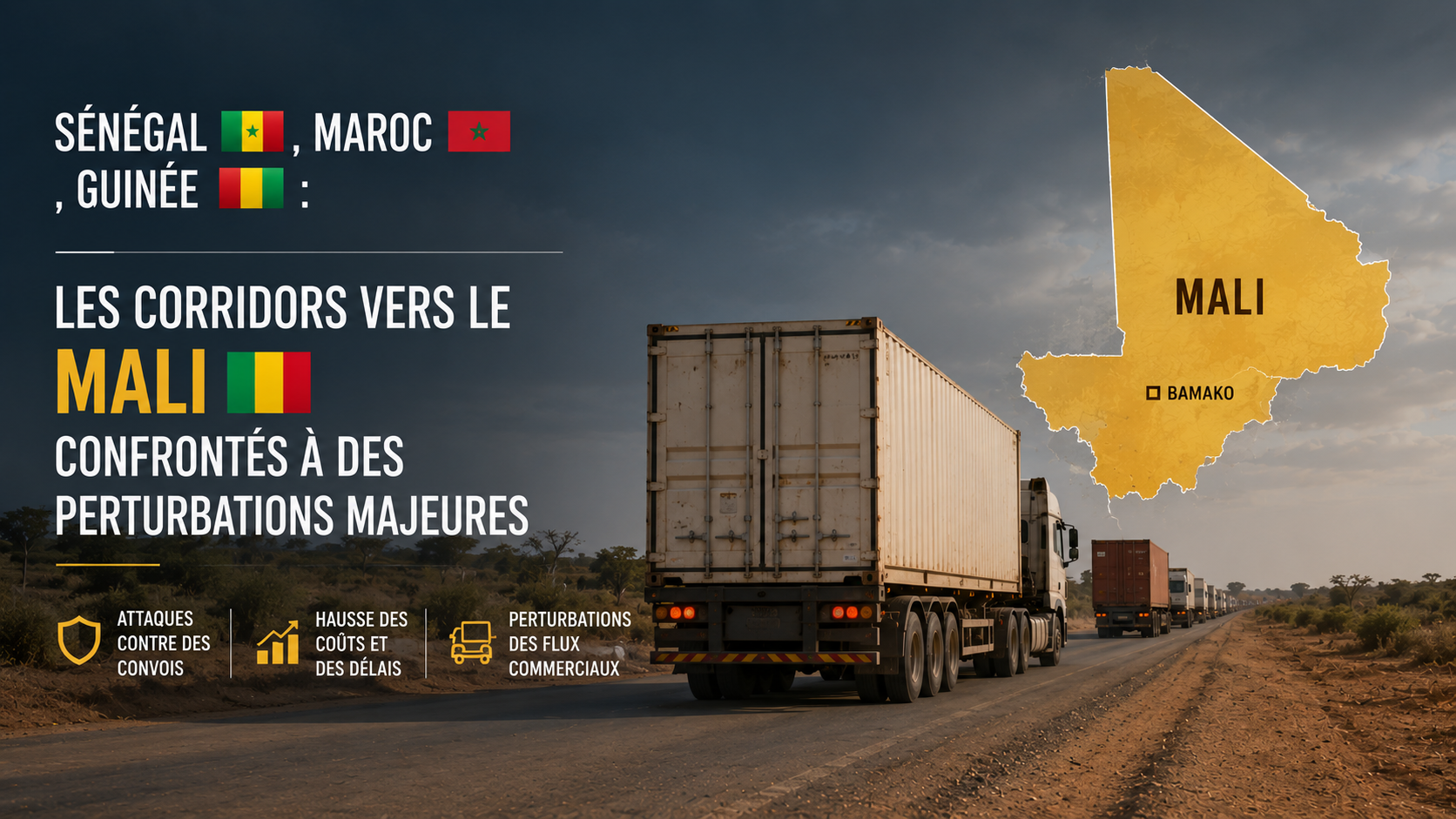
Trade routes to Mali from Senegal, Morocco, Guinea face disruptions

Major disruptions have hit several key road corridors supplying Mali over the past weeks. Senegalese hauliers are calling for a halt to trips to Bamako, Moroccan operators have become increasingly cautious, and the Guinea-Mali route is experiencing serious difficulties.
The challenges on multiple corridors serving Mali are changing regional transporters’ habits. Beyond calls to suspend certain trips and concerns from professional organizations, the disruptions now affect freight costs, delivery times, and the organization of supply chains linking Bamako with its key trading partners.
As a landlocked country, Mali relies heavily on regional road transport. The Dakar-Bamako corridor remains one of the main entry points for Malian imports. In 2024, about 2.6 million tonnes of goods destined for Mali passed through the port of Dakar, highlighting the economic importance of this route. Security concerns are now leading to concrete actions by transporters. In Senegal, the Union of Road Transporters reports that at least eleven Senegalese trucks serving Mali have been burned in recent weeks. Professional organizations have called on drivers to reduce or suspend certain trips, believing the risks are becoming economically unsustainable.
The events of May 6 intensified these fears. Several commercial convoys were attacked on the road linking the Mauritanian border to Bamako. Moroccan union officials reported that more than fifteen Moroccan, Senegalese, and Mauritanian trucks were targeted by armed groups. At least six Moroccan heavy lorries were set on fire.
This incident has also had repercussions in Morocco, where many road transport operators are showing increased caution regarding Mali routes. For transport companies, calculations are rapidly changing: rising insurance costs, vehicle immobilization, higher security expenses, and more frequent detours are squeezing margins on journeys that are already long and expensive.
The Guinea-Mali corridor is no longer spared from disruptions. Since attacks reported in late April on this major commercial route, the movement of goods and passengers has slowed significantly. Yet this route plays an important role in Mali’s logistical diversification, particularly through the port of Conakry. The difficulties on this road limit the alternatives available when other corridors face tensions.
The consequences now extend beyond transport companies. On several routes, drivers are prolonging waiting times before departure, some convoys travel in groups, and families go days without news of relatives on the road. For businesses, each interruption increases storage costs, delays deliveries, and slows commercial exchanges. When multiple corridors are disrupted simultaneously, Mali’s market supply, regional logistics timelines, and cross-border economic activity all suffer directly.
Three years after the security reorientation by Mali, Burkina Faso, and Niger — marked by a distancing from several Western partners and a closer rapprochement with Russia — security challenges continue to weigh on the Sahel. These security difficulties are now increasingly affecting regional trade and traffic on major commercial axes. The repercussions extend far beyond the borders of the Alliance of Sahel States: transport organizations in Senegal, Moroccan operators, and Mauritanian convoys express major concerns over the risks on certain Malian roads.