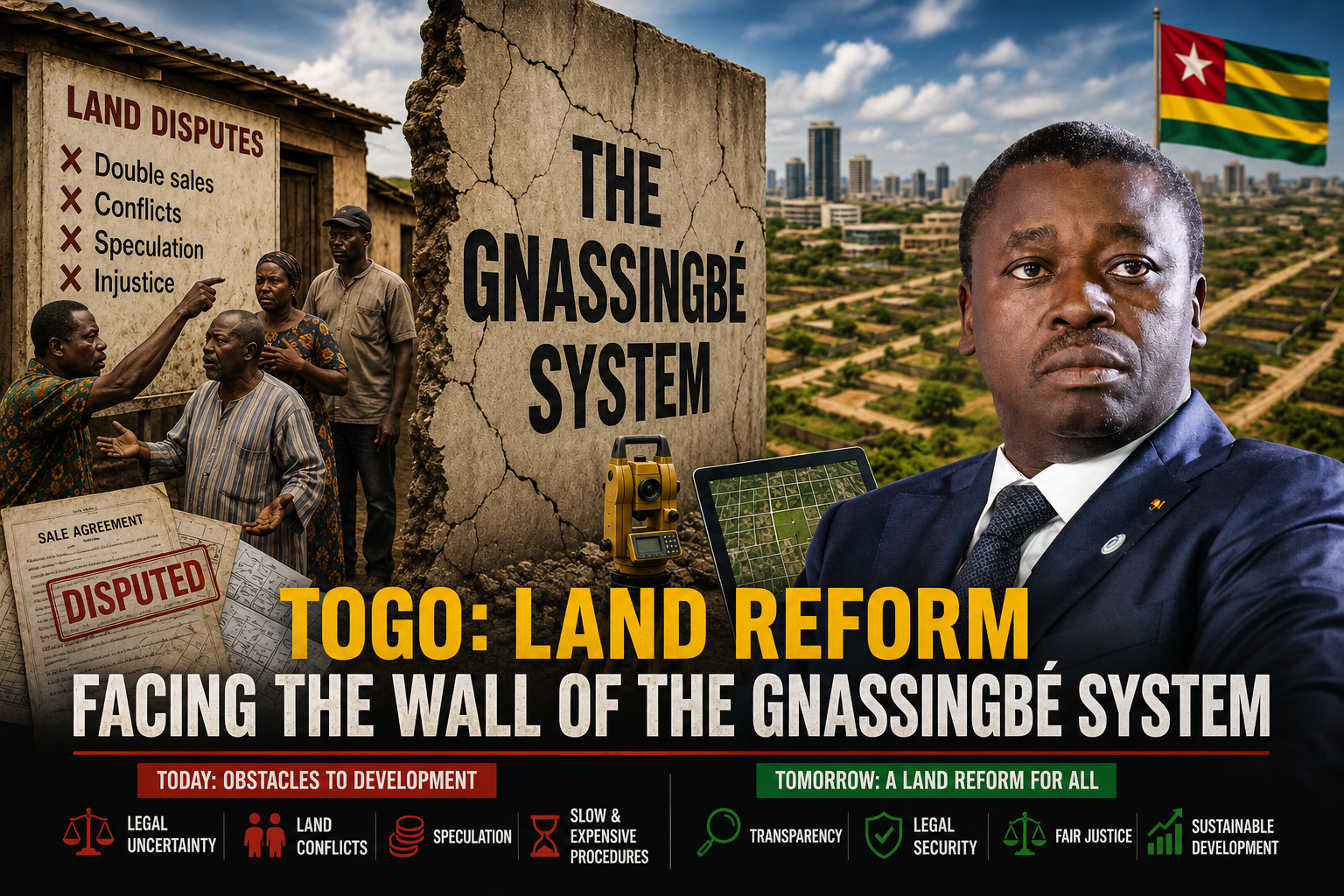
Togo’s land reform: navigating the path to transparency and equity
After six decades characterized by frequently inconsistent land management, the Togolese government is now articulating a renewed ambition: to transform the land sector into a substantial catalyst for economic development. While this pledge appears promising in theory, it immediately confronts a far more complex reality on the ground. Many observers suggest that this initiative risks joining a long list of announced yet unfinished reforms, unless fundamental structural deficiencies are addressed at their core.
The crux of the issue lies in a predicament well-known to Togolese citizens: the proliferation of land disputes. These are exacerbated by practices such as double sales, contested ownership, inadequate document preservation, and the inherent opacity of certain transactions. How can a sustainable development strategy be forged when private property rights remain a perpetual source of legal uncertainty? A simple title deed or sales agreement often proves insufficient to assure the buyer’s peace of mind when the same parcel of land can be subject to multiple, competing claims. This pervasive uncertainty deters investment, erodes household savings, and can transform land ownership into a significant financial hazard.
Prolonged administrative processes
Compounding these issues is the glacial pace of administrative procedures. For both individuals and businesses, navigating these processes can be protracted, costly, and inherently confusing. When access to land information remains restricted and procedures lack transparency, those with social connections, financial resources, or a deeper understanding of the system inevitably gain an advantage. Therefore, reform should not merely aim to generate more land titles; it must fundamentally ensure that every citizen can ascertain the complete history of a parcel before committing to its purchase.
The judicial system is similarly affected. A land conflict that lingers for years constitutes more than just an administrative hurdle; it can devastate families, impede inheritances, render land unusable, and obstruct vital economic projects. Judicial decisions must be executed promptly and equitably, without the social, political, or financial influence of any party swaying the outcome. Without an accessible, independent, and adequately resourced land justice system, no administrative reform can yield lasting results.
Political complexities and vested interests
Beyond the technical assessment, it is the political dimension that significantly complicates this equation. On the ground, the land system involves a multitude of stakeholders: customary owners, families, intermediaries, surveyors, administrative bodies, local authorities, and community leaders. When some of these actors maintain close ties with dominant political or economic networks, the risks of conflicts of interest and favoritism become particularly acute. A credible reform should precisely aim to dismantle these grey areas rather than allowing them to re-emerge in new forms.
The issue of speculation also warrants serious consideration. In urban and peri-urban areas, where land values are appreciating rapidly, real estate pressure can foster land grabbing, multiple sales, and manipulative practices surrounding parcels. Vulnerable populations often become the primary victims of a market they struggle to comprehend. Land then ceases to be a transmissible heritage and progressively transforms into a speculative commodity reserved for those with substantial capital.
Social dimensions and digitalization
There is also an often-underestimated social dimension: land disputes sometimes pit members of the same family, neighboring communities, or multiple generations against each other over a shared inheritance. As long as the safeguarding of customary rights and their integration with modern law remain imperfect, tensions will continue to surface. A serious reform must therefore incorporate enhanced mediation, conflict prevention, and public awareness campaigns regarding legal procedures.
Digitalization offers a potential component of the solution, but it must transcend being a mere administrative slogan. A reliable, accessible, and regularly updated land database could substantially mitigate the risks of double sales and facilitate verifications prior to any transaction. However, a digital system alone will not rectify fraudulent practices if the underlying data is incomplete, susceptible to manipulation, or unequally accessible.
Transparency must also extend to the actors responsible for managing land. Who allocates parcels? Based on what criteria? Who monitors transactions? How are irregularities sanctioned? What guarantees exist for citizens challenging an administrative decision? As long as these questions remain inadequately addressed, distrust will persist, and each new reform will be met with skepticism.
The economic imperative
Finally, the economic stakes must be fully appreciated. Secure land enables individuals to invest, businesses to construct, banks to more accurately assess collateral, and the state to effectively plan territorial development. Conversely, land insecurity immobilizes capital, stalls projects, and perpetuates an economy of mistrust. The problem thus extends far beyond individual property owners; it directly impacts the nation’s capacity to attract and secure investments.
This underscores why the true question is not whether Togo can enact a new land reform, but whether it is prepared to accept the political, administrative, and judicial ramifications of a truly binding transformation. A meaningful overhaul would necessitate greater transparency, effective sanctions against fraudulent practices, a swifter justice system, more controlled administration, and enhanced protection for the most vulnerable citizens.
Without a genuine political commitment to dismantle complicity, reinforce the rule of law, and durably sanitize land justice, any new legislation or reform commission risks being merely a superficial facelift. As long as the protection of particular or partisan interests takes precedence over transparency and equality before the law, land will remain a source of conflict rather than becoming the promised engine of economic growth.
