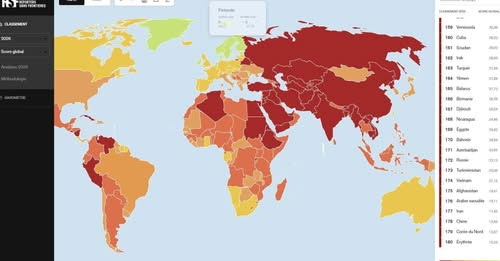
The erosion of press freedom in the Sahel: a critical assessment
On the occasion of World Press Freedom Day, observed this past Sunday, May 3rd, a deeply concerning reality emerges: in the West African region, the act of reporting news has transformed into an endeavor fraught with peril, often requiring extraordinary courage. Following the ascension of military administrations, nations such as Mali, Niger, and Burkina Faso — collectively forming the Alliance of Sahel States (AES) — are grappling with an unparalleled wave of suppression.
An escalating constriction of journalistic liberty
From the suspension of Mali’s Joliba TV channel and Burkina Faso’s daily newspaper L’Observateur Paalga, to the recent abduction of journalist Serge Oulon in Ouagadougou, the tactics employed to exert pressure are proliferating. Governmental bodies are now unreservedly deploying a range of extreme measures designed to silence dissenting voices:
- Abrupt closures of both indigenous and international media outlets.
- Unlawful detentions and forced disappearances.
- Mandatory relocation for individuals who decline to disseminate state-sanctioned narratives.
Fear as an instrument of censorship
The prevailing environment presents information professionals with a stark dilemma: either comply with official directives or remain silent. Ousmane Diallo, a researcher affiliated with Amnesty International, observes a systematic contraction of the civic sphere unfolding across the region.
« This climate of intimidation, characterized by instances of enforced disappearance, compels numerous journalists towards self-censorship, » he elucidates. Essentially, the apprehension of punitive actions leads journalists to refrain from covering sensitive topics.
Towards a ‘prison of thought’?
This pervasive control over information extends beyond journalists to encompass the general populace. By mandating a singular narrative that extols the ruling juntas, the authorities endeavor to eradicate critical thinking among citizens.
A local journalist, speaking anonymously due to the precarious circumstances, draws parallels between the current situation and the era of the Soviet Union. The individual characterizes the Sahel as having become an « information gulag » — a metaphor signifying an environment where truth is systematically confined.
The increasing diplomatic alignment of these nations with Vladimir Putin’s Russia is not considered coincidental by observers; it appears to coincide with the adoption of information control methodologies characteristic of authoritarian regimes. The pressing question now revolves around whether independent voices can continue to resonate within a region where public discourse is progressively being suppressed.
