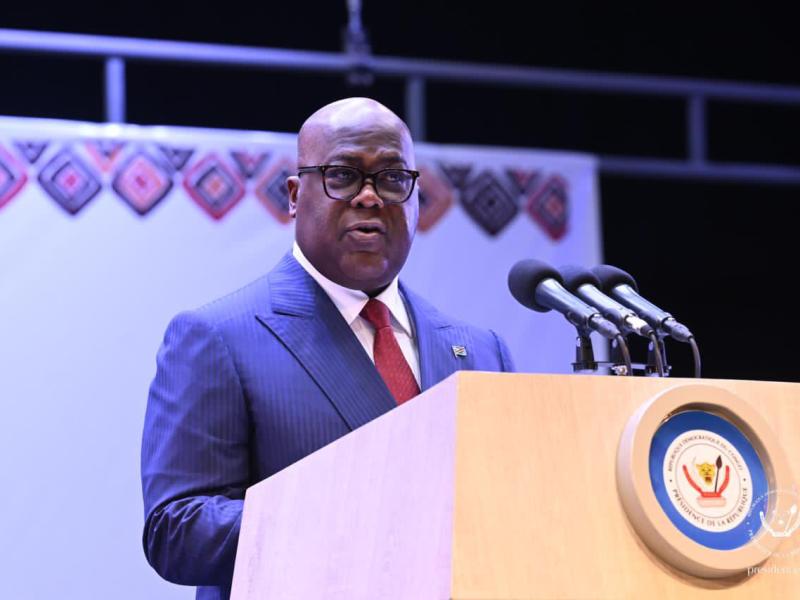
Seven years of Tshisekedi’s leadership: breaking down the key achievements
The first vice-president of the National Assembly, Jean-Claude Tshilumbayi, has presented a detailed account of what he describes as the Democratic Republic of the Congo’s (DRC) remarkable progress under President Félix Tshisekedi’s seven-year governance. Speaking during a live broadcast on X (formerly Twitter), Tshilumbayi refuted claims that the government was attempting to alter the Constitution to conceal governance failures, instead highlighting a series of transformative milestones achieved since 2019.
education and social progress: a nation investing in its future
One of the most significant breakthroughs, according to Tshilumbayi, is the free education policy, which has reintegrated approximately 6 million children into the schooling system. Additionally, the government has prioritized maternal health by providing free childbirth services to 2.5 million women across the country. These initiatives underscore the administration’s commitment to improving social welfare and breaking down barriers to education and healthcare access.
stabilizing the civil service: restoring dignity and functionality
Tshilumbayi shed light on the chaotic state of the public sector inherited by the ruling party, the Union for Democracy and Social Progress (UDPS), in 2018. The government found itself managing a bloated workforce of 1 million civil servants who had been recruited without proper matriculation numbers or salaries, primarily as part of election campaign strategies. Furthermore, 400,000 “ghost employees” had been on the payroll for years without receiving any remuneration. Tshilumbayi confirmed that all these irregularities have since been resolved, with salaries now being paid in full to legitimate workers.
healthcare transformation: more doctors, better pay, and renewed facilities
The healthcare sector has seen a dramatic overhaul, with the number of doctors rising from a mere 1,700 to 7,800. Their average salaries have increased from $300 to $2,400, reflecting a broader commitment to improving working conditions and attracting medical professionals. Magistrates and police officers have also benefited from salary adjustments, with judges’ earnings climbing from $400 to a more dignified figure, and police officers’ pay increasing from $80 to a livable wage.
infrastructure development: roads, hospitals, and world-class institutions
Infrastructure has been a cornerstone of the government’s agenda. The DRC now boasts 7 major hospitals, including the long-neglected Mama Yemo Hospital, which had remained in disrepair since 1917. Additionally, the country has seen the establishment of university campuses of international caliber and the construction of 1,500 new schools. The road network has expanded dramatically, growing from 3,000 km to 9,000 km over the past seven years, facilitating better connectivity and economic opportunities.
economic growth: a budget surge and stronger reserves
On the economic front, the national budget has skyrocketed from $3 billion to $18 billion, marking a 500% increase. Foreign exchange reserves have also seen substantial growth, signaling improved economic stability. Tshilumbayi dismissed criticisms about constitutional changes, arguing that such debates distract from the tangible progress made in governance, healthcare, education, and infrastructure.
“To claim that the Constitution is being altered to mask governance failures is a baseless argument,” Tshilumbayi stated. “The real question we should be asking is: Through what means should our people express their voices?”
