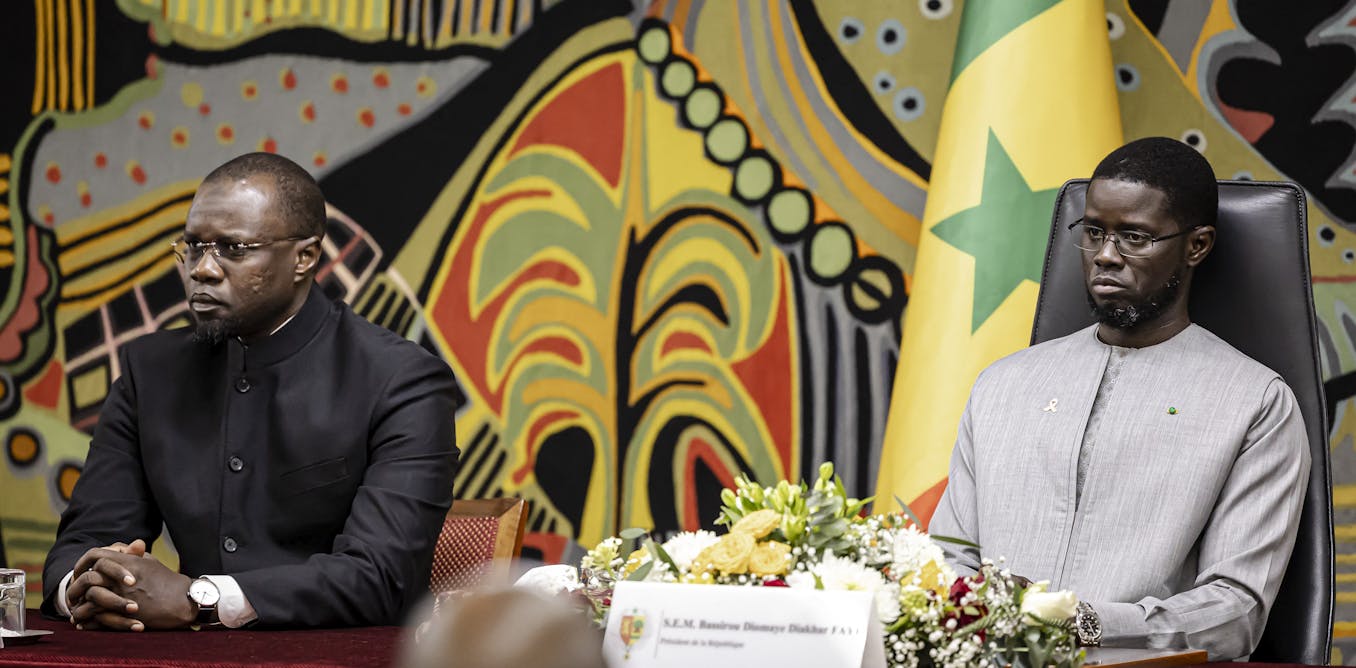
Senegal’s political shift: the sonko-diomaye alliance unravels
Senegal’s political arena frequently witnesses power struggles, whether among members of the same party or between distinct political entities. As Lord Palmerston, the British diplomatic chief, famously asserted in 1848:
In politics, there are no permanent enemies, nor permanent friends, only permanent interests.
The current situation at the pinnacle of Senegal’s executive branch is no exception to this enduring maxim.
The Sonko-Diomaye alliance, comprising Senegalese President Bassirou Diomaye Faye and his Prime Minister Ousmane Sonko, once united in their vision, is now grappling with significant internal discord. These escalating disagreements culminated on May 22 with the President’s announcement of the Prime Minister’s dismissal and the subsequent dissolution of the government.
While a rally on November 8, 2025, hinted at impending fraternal rifts, a crucial meeting on May 2, 2026, removed all ambiguity. The President himself acknowledged disagreements with his Prime Minister, specifically criticizing the “excessive personalization” of power around Sonko.
The recent political landscape in Senegal has seen significant transformations, marked by the rise of Les Patriotes africains du Sénégal pour le travail, l’éthique et la fraternité (PASTEF), now the ruling party. This anti-establishment movement has profoundly reshaped the nation’s traditional sociopolitical order, particularly evident during the period of intense political instability between 2021 and 2024.
The illusory nature of a shared symbolic capital at Senegal’s helm
This unprecedented partnership solidified when Sonko designated Diomaye as his successor after his own candidacy was invalidated. Initially forged on a dynamic of political complementarity, one managed the state apparatus while the other provided strong political legitimacy during their initial months in power.
However, PASTEF’s major political gathering on November 8, 2025, exposed the limitations of a dual leadership illusion championed by Sonko. “The period after November 8,” as Sonko himself declared, became a pivotal moment for the future institutional partnership between the President and him. The relationship between the two is now mired in an impasse, stemming from disagreements first over the choice of the ruling coalition’s coordinator, then their differing visions of power, and finally, their selection of allies.
Consequently, the once unifying slogan “Sonko mooy Diomaye” (Sonko is Diomaye, in Wolof), a survival strategy for PASTEF against the former President Macky Sall’s regime, has begun to wane. It is giving way to new declarations like “Sonko est Sonko” or “Ousmane est Sonko.” Political commentators note that the proclaimed unity has dissolved, replaced by a visible, almost overt duality where roles are being redefined and individual ambitions are asserting themselves.
“Diomaye is no longer Sonko. Sonko is no longer Diomaye.” Yet, within the framework of symbolic domination and reproduction theory, which allowed Sonko to leverage a “capital by proxy,” their symbolic fusion created a “unique partisan habitus.” This led the homopastefien and supporters of the “Project” to perceive not two distinct representatives, but a single, indivisible political force.
This executive duality represents the temporal culmination of their initial “complementarity” upon entering the political landscape. The presidential nature of Senegal’s political system mandates a clear distinction where the President’s authority is not shared. The prerogatives of the President and the Prime Minister are constitutionally defined in articles 42 to 52, transforming what began as a fusion into a “soft rivalry.”
Diomaye often adopts a reserved posture, acting as the guarantor of institutions, while Sonko maintains his register of popular mobilization and disruption. This aligns with what French sociologist Pierre Bourdieu describes as the “position occupying the man,” where the institutional role dictates an individual’s actions, language, and demeanor, rather than the reverse. The presidential function imposes a “sovereign” habitus that inherently distinguishes itself from the Prime Minister’s “party leader” habitus. This distinction, adhering to an ethic of separation between the roles of head of state and party leader, prompted Diomaye to resign from his position as secretary-general and all other leadership bodies within the PASTEF party.
Moreover, a real yet invisible boundary exists between the President and his Prime Minister, marked by the shift from street-level communication like “Diomaye is Sonko” to institutional communication where the President’s image takes precedence, following protocol. While Sonko propelled Diomaye to power, the latter now enjoys discretionary authority, including appointment powers, thus fostering a political bipolarization between pro-Diomaye and pro-Sonko factions.
The inherent limits of dual power
In physics, fluid mechanics illustrate that when two bodies of different masses share an enclosure, the one with greater mass compresses the other. Applying this to Diomaye and Sonko, it signifies that power is not static, much like human nature.
Through an upward flow of influence, his charisma, and control of the party, Ousmane Sonko injects popular legitimacy into Bassirou Diomaye Faye. Conversely, through a downward flow of influence, Bassirou Diomaye, via his state decrees and decisions, materializes the aspirations of the “Project” by enshrining them in Senegalese positive law. Thus, if Sonko becomes too prominent, his influence encroaches upon Diomaye’s institutional territory.
Consequently, the President might appear to be under tutelage. If Diomaye isolates himself too much, he risks losing the vital vein of legitimacy that Sonko represents. They exist within a system of mutual dependence and potential self-destruction. Power continuously oscillates between the presidential office and the Prime Minister’s residence, which sustains this delicate rivalry.
By mimicking each other’s desires, they become antagonistic doubles. The more they resemble each other, the deeper their divergence becomes, as the other mirrors one’s own ambition. Both actors covet the same objectives: power, the presidency, leadership. Sonko aspires to hold executive power; Diomaye seeks to solidify his position.
What is unfolding at the pinnacle of power today reminds us that, in politics, a “gentlemen’s agreement” remains a myth for idealists. It is the relentless resurgence of the number two syndrome. The presumptive successor, initially loyal and competent, climbs the ranks only to turn against their leader when the latter commands all the spotlight.
The hegemonic figure, in their drive to secure future electoral victories, transforms a loyal ally into an adversary out of mistrust. This dynamic fosters a reciprocal paranoia, foreshadowing a period of social and political turbulence in Senegal.
