
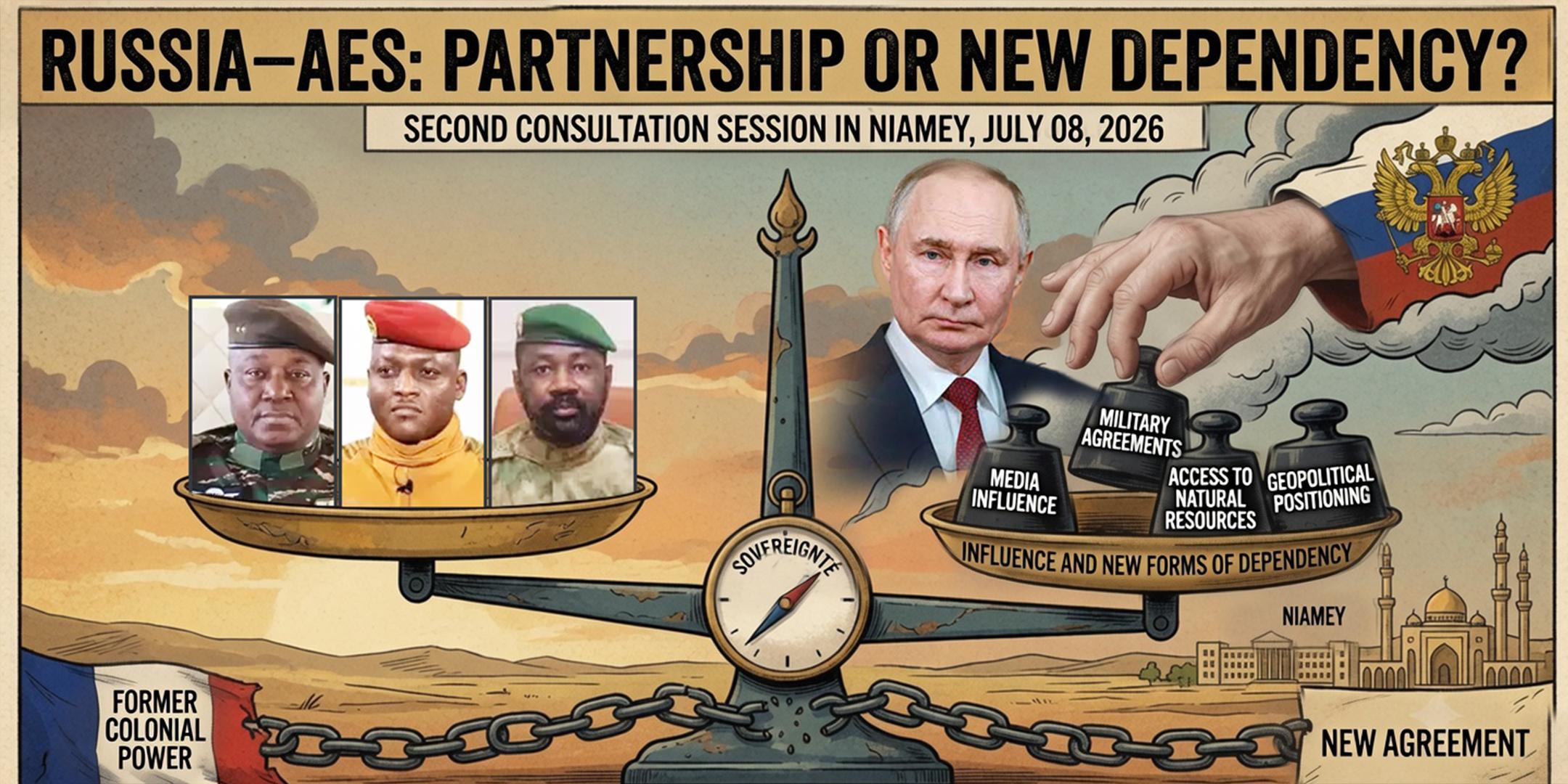
The second session of ministerial consultations between the Confederation of Sahel States (AES) and Russian Foreign Minister Sergey Lavrov took place in Niamey on July 8, 2026. Officially framed as a milestone in fostering a partnership rooted in sovereignty and mutual respect, the meeting raises a critical question: could this growing alignment with Moscow inadvertently lay the groundwork for a fresh form of dependency?
For years, the AES leadership has vocally rejected the long-standing influence of former colonial powers—particularly France
Russia has been steadily expanding its footprint across the Sahel, forging military, diplomatic, and economic ties while deepening cultural and media exchanges. While AES governments tout this diversification as a sovereign choice, critics warn that such alignment may come at a cost: the potential erosion of diplomatic autonomy and the risk of becoming ensnared in a new dependency. The question remains: how far can this influence extend before it compromises the region’s hard-won sovereignty? Major powers rarely engage in such partnerships without expecting tangible returns. Whether through access to natural resources, diplomatic leverage, or strategic positioning in Africa, these alliances are rarely altruistic. Russia, too, operates within this framework, pursuing objectives that align with its national interests. This shift has also sparked political concerns. A close alignment with a single power could constrict the diplomatic maneuverability of Sahel nations, restrict their ability to diversify partnerships, and expose them to the fallout of global power struggles. In a world increasingly defined by great-power rivalry, there is a very real risk that the Sahel could become a battleground for influence rather than an independent actor shaping its own future. Sovereignty, however, is not merely about choosing a new ally. It demands the capacity to preserve decision-making independence, cultivate balanced relationships, and safeguard national interests without falling into a pattern of rigid alignment. The AES leadership emphasizes a “mutually beneficial” partnership, but the true measure of its success will lie in tangible outcomes: enduring security improvements, economic growth, job creation, knowledge transfer, and institutional strengthening. Without these, the rhetoric of sovereignty risks sounding hollow to those it aims to serve. The trajectory of this cooperation remains uncertain. Will it empower the AES states to achieve greater autonomy, or will it merely shift their sphere of influence from one external power to another? For many analysts, the hallmark of genuine independence is not the substitution of one dominant partner for another, but the ability to engage in diplomacy freely—without becoming beholden to any single actor.