Regional security crisis: Côte d’Ivoire extends cooperation to Mali and Burkina Faso
The escalation of terrorist threats across the Sahel has compelled West African nations to set aside historical grievances in favor of collective action. Côte d’Ivoire has taken a decisive step by reaching out to Mali and Burkina Faso, signaling a shared commitment to confronting a transnational security crisis that threatens regional stability.
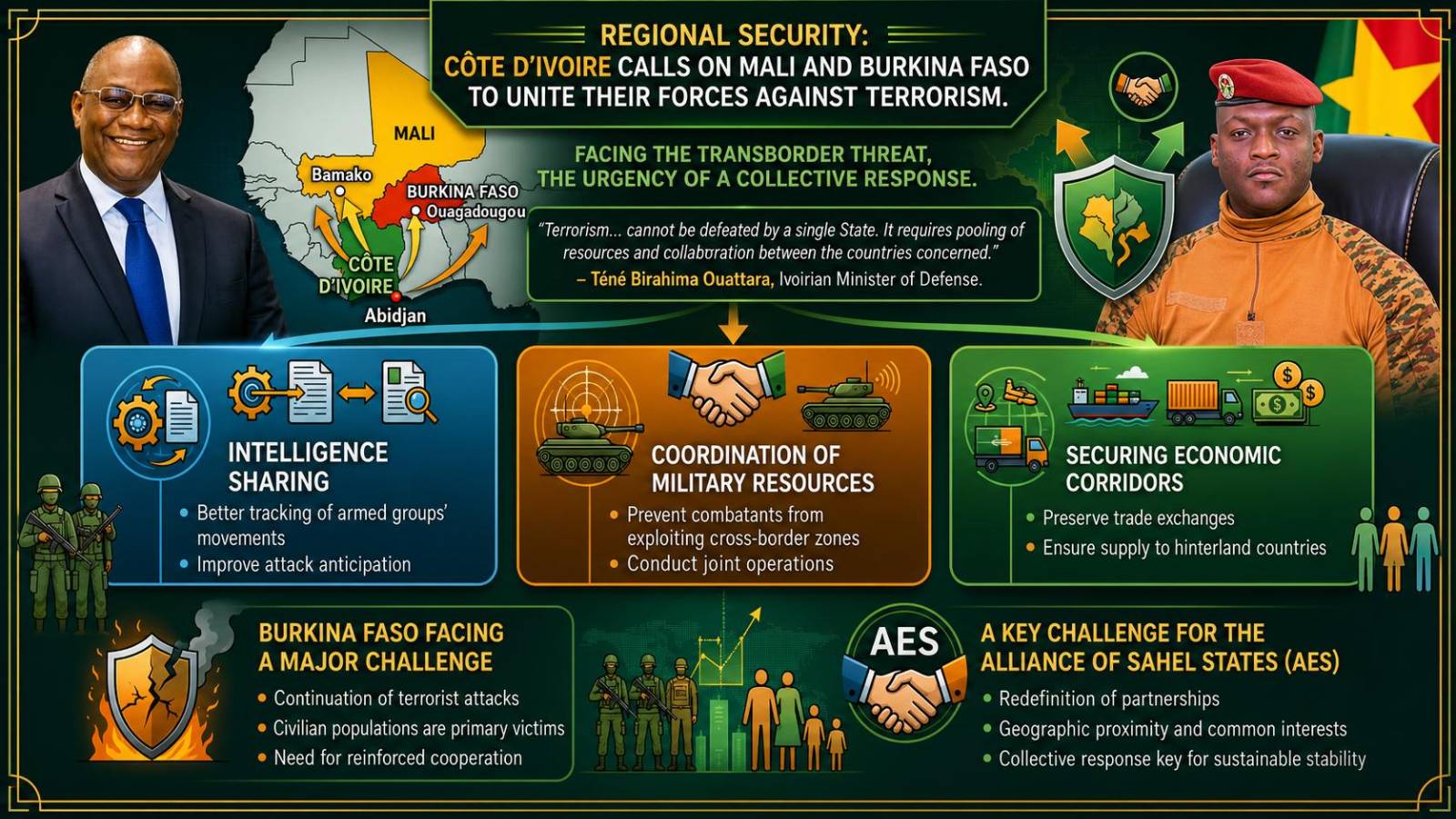
In a bold diplomatic initiative, Côte d’Ivoire has underscored the urgency of coordinated efforts to neutralize armed groups operating along porous borders. The Ivorian government, through its Minister of Defense, Téné Birahima Ouattara, has articulated a clear stance:
The evolving nature of terrorism demands a unified response. No single nation can address this threat alone. Strategic collaboration and resource-sharing are essential to safeguarding our collective security.
Burkina Faso: a nation at a crossroads
Despite concerted national mobilization efforts, Burkina Faso continues to grapple with persistent security challenges. The relentless wave of attacks, coupled with fragile territorial control, has placed immense pressure on civilian populations. For Captain Ibrahim Traoré, leader of Burkina Faso’s transitional government, the current crisis presents a pivotal moment. Analysts within the region suggest that the magnitude of the threat necessitates a strategic reassessment—one that prioritizes regional solidarity over isolated approaches.
The proposed framework for cooperation
Côte d’Ivoire’s proposal rests on three foundational pillars designed to strengthen regional resilience:
- Intelligence sharing: Establishing real-time monitoring systems to track the movements of jihadist factions across vulnerable border zones.
- Joint military operations: Aligning defense strategies to prevent insurgents from exploiting cross-border sanctuaries.
- Economic corridor protection: Ensuring the uninterrupted flow of critical trade routes that sustain landlocked nations’ economies.
A pivotal moment for the Alliance of Sahel States
The outreach from Côte d’Ivoire serves as a litmus test for the Alliance of Sahel States (AES). While Mali and Burkina Faso have redefined their international partnerships, geography remains an immutable reality. Côte d’Ivoire’s geographic position and operational capabilities position it as a natural and indispensable ally in this fight.
For Captain Ibrahim Traoré, embracing collaboration with Côte d’Ivoire would not signify a concession of weakness but rather a demonstration of political wisdom and civic duty. In the face of an adaptive and mobile adversary, fragmentation is tantamount to defeat. Only through cohesive, region-wide action can the cycle of violence be broken and lasting peace restored to the Sahel.
