Protecting human rights in the Sahel’s tri-border conflict zone
Regional conference seeks solutions for human rights in an unstable Sahel
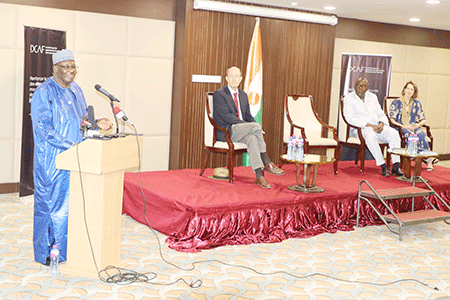
On Tuesday, May 23, 2023, a pivotal regional conference commenced in Niamey, focusing on the mechanisms for protecting human rights amidst the severe insecurity plaguing the Sahel. The event, opened by Maty El Hadj Moussa, president of Niger’s National Commission on Human Rights (CNDH), specifically targets the challenges in the tri-border area of Burkina Faso, Mali, and Niger. The inaugural session was attended by notable figures, including the Deputy Secretary-General of the Ministry of Justice, the Africa Director of DCAF, and the German Ambassador to Niger.
This two-day gathering has several core objectives. It aims to raise awareness among stakeholders about best practices in human rights protection and to strengthen their capacity to use tools that prevent violations. A key goal is also to improve good governance and the rule of law by empowering internal and external oversight bodies to fully perform their respective duties.
Addressing a multifaceted crisis
During the opening, CNDH President Maty El Hadj Moussa explained that the instability in the tri-border region is marked by massive human rights abuses. These violations are perpetrated not only by unidentified armed groups terrorizing local populations but also by certain elements of the defense and security forces. “In this area, peaceful populations are enduring the horrors of an asymmetric war of unprecedented violence, as the enemy lives within the communities they terrorize, where any suspicion of denunciation is a death sentence,” he stated. Mr. Moussa emphasized that this persistent crisis calls on all human rights defenders to engage in deep reflection to find solutions that meet citizens’ aspirations for peace and stability.
Moussa Sahirou Tchida, the Deputy Secretary-General of the Ministry of Justice, stressed that the initiatives being pursued by Sahelian countries require a synergy of action from all actors. “The support of partners, particularly from European Union member countries, as perfectly illustrated by their backing for this conference, is highly reassuring,” he said, reaffirming his ministry’s commitment to collaborating on any initiative aimed at stabilizing the tri-border area.
Anne Benette, the Africa Director for DCAF, highlighted that the political, social, humanitarian, health, and environmental crises in the Sahel make governance increasingly complex. She noted that growing insecurity, conflict, armed attacks, and transnational crime lead to human rights violations and erode the social fabric. “This regional conference is therefore of crucial importance, as it creates a space for exchanging best practices, highlights the challenges we face, and allows us to learn from each other to improve our collective response to security challenges that threaten the rule of law and respect for human rights,” she added.
Echoing these concerns, Germany’s Ambassador to Niger, Herman Nicolai, affirmed that the Sahel region is tragically experiencing a faster rise in violence than any other part of Africa. “We are witnessing an uninterrupted spread of violent events linked to the activities of extremist groups and organized transnational crime, which for over a decade have caused thousands of civilian and military deaths and displaced persons,” the German diplomat remarked.
