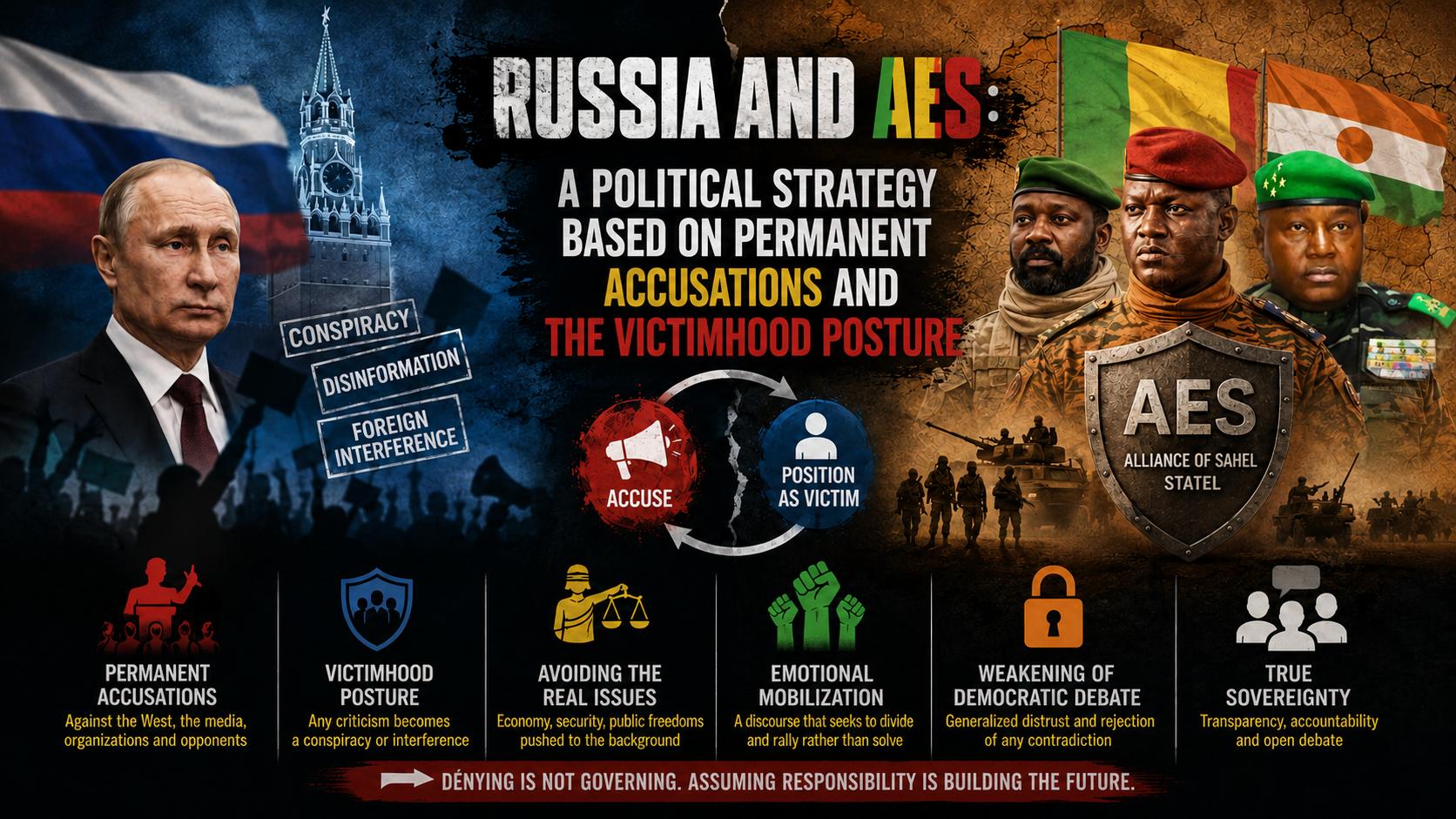
Political strategy of Russia and Sahel alliance: constant accusations and victimisation
Over recent years, Russia and the governments of the Alliance of Sahel States (AES) have integrated systematic denunciation into their political communication strategies. This approach targets Western powers, international media outlets, regional bodies, and domestic adversaries alike, with accusations being levelled at an unprecedented frequency. However, a recurring paradox emerges: whenever these actors themselves face criticism, they swiftly shift from the role of accuser to that of victim.
From accusers to victims: a deliberate shift in narrative
This communication pattern has become almost institutionalised. The moment their policies are questioned, they frame any critique as a fabricated conspiracy, a disinformation campaign, or an act of foreign interference. Criticism is consistently reinterpreted as a coordinated effort to undermine their governments or obstruct their proclaimed progress toward sovereignty.
This strategy offers clear political advantages. By casting themselves as victims of external enemies, leaders avoid addressing substantive issues affecting their populations. Economic hardship, persistent insecurity, restrictions on public freedoms, and the mixed outcomes of certain policies are sidelined. Public discourse shifts from constructive debate to an emotional appeal designed less to provide solutions than to rally support.
AES: accusations as a political reflex
Within the Alliance of Sahel States, authorities frequently attribute their challenges to sanctions, former colonial powers, or foreign actors. Yet when citizens, journalists, or human rights organisations highlight internal governance failures, these concerns are rarely examined on their merits. Instead, they are dismissed as part of a broader destabilisation plot orchestrated from abroad.
The pattern mirrors Russia’s international posture. Whenever criticised for its foreign interventions, military actions, or human rights violations, the Russian government routinely asserts that the country is the target of relentless Western hostility. This narrative serves to deflect scrutiny and recast valid concerns as proof of an orchestrated smear campaign.
The long-term risks of a victimisation narrative
A credible system of governance demands the ability to engage with dissent, respond to criticism with reasoned arguments, and remain accountable to citizens. Consistently framing every challenge as a conspiracy undermines democratic debate and fosters a climate of distrust. Over time, such a tactic risks eroding public confidence rather than strengthening it.
Accusing others is a convenient tactic. Assuming responsibility is far more demanding. By repeatedly resorting to victimisation rhetoric, Russia and several Alliance of Sahel States leaders risk giving the impression that they prioritise evasion over engagement. A critical voice—even a harsh one—is not inherently a conspiracy. In any functioning society, it can serve as an opportunity to refine policies, correct missteps, and rebuild public trust.
True sovereignty is not measured solely by the capacity to denounce perceived enemies. It is also reflected in transparency, accountability, and the willingness to engage in open debate. Without these pillars, the narrative of perpetual victimhood risks losing its credibility, appearing less like a genuine response to challenges and more like a political communication tool.
