
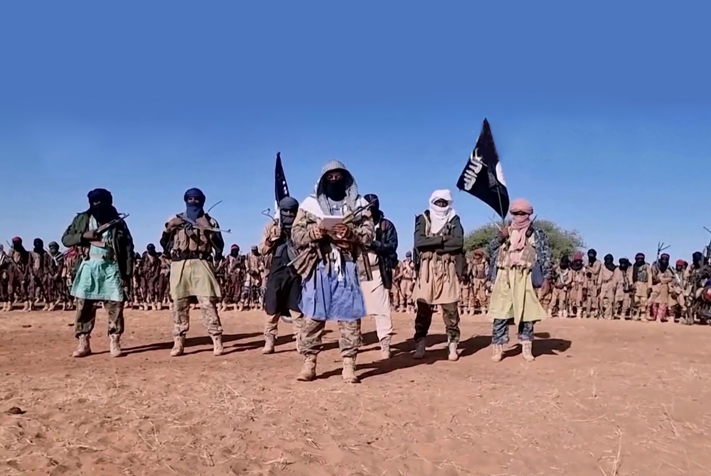
The Islamic State Sahel Province (ISSP) continues to exert significant influence across Mali’s northeastern territories, maintaining its active presence in several strategic locations despite the primary focus often placed on the JNIM.
The Gao region, particularly the Ansongo circle, and the Ménaka region remain under the sway of the Islamic State Sahel Province (ISSP), formerly known as EIGS. This crucial zone encompasses the vital localities dubbed the « 3 T » – Talataye, Tin-Hama, and Tessit – alongside Labbezanga. These areas form the epicenter of the group’s operational activities, where it maintains territorial control and exerts relentless pressure on local communities, deeply affecting Mali current affairs.
Command
Abou Al-Bara now leads the group, having assumed command following the elimination of Adnan Abu Al-Walid Sahraoui in 2021, though the precise command structure remains somewhat veiled. Since 2020, the ISSP has strategically adapted its operational methods. It shifted from a strategy marked by public executions and widespread terror to a more nuanced approach focused on territorial control and localized governance. This change has led to a reduction in high-profile attacks that once drew considerable media attention, as the group now undertakes a concerted effort to gain acceptance among the local populace.
Nonetheless, military operations against this formidable group continue without respite. The Malian Armed Forces (FAMa) recently achieved a significant success, neutralizing an ISSP operational commander during an airstrike in Bara, within the Ansongo circle, on the night of May 14-15, 2026. This operation also resulted in the elimination of several subordinate fighters. Such actions underscore the persistent pressure exerted by Malian forces on Islamic State strongholds in the Sahel, even as the group demonstrates an enduring capacity to regroup in border areas and sustain its logistical networks.
Operations
The ISSP consistently targets key strategic localities along the Mali – Niger axis, including Talataye, Tin-Hama, Tessit, Labbezanga, and Ménaka. Here, it controls the movement of people and goods and maintains considerable influence over local armed factions. These calculated actions are designed to assert the group’s enduring presence and solidify its dominance over these critical regional corridors.
Furthermore, the ongoing rivalry with the JNIM remains a pivotal factor in the Sahel’s complex security dynamics. Contrary to some perspectives, the heightened visibility of the JNIM following its coordinated attacks on April 25, 2026, around Bamako and in various other parts of the country does not signify the disappearance of the ISSP. Both groups pursue distinct strategic objectives. While the JNIM concentrates its efforts on media-grabbing attacks and spectacular strikes, the ISSP prioritizes discreet territorial control, applying pressure on local communities, and securing vital strategic routes, a key aspect of West Africa Mali news.
Initially, defectors from the JNIM contributed to a unique « Sahelian exception » where direct confrontations between the two groups were limited. However, this relative truce has eroded since 2020. Despite this, recent security developments within Mali, particularly the Malian army’s sustained offensives, have temporarily redirected both groups’ focus toward their common adversary, though no formal peace agreement has been reached between them.
Threats
An ACLED report dated May 15, 2026, confirms that 86% of Islamic State activity during the first quarter of 2026 was concentrated in Africa. This period witnessed an increase in the use of armed drones, motor-borne attacks, and economic coercion along both urban and rural axes. The ISSP has specifically targeted civilian and military infrastructure along the Ménaka – Ansongo – Tessit corridor and in Labbezanga, leveraging local vulnerabilities to impose its de facto governance. The attack on escorted civilian convoys in Kobé, 35km from Gao, on February 7, 2026, serves as a stark illustration. While international security cooperation has led to the neutralization of key figures, such as Abu-Bilal Al-Minuki on May 16, 2026, during a Nigeria – United States operation in the Lake Chad basin, the ISSP threat remains potent in northeastern Mali, particularly in the « 3 T » localities and Labbezanga, where territorial control and influence over local armed groups persist.
The ISSP stands as a central actor in northeastern Mali, strategically leveraging the media’s focus on the JNIM and the FLA to consolidate its position, control local populations, and exert continuous pressure on the Malian forces. Its established territorial organization and ongoing operations clearly indicate a deeply rooted threat. This necessitates intensifying pressure in specific strategic areas, especially along the Niger-Malian border, to address this critical aspect of Mali politics english and regional stability.