Mali’s unfolding crisis: military reversals and a new political front in the north
A palpable sense of alarm now permeates Northern Mali. Within a mere few days, the nation’s security paradigm has undergone a dramatic shift. Following the symbolic fall of Kidal, armed factions have pressed forward with rapid advancements, while the Support Group for Islam and Muslims (JNIM) has initiated an unprecedented political maneuver, advocating for the overthrow of the transitional administration.
A military setback evoking past events
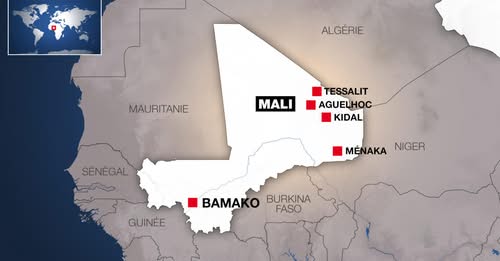
The grave scenario of 2012 appears to be recurring. On Friday, May 1, 2026, combatants from the JNIM, alongside separatist forces of the Azawad Liberation Front (FLA), asserted control over the strategically vital camps of Tessalit and Aguelhoc. The withdrawal of the Malian Armed Forces (FAMa) and their Russian partners from Africa Corps facilitated the assailants’ entry without confrontation.
An image, authenticated by multiple sources, starkly illustrates this humiliation: it depicts Seidane Ag Hitta, a prominent figure within the JNIM, proudly displaying the keys to the Tessalit camp. This gesture carries significant weight, occurring five years after the departure of the French Barkhane force. Since April 25, the localities of Ber, Tessit, Hombori, and Gourma Rharous have been reclaimed by these groups, leaving the populations of Gao and Timbuktu in a state of profound apprehension.
Bamako’s counter-response and Moscow’s unwavering support
Despite this severe reversal, the Koulouba Palace remains resolute. General Assimi Goïta has issued a call for « national resurgence », emphasizing that no « intimidation » would divert Mali from its determined course.
The ongoing military effort is now concentrated on two primary fronts:
- Aerial and Ground Operations: The Malian army is intensifying precise strikes on Kidal, targeting the governorate and logistical depots. Although FLA rebels dispute the casualty figures, Bamako claims numerous « neutralized terrorists ».
- Logistics: As a jihadist blockade constricts the main routes leading to the capital, a substantial convoy comprising 800 tanker trucks successfully navigated the passage this Friday, under the escort of air support and ground troops.
From Moscow, the Kremlin, through its spokesperson Dmitri Peskov, reaffirmed its complete backing for the transitional authorities, dismissing any speculation regarding a potential Russian disengagement subsequent to losses incurred in Kidal.
The JNIM’s political gambit: between « sovereignty » and Sharia
The true divergence in this sequence of events is semantic. In a communiqué disseminated on the night of April 30, the JNIM abandoned its customary militant discourse for a political rhetoric mirroring that of its adversaries.
The group now appeals to the « nation’s vital forces », political parties, and even religious authorities to forge a « common front » aimed at establishing a « peaceful transition » and ending the « junta’s dictatorship ». By employing terms such as « sovereignty » and « dignity », the JNIM endeavors to sway a segment of public opinion weary of the conflict, all while reiterating its ultimate objective: the implementation of Sharia law.
« From the worst, one will seek the lesser evil, » remarked a former opposition minister, encapsulating the dilemma now confronting Mali’s political class: should dialogue be initiated with yesterday’s adversary to halt the escalating crisis?
A regime under internal pressure
Tension is palpable even within the state apparatus. The Public Prosecutor at the Bamako Tribunal has announced the apprehension of several Malian military personnel, suspected of complicity during the attacks of the past weekend.
Between the territorial advancements of the rebels, the JNIM’s ambiguous political overture, and the economic strain of the blockade, the transitional regime is navigating its most profound crisis. The struggle for Mali is no longer confined to the northern sands but also unfolds on the terrain of political legitimacy within Bamako itself.
