Mali’s junta faces collapse as Russian alliance falters
The unraveling of a political strategy often becomes evident as its key backers swiftly depart. In Mali, recent military setbacks against joint offensives by the Azawad Liberation Front (FLA) rebel groups and jihadists from the Group for the Support of Islam and Muslims (GSIM) have starkly revealed the systemic failures of the ruling junta. By entrusting the nation’s security sovereignty to foreign paramilitaries without critical oversight, authorities in Bamako inadvertently cemented their own vulnerability.
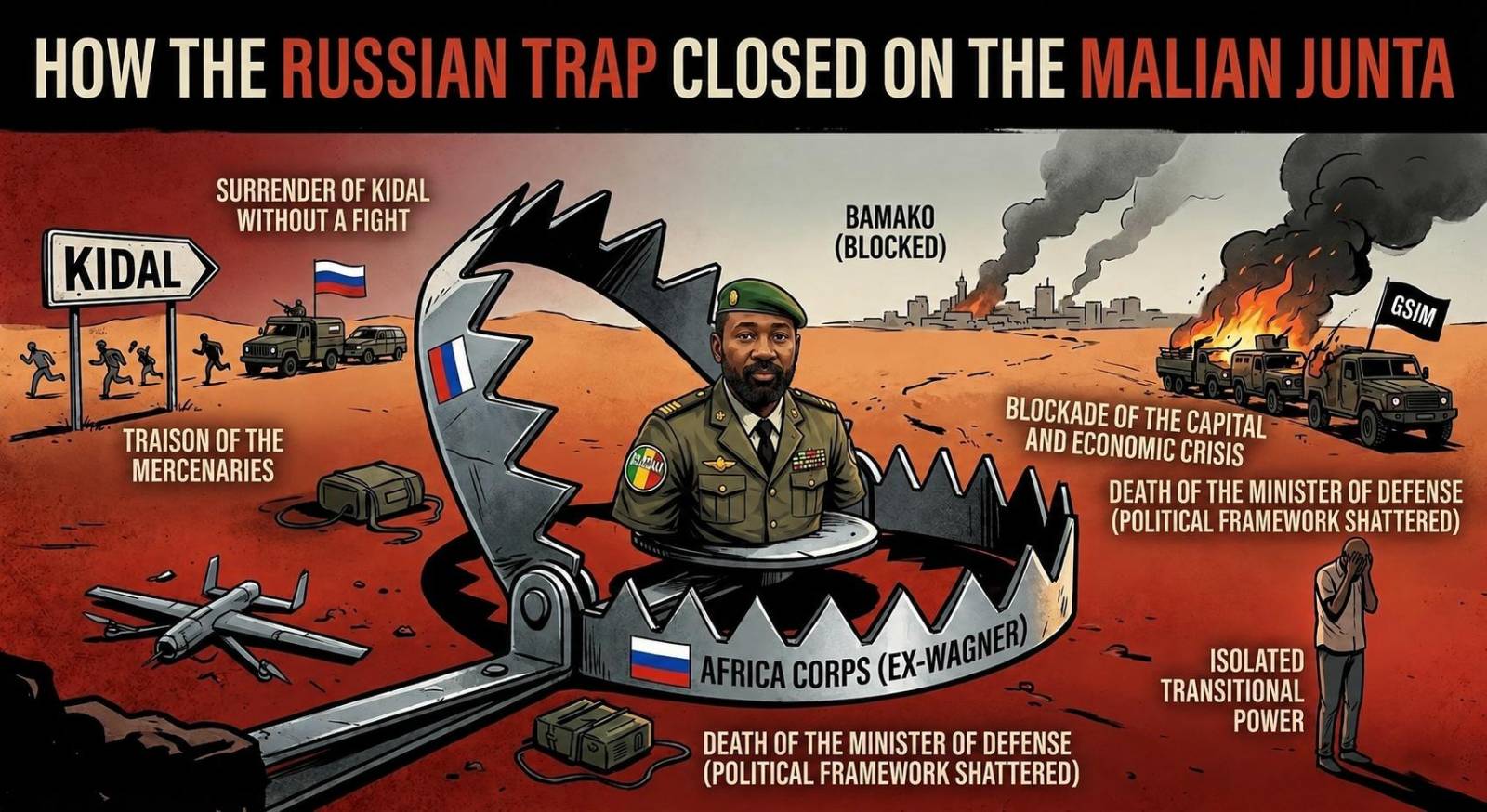
Today, the consequences of these decisions are unavoidable. Amid reports of regional mediation efforts to oversee the withdrawal of Russian mercenaries from Africa Corps (formerly Wagner), the transitional government led by Assimi Goïta faces unprecedented isolation and the looming threat of complete collapse, impacting Mali current affairs profoundly.
Kidal: a symbol of negotiated surrender
The pivotal moment arrived in Kidal in late April 2026. This northern city, which the Malian army and its Russian auxiliaries had triumphantly recaptured in 2023, crumbled back into rebel hands with startling speed. Even more humiliating for Bamako’s authorities: Africa Corps forces were not driven out after a fierce struggle; instead, they negotiated their own evacuation with the rebels. They abandoned their positions without engaging in combat, at times even leaving heavy weaponry behind to secure safe passage. This event sent shockwaves through Mali politics.
“The Russians betrayed us in Kidal,” a Malian official, speaking anonymously to international press, confided, encapsulating the deep sense of abandonment pervading the corridors of power in Bamako.
This pragmatic desertion by Moscow underscores a harsh geopolitical truth: a mercenary force operates primarily on its own financial and strategic interests. It does not sacrifice itself for another nation’s cause. By prioritizing its own survival over defending Mali’s territorial integrity, Russia exposed the limitations of its commitment in West Africa Mali.
Escalation to the South and the death of Sadio Camara
The failure of this ‘blind security’ approach is no longer confined to the northern deserts. Its ripple effect has reached the very heart of the state. A major offensive in April impacted Kati and Bamako, culminating in the death of General Sadio Camara, the Minister of Defense and the principal architect of the alliance between Bamako and the Kremlin. This was significant Bamako news.
Deprived of its political linchpin, the junta finds itself effectively decapitated amidst a pervasive humanitarian and economic crisis. For months, the GSIM has enforced a stringent blockade on fuel, food, and goods destined for the capital. The economy is crippled, schools have been forced to close, and electricity has become a rare commodity. The promised Russian shield proved incapable of preventing either the siege of the capital or the infiltration of hostile forces into the core of the government.
The mirage of drones and impunity
To justify the expulsion of traditional international forces (MINUSMA, Barkhane), the junta had pledged a ‘surge in capability’ for the Malian Armed Forces (FAMa), bolstered by Russian technology and observation drones. While the intensive deployment of these drones did increase strikes, it primarily intensified the junta’s isolation by frequently causing civilian casualties, exacerbating local tensions without ever achieving territorial stabilization.
While Moscow attempts to save face by claiming to have “foiled a coup d’état,” the reality on the ground reveals a clear defensive retreat. Analysts now believe that Africa Corps will concentrate its remaining personnel solely on the physical protection of the regime in Bamako, definitively abandoning any ambition to reconquer or pacify the rest of the country.
Towards an inevitable downfall?
The Alliance of Sahel States (AES), once touted as a new bloc of regional solidarity, remains conspicuously silent and powerless in the face of Mali’s urgent crisis. Abandoned by its Russian partner, who now seeks an honorable exit, rejected by regional organizations like ECOWAS, and internally challenged by a population suffocating under blockades, the Bamako junta appears to have entered its terminal phase. This situation is critical for West Africa Mali news.
The investment in ‘blind security’ imported from Moscow is proving to be the greatest strategic failure in the country’s modern history. By consistently sacrificing diplomacy, national dialogue, and regional alliances for a private protection contract, the military regime has trapped itself in an insurmountable impasse. In Bamako, the question is no longer if power will shift, but how many weeks or months it can still endure before the security vacuum it created ultimately consumes it.
