
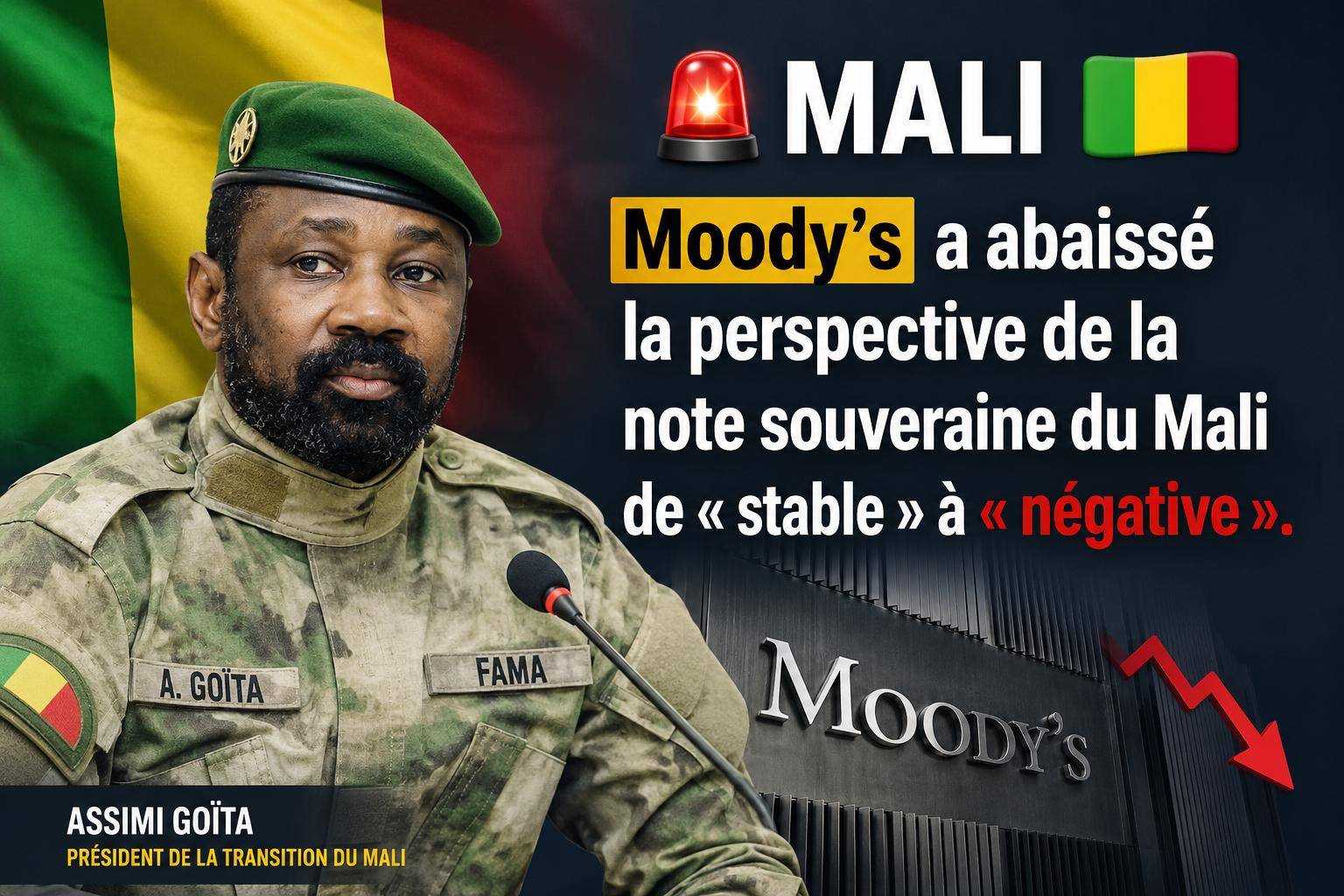
The financial rating agency Moody’s has revised its sovereign outlook for Mali, moving it from “stable” to “negative” while affirming the Caa2 rating. This decision stems from escalating security risks, acute financing pressures within the regional market, and persistent political uncertainties. For the Malian economy, this signal to international and regional investors further complicates the crucial pursuit of capital essential for development.
a financial warning driven by on-the-ground realities
Moody’s assessment serves as a critical barometer for market confidence. By downgrading the outlook from “stable” to “negative,” the international agency delivers a clear warning: the probability of a broader downgrade to Mali’s overall rating in the short to medium term has increased. The current Caa2 rating already places Malian sovereign debt in the high-risk investment category, often considered speculative.
The primary factor cited by Moody’s is the continuous deterioration of the security landscape. Despite ongoing efforts to restructure national defense capabilities and active military operations, insecurity remains a significant impediment to economic activity. Persistent attacks and geographical instability disrupt supply chains, burden the agricultural sector, and limit the state’s capacity to effectively collect tax revenues across various parts of the country. This challenge is a critical piece of current Mali current affairs impacting the nation’s stability.
the regional financing dilemma
Beyond security, the core issue highlighted by the rating agency is strictly financial. Mali faces mounting difficulties in securing funds. Deprived of access to some traditional external financing channels due to diplomatic and institutional breakdowns, Bamako has increasingly turned to the bond market of the West African Economic and Monetary Union (UEMOA).
However, this regional market has become considerably tougher. Rising global interest rates, orchestrated by the Central Bank of West African States (BCEAO) to curb inflation, have significantly increased the cost of credit. For the Malian Treasury, borrowing money is now substantially more expensive. Recent issuances of Treasury bills and bonds have shown mixed coverage rates, illustrating a nascent reluctance among regional investors, particularly commercial banks, regarding Mali’s credit risk. This situation constrains the government’s budgetary flexibility to fund infrastructure projects and routine expenditures, a key aspect of West Africa Mali news.
the shadow of political and institutional uncertainties
The third pillar of Moody’s rationale rests on governance and the political calendar. Mali is navigating a prolonged transitional phase. Successive postponements of electoral deadlines and the ambiguity surrounding a peaceful return to constitutional order fuel caution among funders and multilateral partners. This is a central theme in Mali politics english discussions.
Furthermore, Mali’s decision to withdraw from the Economic Community of West African States (ECOWAS), formalized within the Alliance of Sahel States (AES) alongside Niger and Burkina Faso, is reshaping local geopolitical balances. While transitional authorities champion renewed sovereignty and new strategic alliances, global financial markets perceive this detachment as a source of legal and commercial uncertainty. Investors fear potential future tariff barriers or disruptions to the free movement of capital at the sub-regional level.
what impact for everyday malians?
This decision by Moody’s is not merely a matter of figures for financial specialists. It carries concrete repercussions for the real economy. When the state borrows at higher rates, it means less money is available for essential social services: healthcare, education, and subsidies for basic necessities.
For Malian businesses, the ripple effect is immediate. Local banks, heavily exposed to public debt, become more hesitant to extend credit to the private sector. Small and medium-sized enterprises (SMEs), the lifeblood of the national economy, face tighter credit conditions, which stifles investment and job creation. This impacts the everyday lives of citizens, a crucial element of Bamako news and national economic stability.
Moody’s lowering of the outlook underscores the urgency of the structural challenges confronting Mali. While the Malian economy demonstrates notable resilience, particularly driven by the gold mining sector and cotton production, it cannot entirely detach itself from the rules of global finance. To stabilize this outlook and reassure markets, authorities must strike a delicate balance between restoring security, ensuring political clarity, and implementing rigorous public finance management to rebuild regional investor confidence.