
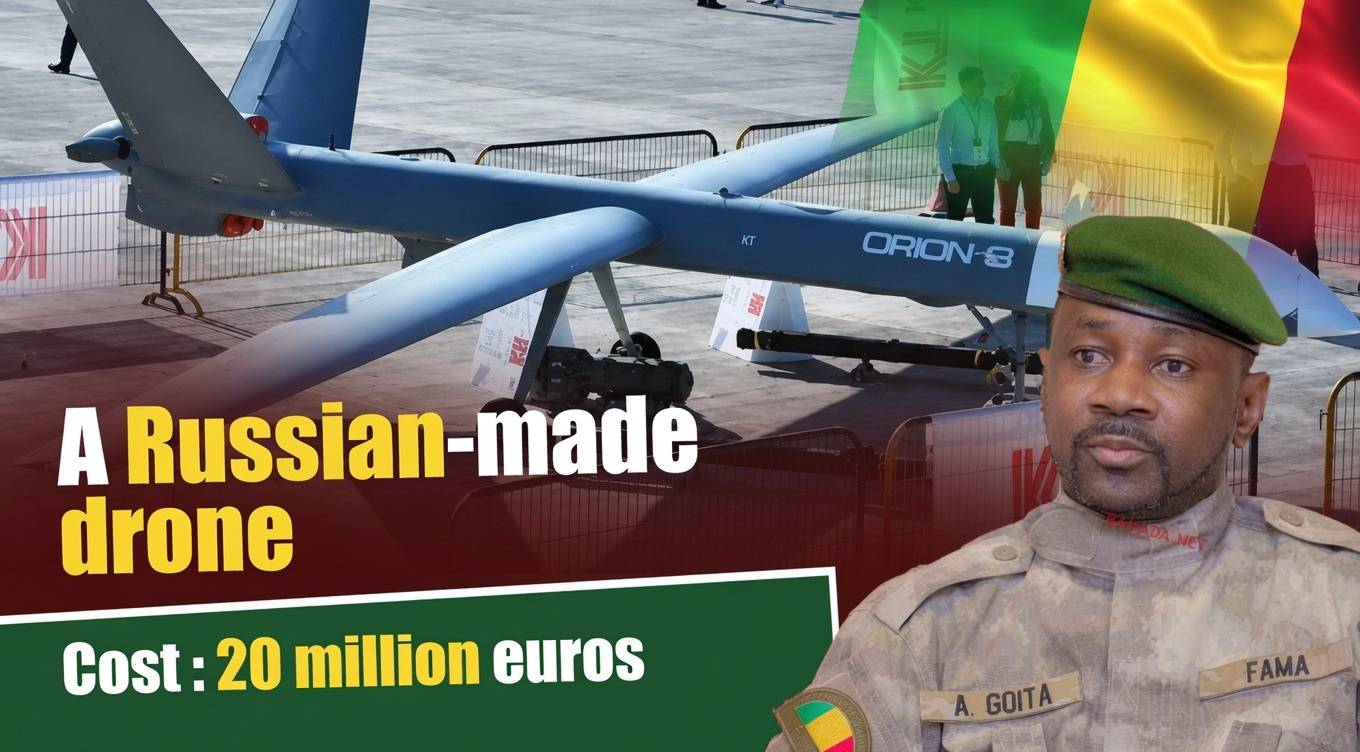
The Malian Armed Forces have just taken delivery of a state-of-the-art Russian-made Orion drone, a significant addition to their aerial capabilities. Designed for reconnaissance and precision strikes, this Medium Altitude Long Endurance (MALE) aircraft is now part of Bamako’s military assets. While officials hail this procurement as a breakthrough in national defense, experts are raising serious concerns about its practicality in Mali’s current security landscape.
Moscow’s military partnership bolsters Bamako’s aerial ambitions
The Orion drone joins a growing arsenal of Russian-supplied equipment acquired by Mali in recent years. Its arrival marks a deliberate shift toward strengthening the country’s military independence, particularly from former Western partners. Proponents argue that the drone’s surveillance capabilities could prove invaluable in monitoring the vast, sparsely populated desert regions of northern Mali. Yet, beneath the celebratory rhetoric, questions linger about whether this high-profile acquisition genuinely addresses the nation’s urgent security needs.
Asymmetric warfare’s silent killer: why noise ruins stealth
Mali’s conflict is defined by asymmetric warfare, where elusive, mobile terrorist groups exploit the terrain to evade conventional forces. The Orion, however, presents a glaring vulnerability: its loud operational noise. In a region where armed groups rely on silence and camouflage, the drone’s acoustic signature makes it an early warning system for militants, who can scatter or conceal themselves long before the aircraft reaches its target zone.
Compounding the issue, these groups have demonstrated an alarming capacity to acquire man-portable air defense systems (MANPADS) and other anti-aircraft weaponry. A single, slow-moving drone with a high visibility profile becomes an easy target, risking swift destruction by ground fire or missile strikes. The likelihood of losing this expensive asset in its first operational mission is uncomfortably high.
20 million euros for one drone: a justified expense or reckless spending?
The financial toll of this acquisition is sparking intense debate. Priced at nearly 20 million euros, the Orion represents a colossal investment for a country grappling with severe budget constraints and pressing social priorities. Critics argue that such a sum could have funded an entire fleet of smaller, more discreet, and cost-effective tactical drones instead.
By opting for a single high-end drone, Bamako appears to prioritize symbolic military prestige over tactical necessity. In a conflict where adaptability and rapid response are critical, this strategy risks squandering resources on a tool that may never deliver meaningful operational value.
The illusion of control: one drone, a nation’s vast insecurity
Mali’s geography is a formidable challenge, with large swaths of territory—from the arid expanse of Taoudénit to the dense forests of Kayes—remaining outside government control. The Orion, despite its extended endurance, cannot be everywhere at once. Its limited operational range means that while it patrols Gao, other critical zones like Tombouctou or Mopti remain unmonitored. Once grounded for maintenance or refueling, the skies fall silent again, leaving gaps that terrorist groups exploit without hesitation.
The hidden costs: logistics, maintenance, and operational paralysis
The sticker price of the Orion is only the beginning. Sustaining its operations demands a heavy logistical and financial commitment. Ground infrastructure must include advanced control stations, climate-controlled shelters to protect sensitive electronics from the Sahel’s punishing heat, and specially reinforced landing strips.
Ongoing expenses are equally daunting: specialized fuel, imported spare parts from Russia, and precision-guided munitions all add up. Training Malian technicians to maintain the system requires continuous support from foreign experts, further straining the national budget. Without a steady financial commitment, this 20 million euro drone could end up grounded permanently, reduced to a costly relic rather than a functional asset.
Symbol over substance: the dangers of over-equipping in asymmetric warfare
The arrival of the Orion reflects Mali’s visible push to over-equip its armed forces, but it also exposes the pitfalls of a strategy fixated on high-profile acquisitions. In a conflict defined by unpredictability and mobility, a single, expensive, and easily detectable aircraft is no match for the agility and stealth of terrorist networks.
For Mali to achieve lasting security, its military would benefit far more from a diversified, sustainable approach—one built on affordable, adaptable, and discreet tools rather than solitary symbols of power.