Malians demand universal healthcare access and better health services
malians prioritize universal healthcare despite persistent challenges
Recent years have seen the Mali government making strides in key health indicators, including reductions in infant mortality, under-5 child mortality, maternal mortality, and gains in life expectancy (World Health Organization, 2025; UNICEF, 2025). In 2018, the country launched an ambitious universal health coverage (UHC) plan as outlined in research by Mathauer et al. (2019). Yet, despite these efforts, securing high-quality healthcare remains a critical challenge for most Malians.
The obstacles are significant: a severe shortage of trained healthcare professionals, insufficient funding, and a legacy of political instability have all contributed to an uneven health system (World Bank, 2024; Touré et al., 2022; UN Human Security Trust Fund, 2025; Arie, 2019). Rural communities are disproportionately affected, with over half of the nation’s doctors concentrated in the capital, Bamako (Sangare et al., 2021).
The gaps in service delivery are clearly reflected in Mali’s score of 41 out of 100 on the World Health Organization’s 2024 Universal Health Coverage Service Coverage Index—well below both the African average (44) and the global average (68).
public demand for action: health tops the agenda
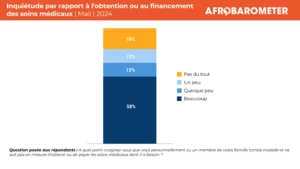
Findings from Afrobarometer Round 10’s special health module reveal that health is the top concern among Malians, with universal access to medical care being their most pressing demand. Currently, only about one in seven adults has health insurance, and many citizens worry about their ability to afford or access essential medical services. An overwhelming majority believe the government must ensure equitable healthcare access, even if it means raising taxes.
Those who visited public clinics or hospitals in the year prior to the survey reported mixed experiences. While many managed to receive necessary care, frequent complaints included unaffordable fees, long waiting times, drug shortages, and inadequate medical supplies. Nearly half of Malians stated that a family member was unable to obtain needed medical treatment in the past year.
Despite these frustrations, two-thirds of citizens express approval for the government’s progress in improving basic healthcare and trust the Ministry of Health to continue advancing these services.
