
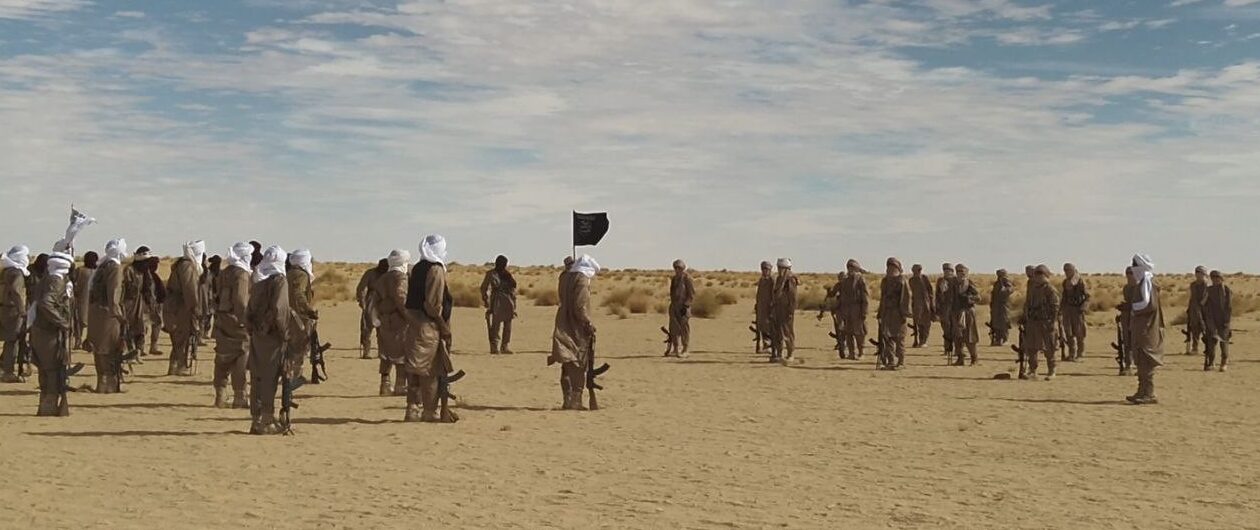
The once familiar rhythm of sporadic armed clashes in central and northern Mali has given way to a new reality: a grinding, unrelenting conflict that has reshaped lives and landscapes. Recent offensives by the Group for the Support of Islam and Muslims (JNIM) and the Azawad Liberation Front (FLA)—targeting military outposts, supply convoys, and critical road infrastructure—signal a deliberate strategic pivot rather than isolated incidents.
These groups no longer aim merely to seize towns or launch high-profile attacks. Their objective is more insidious: to progressively render vast swathes of the country ungovernable, pushing the military junta into ever-tighter corners around Bamako. The battlefield is no longer defined by control of cities or barracks, but by the ability—or failure—to move people, goods, fuel, and administrative services across the land.
Sabotaging the lifelines of the state
Over recent months, the frequency of road ambushes and convoy strikes has surged. In some regions, civil servants and traders can no longer travel without armed escorts, a development that weakens not only the Malian army but the very capacity of the state to function beyond its major urban centers. This is no accident. The JNIM’s evolving strategy leverages exhaustion over confrontation—a low-cost, high-impact approach that drains military resources, inflates security budgets, and fosters a climate of perpetual insecurity.
The result is a slow but devastating erosion of public trust. Where once communities faced armed groups, now they face the growing absence of stable governance. Schools, clinics, courts, and local administrations are disappearing, leaving behind a vacuum that armed factions are quick to fill with their own parallel systems of protection and justice.
The limits of a purely military response
The Malian military leadership has staked its legitimacy on restoring security, particularly since the series of coups and the subsequent withdrawal of French forces. The pivot toward Russian military support was framed as a restoration of sovereignty. Yet sovereignty cannot be measured solely by the capacity to wage war. It is also measured by the ability to maintain territorial continuity, economic flow, and administrative presence.
Despite intensified military operations, stabilization remains elusive in many rural areas. The paradox is stark: while offensives and strikes continue, the state’s administrative footprint recedes. Roads, schools, and health centers are not being rebuilt. Instead, communities increasingly rely on informal networks to survive—creating spaces where armed groups thrive by exploiting local grievances rooted in poverty, land disputes, and intercommunal tensions.
A regional crisis with no regional answers
The Malian conflict is no longer contained within its borders. The Sahel—particularly Mali, Burkina Faso, and Niger—has become a fluid arena where armed groups move across porous frontiers. While these nations once formed a political and military alliance, their collaboration has proven fragile in the face of coordinated offensives. The recent joint operations by the JNIM and FLA exposed the isolation of the Malian junta, which now relies heavily on the Africa Corps mercenary group for support.
This asymmetry favors groups that operate with agility, deep local roots, and entrenched positions in informal economies. Their goal is not to govern entire regions, but to render governance impossible—turning the Sahel into a war of endurance where the state is constantly on the defensive.
The real war is political—and it’s being lost
Reducing the crisis to a counterterrorism struggle obscures its deeper roots. The conflict is as much about governance as it is about guns. Across rural Mali, communities reel from decades of state neglect, resource disputes, and economic marginalization. Armed groups exploit these fractures, offering alternative systems of order where the state has failed to deliver.
The future of Mali will not be decided in a single decisive battle, but in the capacity—or incapacity—of the state to rebuild a stable, visible presence beyond the realm of military patrols. A war of attrition doesn’t just destroy positions—it erodes roads, economies, administrations, and social bonds. It dismantles the very idea of a governed territory.
Mourad Ighil