
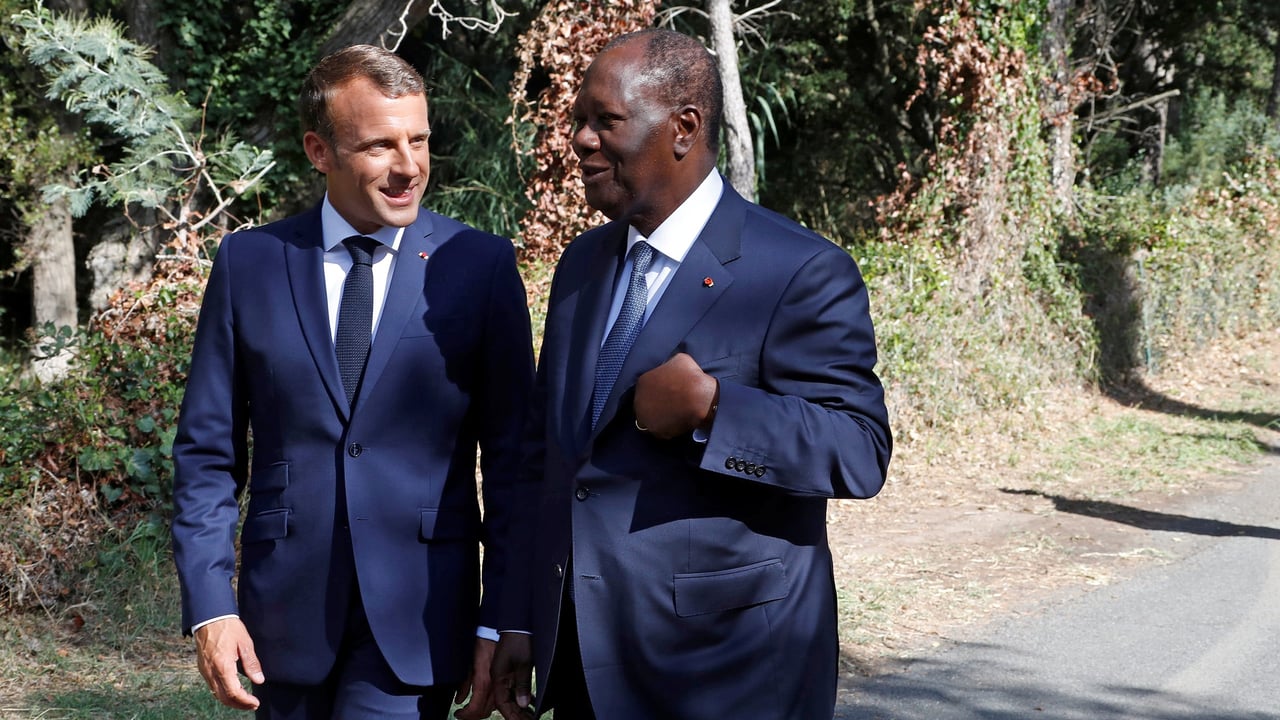

From the sun-drenched slopes of Mougins to the hallowed halls of the Élysée Palace, the relationship between Alassane Ouattara and French leadership has remained a defining feature of Ivorian politics for decades. This enduring connection has shaped critical decisions, economic ties, and diplomatic strategies between Abidjan and Paris.
Decades of deep-rooted connections
President Ouattara’s ties to France stretch back to his formative years. Trained in French institutions, he cultivated close bonds with key French political figures long before assuming leadership in Côte d’Ivoire. These relationships have often played a pivotal role in navigating the complexities of Ivorian governance and international partnerships.
His interactions with successive French administrations—ranging from Nicolas Sarkozy to Emmanuel Macron—have underscored a consistent pattern: mutual respect, strategic collaboration, and a shared vision for regional stability. Whether through high-level summits or private exchanges, these connections have facilitated robust economic exchanges, security cooperation, and development initiatives.
Economic and diplomatic milestones
The collaboration between Côte d’Ivoire and France has yielded tangible results. French investments continue to flow into sectors like infrastructure, energy, and agribusiness, reinforcing Côte d’Ivoire’s position as a West African economic powerhouse. Trade agreements have further solidified this partnership, ensuring that both nations benefit from a dynamic exchange of goods and services.
Diplomatically, the alignment between Abidjan and Paris has been equally significant. France’s unwavering support during periods of political turbulence in Côte d’Ivoire has been a stabilizing force, reinforcing the country’s resilience on the global stage. These efforts have not only bolstered Côte d’Ivoire’s sovereignty but also strengthened its voice within regional and international organizations.
Cultural and educational exchanges
Beyond politics and economics, the bond between the two nations thrives on cultural and educational exchanges. Thousands of Ivorian students pursue their studies in France each year, while French cultural institutions in Côte d’Ivoire—such as the Institut Français—serve as bridges fostering artistic and intellectual collaboration.
These exchanges have nurtured a generation of Ivorian professionals who are fluent in French, culturally attuned, and professionally integrated into the broader Francophone world. The result is a workforce that is not only skilled but also deeply connected to European markets and ideas.
A partnership built on trust
The relationship between Ouattara and French leadership is more than a diplomatic formality; it is a testament to trust and mutual understanding. Whether addressing regional security challenges or negotiating trade deals, both sides have consistently demonstrated a willingness to collaborate closely. This trust has been instrumental in overcoming obstacles and achieving shared goals.
As Côte d’Ivoire continues to chart its path toward progress, this partnership remains a cornerstone of its strategy. With France as a reliable ally, the future holds promise for continued growth, stability, and prosperity in West Africa.