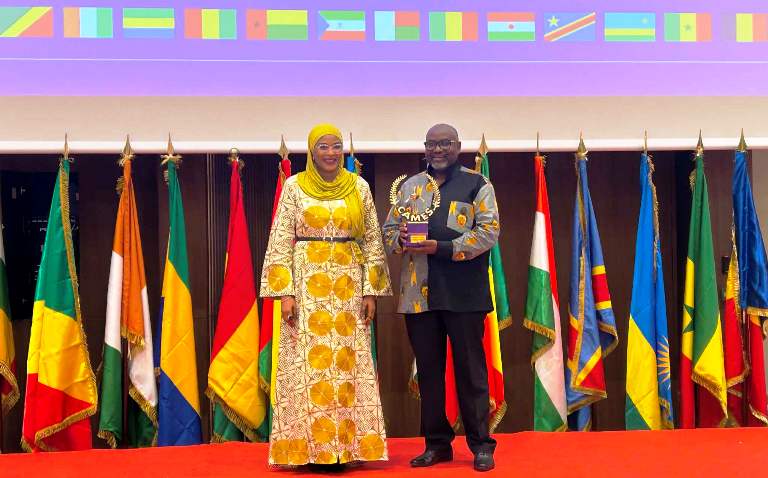
Outgoing CAMES president Dr. Diaka Sidibé hands over the torch to incoming president Pr. Charles Edgard Mombo on June 19 in Libreville © Gabonactu.com
Libreville hosted the 43rd ordinary session of the Council of Ministers of the African and Malagasy Council for Higher Education (CAMES) from June 15 to 19, 2026, culminating in a landmark decision: Gabon, represented by Higher Education Minister Pr. Charles Edgard Mombo, assumed the rotating presidency of the institution for one year. This strategic role positions the country at the forefront of Africa’s higher education modernization, excellence, and global influence ambitions.
Following intense deliberations that led to the adoption of key recommendations and resolutions, the Gabonese government official reaffirmed the nation’s commitment to transform this presidency into a period of tangible actions and measurable outcomes for universities, academics, researchers, and students across the CAMES space.
« This year-long presidency will prioritize rigorous implementation of adopted decisions to ensure every resolution yields concrete results », declared Mr. Mombo while outlining his mandate’s core priorities.
The Gabonese strategy focuses on several transformative pillars: expediting the implementation of ministerial resolutions, enhancing quality assurance and academic excellence in higher education institutions, boosting the international visibility and appeal of scientific research from member states, and accelerating digital transformation in higher education and research.
This vision aligns with the ongoing efforts of the CAMES General Secretariat, led by Pr. Souleymane Konaté. The 43rd session validated expert proposals discussed during the June 15–16 preparatory meeting in Libreville. Among the groundbreaking initiatives adopted is a revitalization strategy to elevate CAMES’s standing on the global scientific stage—currently representing only about 2% of global scientific output despite its vast potential.
To reverse this trend, several innovative measures were greenlit, including the creation of a CAMES Virtual Academy. This digital platform will serve as a centralized hub for scientific and academic services, empowering member states and institutions to enhance university performance, facilitate knowledge sharing, and strengthen researcher capabilities.
The Gabon-led program also emphasizes solidarity among member states, academic mobility, intensified scientific cooperation, and the promotion of innovation, university entrepreneurship, and graduate employability.
Outgoing CAMES presidency holder Dr. Diaka Sidibé, Guinea’s Minister of Higher Education, Research, and Innovation, praised the collective commitment of member states to institutional transformation. She expressed confidence in Gabon’s ability to advance the reforms initiated during her tenure.
The Libreville session also featured a tribute to Gabonese President Brice Clotaire Oligui Nguema, whose unwavering support for higher education, scientific research, and African academic integration was unanimously recognized by participants.
With this presidency, Gabon inherits a pivotal mission: to propel CAMES into a more high-performing, innovative, and competitive entity, capable of addressing contemporary challenges in training, research, and development. This ambition could herald a new era for African higher education and further amplify its global scientific influence.
The supreme governing body of CAMES confirmed that the 44th ordinary session of the Council of Ministers will convene in 2027 in Yaoundé, Cameroon.