
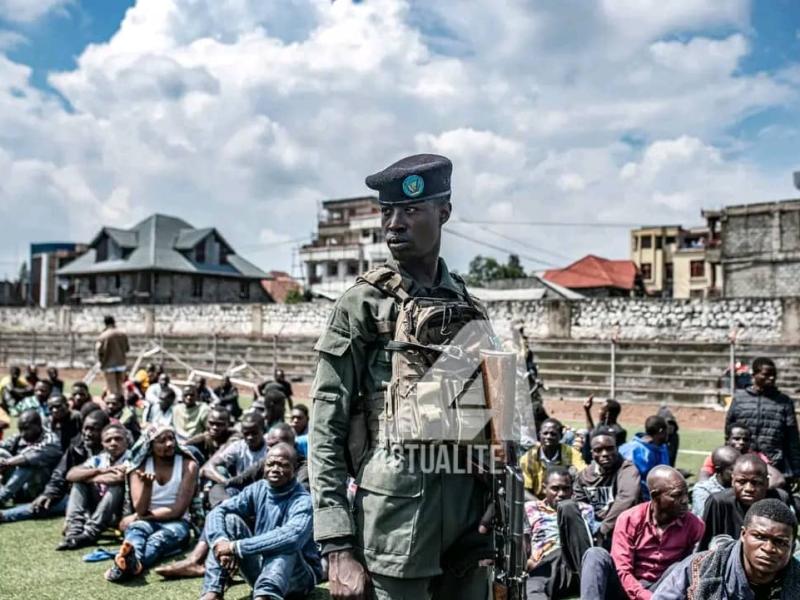
Eastern DRC: Aimé Boji reaffirms unbreakable national unity in the face of occupation
- Security
Eastern DRC: Aimé Boji reaffirms unbreakable national unity in the face of occupation
The President of the National Assembly, Aimé Boji Sangara, has praised the resilience of populations affected by armed conflicts in the eastern Democratic Republic of the Congo while firmly reaffirming the National Assembly’s position on national unity and territorial integrity.
During his address marking the closure of the March 2026 ordinary session, he first paid tribute to internally displaced persons and refugees, whose humanitarian situation remains precarious. Addressing the people of North Kivu, South Kivu, and Ituri, he conveyed a message of solidarity and hope in the face of trials imposed by armed conflicts.
Resilience and solidarity in times of crisis
“This is an opportunity to commend the remarkable resilience of our internally displaced and refugee compatriots. Their suffering remains at the heart of the National Assembly’s concerns. At this juncture, I wish to extend a message of solidarity and hope to our brothers and sisters in North Kivu, South Kivu, and Ituri, who continue to demonstrate resilience and resistance in the face of trials imposed by Rwandan troops and their auxiliaries, the AFC/M23,” he declared.
Speaking in Swahili and French, the Speaker of the National Assembly firmly reaffirmed the unyielding belonging of eastern DRC to the Democratic Republic of the Congo, asserting that the occupation cannot be permanent.
“North Kivu, South Kivu, and Ituri are and will forever remain integral parts of the Democratic Republic of the Congo—a blessed gift and sacred heritage passed down by our ancestors. We are convinced that the illegal occupation plaguing our eastern region is neither definitive nor irreversible. Like all unjust situations in the history of peoples, this barbaric occupation will come to an end.”
Rejecting division and betrayal
Addressing those who advocate for the country’s balkanization, Aimé Boji Sangara warned against any attempt to undermine national unity or the belonging of populations in occupied zones. He emphasized the unbreakable bond between Congolese citizens, even amid the current security crisis driven by aggression and occupation attributed to the AFC/M23, allegedly backed by Rwanda.
“Here is the place to declare loudly to all those who believe that our brothers and sisters in occupied territories can renounce their national belonging or conspire against the nation that they are mistaken—for we remain in perfect communion with them and continue to defend, tirelessly, national unity, territorial integrity, and our country’s sovereignty together. Our greatest weapon against adversity is not merely military; it is first and foremost our strong sense of patriotism, our national unity, and our resilience,” he stated.
He categorically rejected any attempts to divide or instrumentalize the populations of eastern DRC, reaffirming the indivisibility of the Democratic Republic of the Congo and the institutions’ determination to defend every inch of national territory.
“Let the dark forces attacking our country in the East and attempting to mislead our compatriots in occupied areas know that we will oppose them with an unbreakable wall of solidarity. The Democratic Republic of the Congo is one, indivisible, and diverse. Whether you are in Goma, Muanda, Gemena, or Lubumbashi, the blood spilled in the East is our own. National unity is not an empty word; it is the foundation of our survival and greatness. Let them be clear: we will defend every square millimeter of our territory to the end,” he declared.
Enduring crisis despite diplomatic efforts
Despite international mediation efforts, including the Washington Agreement under U.S. auspices, the Doha Process facilitated by Qatar with AU support, and ongoing evaluation meetings, the security and humanitarian situation in eastern DRC remains dire. Civilian populations continue to bear the brunt of violence and forced displacement, exacerbating an already catastrophic humanitarian crisis amid declining international funding for aid.
While calls for peace persist at national, regional, and international levels, tangible progress remains elusive. Disagreements over the interpretation and implementation of peace agreements persist, leaving persistent gaps between diplomatic commitments and ground realities.
Clément Muamba