DRC president unveils inclusive national dialogue roadmap
DRC president unveils inclusive national dialogue roadmap
In a decisive move to foster national cohesion, President Félix Tshisekedi has announced the launch of an inclusive national dialogue, entrusting religious leaders with its facilitation. The historic announcement follows a high-stakes meeting at the Cité de l’Union africaine in Kinshasa, where the president outlined his vision for a peaceful and united Democratic Republic of the Congo (DRC).
Dialogue aims to strengthen national unity
The president’s initiative seeks to consolidate peace and stability across the nation, with a clear emphasis on respecting constitutional frameworks. A presidential communiqué emphasized that the dialogue would be “inclusive, peaceful, and firmly rooted in republican values“, designed to bridge divides between political factions and societal groups.
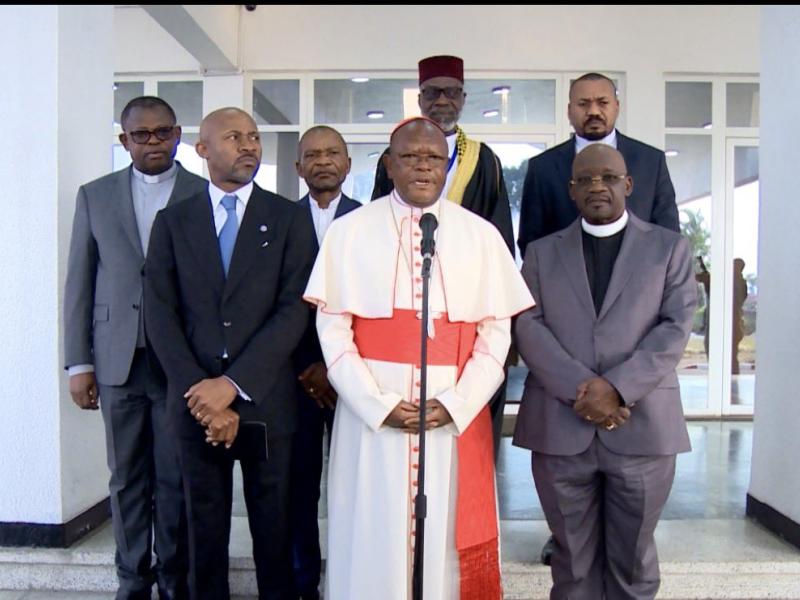
Cardinal Fridolin Ambongo, Archbishop of Kinshasa and spokesperson for the religious delegation, expressed strong support for the president’s initiative. “We commend this bold step and stand ready to accompany the process with unwavering commitment,” he stated. The cardinal highlighted that the dialogue represents a critical opportunity to address the country’s deep-rooted challenges, including the ongoing conflict in the eastern provinces.
Religious leaders to lead facilitation
The delegation of religious leaders, representing diverse faith communities, has accepted the critical mission of guiding the dialogue. Among the key figures present were:
- Cardinal Fridolin Ambongo (Catholic Church)
- Mgr André Bokundoa (Église du Christ au Congo)
- Mgr Ejiba Yamampia (Église de Réveil du Congo)
- Cheikh Abdallah Mangala (Muslim Community)
- Mgr Donatien Nshole (Catholic Church spokesperson)
- Pastor Éric Senga (Église du Christ au Congo spokesperson)
The religious leaders have vowed to approach their role as a moral and spiritual mission, urging both the ruling majority and opposition to engage constructively. “This is an apostolic calling to unite the sons and daughters of Congo,” Cardinal Ambongo remarked, underscoring the urgency of addressing the eastern conflict, which he attributed to external interference.
Eastern conflict and regional tensions
The dialogue initiative comes at a time of heightened tensions in the eastern DRC, where armed groups continue to destabilize the region. The government has repeatedly accused neighboring Rwanda of supporting the M23 rebel movement, a claim consistently denied by Kigali. International observers, including United Nations experts, have documented evidence supporting Kinshasa’s allegations, further complicating efforts to restore peace.
Cardinal Ambongo’s remarks reflect growing concerns about the humanitarian crisis, which has displaced millions and left communities vulnerable. “Our nation cannot thrive amid division and war,” he asserted, calling for unity to counter external threats.
Next steps and challenges ahead
While the president’s announcement marks a significant milestone, key details of the dialogue remain to be finalized. The government has yet to disclose the timeline, format, or participants, leaving many questions unanswered. Opposition factions have already articulated their demands, including the release of political prisoners, the cessation of perceived politically motivated prosecutions, and guarantees for public freedoms.
President Tshisekedi has reiterated his commitment to dialogue but cautioned against any attempts to undermine constitutional processes. “Dialogue must strengthen, not bypass, our institutions,” he emphasized during a recent address in Luanda.
Religious leaders have pledged to work diligently to ensure the dialogue’s success, with a roadmap expected to be published in the coming weeks. The initiative aligns with broader regional efforts, including consultations held in Bujumbura and Brazzaville, where regional leaders have urged flexibility and compromise among Congolese stakeholders.
Conclusion: A path toward reconciliation
The announcement of an inclusive national dialogue represents a pivotal moment for the DRC, offering a potential pathway to reconciliation and stability. As religious leaders prepare to lead the facilitation, the nation watches closely, hoping for a process that delivers lasting peace and unity. The coming weeks will be critical in determining whether this initiative can bridge deep-seated divides and restore confidence in the country’s future.
