
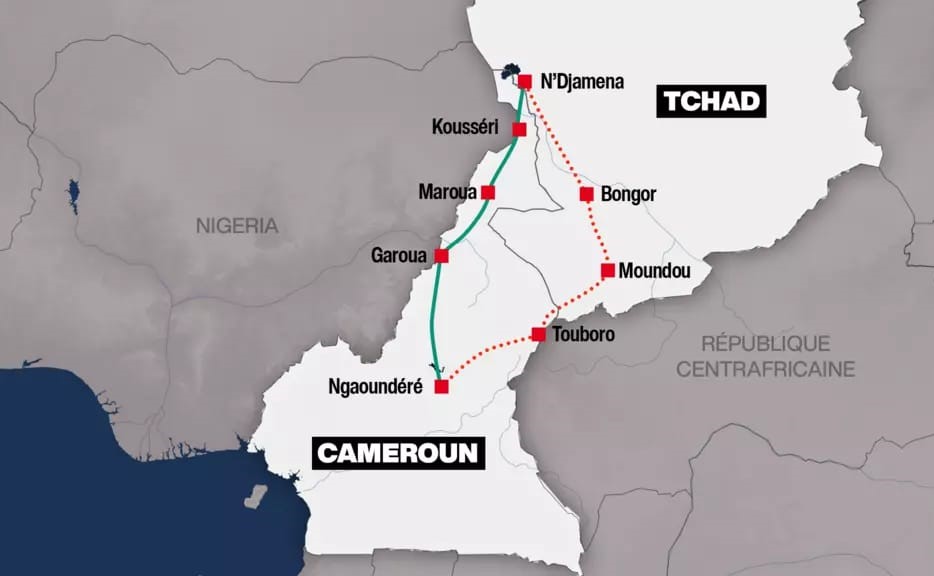
The announcement of the Cameroon-Chad railway route by Cameroonian authorities has sparked immediate opposition from Chad, revealing deep-seated challenges in regional infrastructure projects. The disagreement over the proposed railway corridor underscores the complexities of balancing national interests with collective development goals in Central Africa.
During a June 4 meeting at the Palais de l’Unité, Cameroon’s steering committee for structural projects, led by the country’s president, approved a railway line connecting Ngaoundéré to N’Djamena via Garoua, Figuil, Maroua, and Kousséri before crossing into Chad. Cameroonian officials presented this route as the most economically and technically viable option, positioning Cameroon as the maritime gateway to landlocked Central Africa.
However, Chad’s Ministry of Transport swiftly responded with a public statement rejecting the proposal, asserting that no definitive route had been jointly approved. N’Djamena argued that discussions remained ongoing in bilateral consultations and studies, framing Cameroon’s unilateral decision as premature. This dispute highlights the persistent difficulties in implementing cross-border initiatives where national priorities often take precedence over regional cooperation.
a transformative project with high stakes
The proposed railway, spanning over 900 kilometers, represents one of Central Africa’s most ambitious infrastructure ventures. Designed to link Cameroon’s existing rail network to Chad’s landlocked economy, the project aims to reduce logistics costs, accelerate trade flows, and enhance competitiveness for both nations. More than 80% of Chad’s external trade currently transits through the Douala-N’Djamena corridor, making rail connectivity a strategic priority. The initiative aligns with the Economic Community of Central African States (ECCAS) multimodal corridor development strategy, with an estimated cost running into billions of dollars.
The railway is expected to facilitate the movement of hydrocarbons, cotton, livestock, cereals, construction materials, and containerized goods from ports in Douala and Kribi. Proponents anticipate significant reductions in transport costs, improved market access for producers, and the creation of new industrial and logistics hubs along the route. For Cameroon, the project offers an opportunity to leverage its port infrastructure more effectively while strengthening economic ties with Sahelian hinterlands.
competing visions for economic distribution
While the debate centers on technical specifications, underlying tensions reflect fundamentally different perspectives on economic development. Cameroon’s proposed route prioritizes northern regions such as Garoua, Maroua, and Kousséri, aiming to address long-standing infrastructure deficits and stimulate local economic activity. The government views the railway as both a transport solution and a tool for territorial planning.
Chadian authorities, however, contend that the current proposal fails to adequately serve key agricultural and productive zones in their country. They advocate for a route that would better integrate Chad’s interior regions, ensuring equitable benefits from the future corridor. This divergence exemplifies a recurring challenge in regional projects: each nation seeks to maximize returns on its territory, turning infrastructure choices into decades-long economic opportunity distributions.
regional cooperation versus national sovereignty
The dispute exposes the fragility of Central African economic integration, where infrastructure projects often follow national rather than regional logic. International experience shows that successful transnational corridors require shared governance mechanisms from the outset. Decisions on financing, route selection, technical standards, and operations must be made collaboratively to secure political buy-in from all stakeholders. Without this, the risk of project delays or abandonment increases substantially.
The Cameroon-Chad railway controversy occurs amid broader efforts across Africa to revitalize regional connectivity. Yet this case demonstrates that without genuine cooperation, even visionary projects risk stalling before construction begins. The challenge ahead lies in reconciling national ambitions with the collective benefits of integrated infrastructure, ensuring that both Cameroon and Chad—and the broader Central African region—can fully realize the potential of this transformative corridor.