
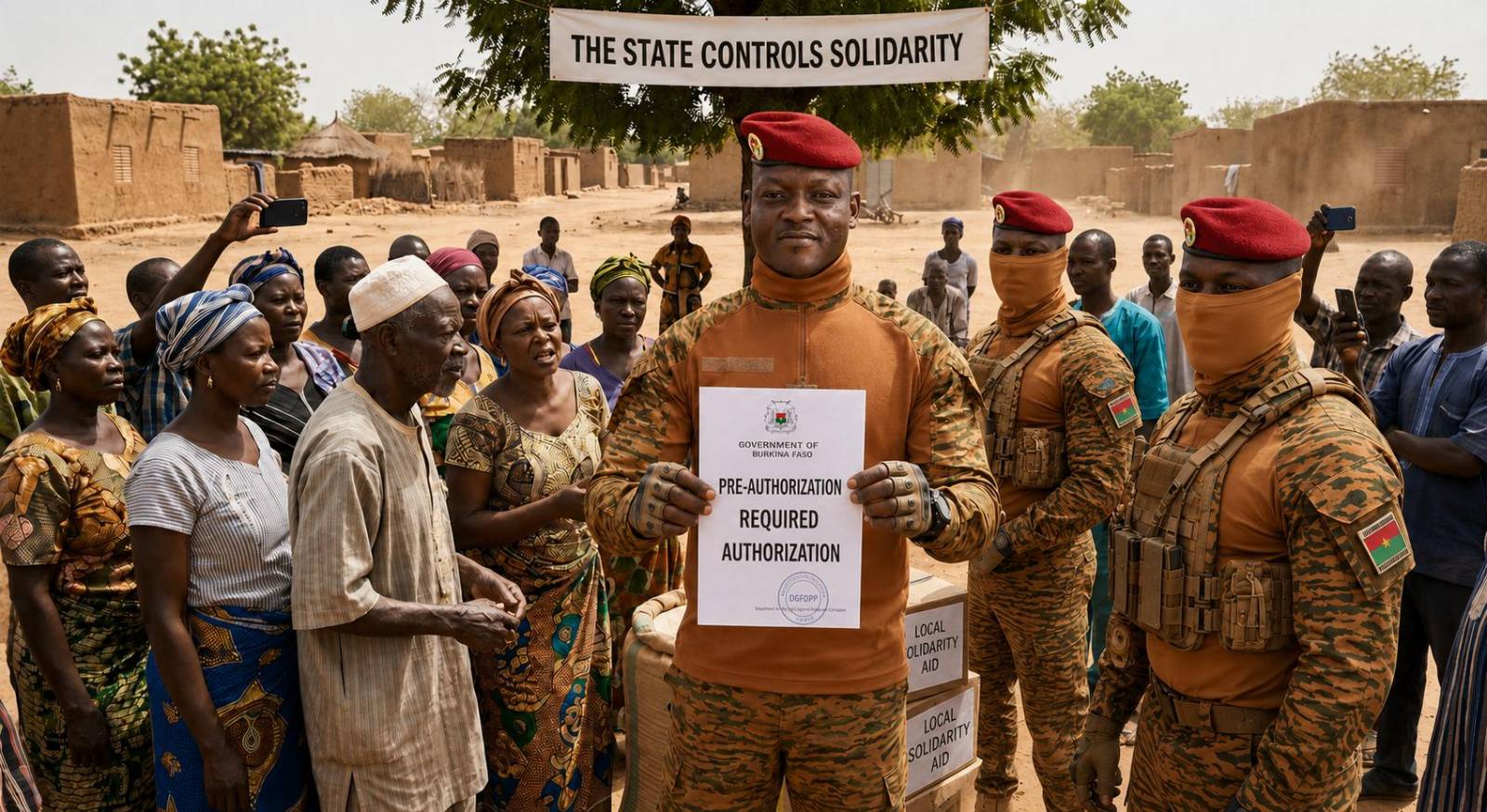
Gone are the days of unregulated charitable drives and spontaneous online appeals in Burkina Faso. The Ministry of Solidarity has issued a sweeping decree: all humanitarian initiatives must now secure prior government approval—or face penalties. While authorities justify the move as a safeguard against exploitative online campaigns, the policy raises a profound question: when altruism itself becomes a potential crime, how much freedom remains to help one’s fellow citizens?
From protection to restriction: the unintended consequences
The stated goal—preserving human dignity and preventing the commodification of suffering—is understandable. Yet the blanket requirement to seek state authorization risks conflating legitimate aid with suspicious activity. In a nation where crises demand rapid, decentralized responses, treating every act of generosity as a potential threat to national security undermines the very fabric of community resilience.
Historically, Burkina Faso’s most vulnerable populations have relied not on slow-moving bureaucracies, but on the immediate actions of neighbors, religious groups, diaspora networks, and local associations. These grassroots efforts have filled critical gaps left by under-resourced public services. By mandating prior approval, the government risks suffocating the very mechanisms that have sustained communities through years of instability.
A monopoly on compassion?
The new regulations hint at a troubling shift in governance philosophy. Rather than collaborating with civil society, the transitional administration led by Captain Ibrahim Traoré appears to view independent humanitarian initiatives as challenges to its authority. This centralized approach transforms acts of kindness into administrative hurdles, breeding distrust between citizens and institutions.
Under such a system, even the most urgent needs—medical emergencies, displaced families, or food shortages—must await ministerial clearance. While paperwork accumulates in government offices, human suffering does not pause. The policy effectively criminalizes the spontaneous solidarity that has long defined Burkina Faso’s social contract, replacing it with a top-down model that prioritizes control over compassion.
The real cost of bureaucratic charity
This policy arrives at a critical juncture. Burkina Faso continues to grapple with escalating security threats, mass displacements, and widening economic precarity. In such conditions, the state lacks the financial, logistical, and human resources to replace the vital role played by local actors. By stifling independent aid efforts, the decree risks creating a void that neither government agencies nor international organizations can fill in time.
For many Burkinabè, aiding distant relatives or organizing community support is not an abstract gesture—it is survival. A diaspora family sending remittances, a village collecting grain for displaced neighbors, or a religious group distributing meals all operate outside formal channels. Forcing these initiatives through a bureaucratic maze will discourage participation, weaken social cohesion, and leave countless families without recourse.
Dignity under threat
Officials argue that the measures protect the dignity of vulnerable populations by curbing exploitative online campaigns. Yet this framing obscures a harsh reality: dignity is not preserved by silence. A child starving in a remote village, a displaced mother giving birth without medical care, or an elderly farmer unable to access clean water—none of these crises disappear when their visibility is suppressed by government decree.
A more balanced approach would focus on ethical fundraising standards, consent protections, and transparent reporting—without dismantling the organic networks that have sustained Burkina Faso through decades of hardship. The current policy does not elevate human dignity; it buries it beneath layers of administrative red tape.
The path forward
Rather than policing altruism, Burkina Faso’s leadership could invest in strengthening civil society partnerships. Clear guidelines for ethical aid, faster approval processes for urgent cases, and sustained funding for local organizations would preserve both dignity and efficacy. The alternative—a government-monopolized approach to compassion—risks leaving the most vulnerable without hope, and the nation without the resilience that has always defined it.