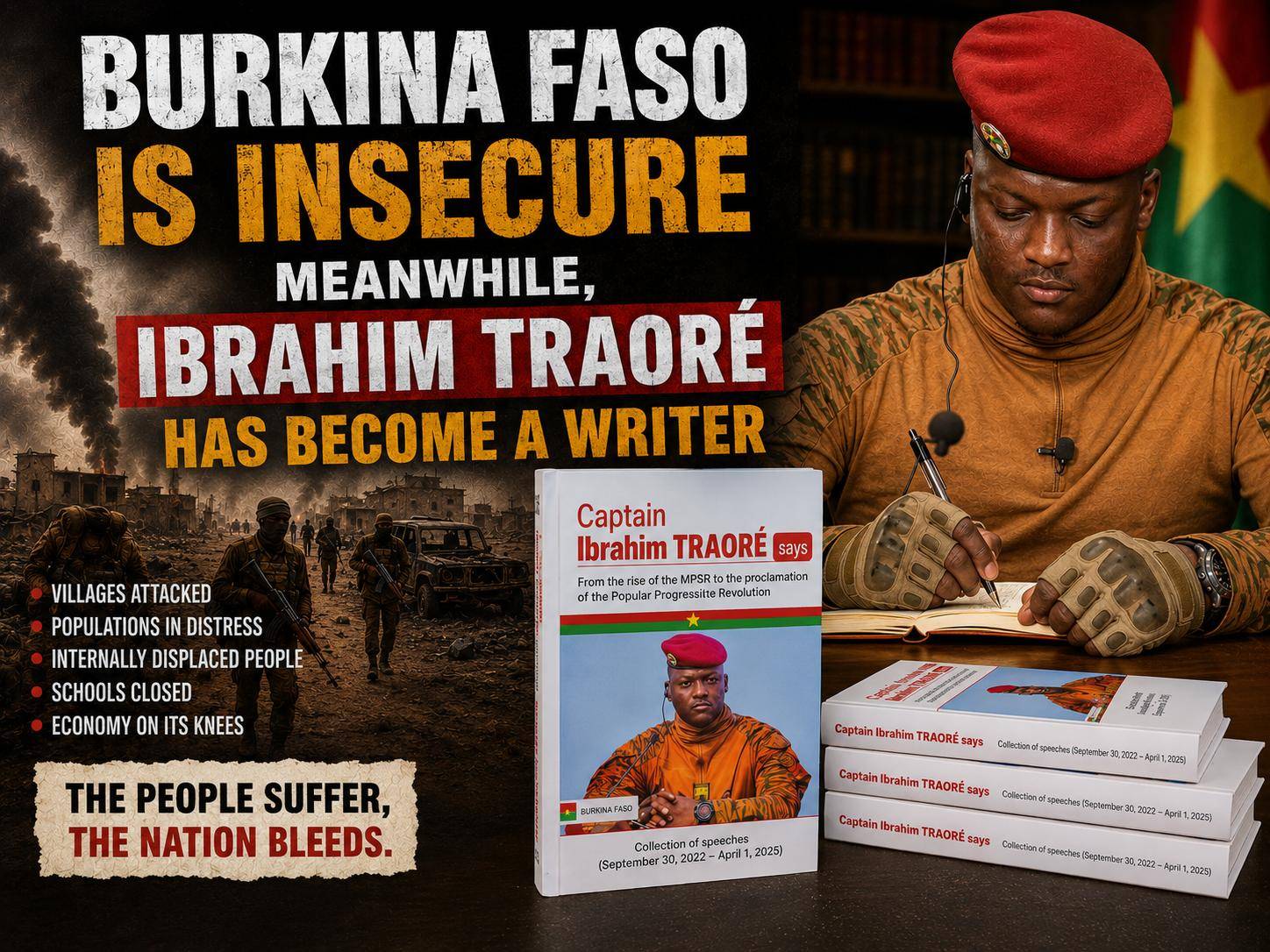
Burkina Faso’s leadership focus: books over security
As Burkina Faso continues its descent into an unprecedented humanitarian and security crisis, the recent priorities of the transitional government have drawn significant scrutiny. A substantial and concerning divergence has emerged between official communication initiatives and the grim realities on the ground.
This situation presents a stark, almost unconscionable, dichotomy. On one side, daily reports detail relentless terrorist assaults, besieged communities, and a burgeoning population of internally displaced persons who desperately seek peace and the restoration of territorial sovereignty, often contending with severe hunger. On the other, the presidential office appears to be dedicating resources to promoting publications characterized by propaganda or self-congratulatory narratives.
For a considerable segment of the Burkinabè populace, a bitter truth has crystallized: the transitional presidency increasingly resembles an enterprise focused on political communication.
The illusion of rhetoric versus the reality of conflict
The recent publication of a book, either attributed to or dedicated to Captain Ibrahim Traoré, has sparked a mixture of incomprehension and profound exasperation. Across the capital, Ouagadougou, and throughout the most remote provinces, the public’s message remains unequivocally clear: citizens are not requesting literature; they demand security.
The decision to fund, publish, and promote state-sanctioned literary works at a time when the nation’s Defense and Security Forces (FDS) and Volunteers for the Homeland (VDP) frequently face critical logistical shortages on the front lines exemplifies an alarming detachment from reality. One cannot extinguish a raging inferno with printed pages, nor can lives be safeguarded through mere cover slogans.
“The populace does not require stories; it requires the restoration of its homeland.” – An anonymous civil society activist.
A breach of moral covenant
Upon assuming authority, Captain Ibrahim Traoré established a tacit moral compact with the nation: to re-establish territorial integrity and bring peace to areas where previous administrations had faltered. The substantial public trust initially vested in him was exclusively predicated upon this pledge of military effectiveness.
Presently, it is evident that rhetoric has overshadowed tangible tactical progress. By directing the state apparatus towards the cultivation of a personality cult and political marketing, the regime is incurring the wrath of an exhausted population. For many, the threshold of tolerance has been surpassed. Discontent is escalating, and the popular mandate is becoming uncompromising: if the primary mission of securing the nation cannot be fulfilled, it is time for a change in leadership.
What future awaits the transition?
The incumbent administration stands at a critical juncture. Persisting in managing the presidency as a public relations entity, to the detriment of the security front, will only exacerbate the disconnect with the people. The challenges facing Burkina Faso mirror broader security concerns across West Africa, making effective governance crucial.
Burkina Faso requires strategic commanders capable of restoring stability, not publicists at its helm. Should Captain Traoré fail to immediately reorient efforts towards the singular, paramount priority of security, history will record his tenure as one written in the ink of illusion, while the nation itself was consumed by fire.
