Burkina faso’s industrialisation push amid economic and security crises
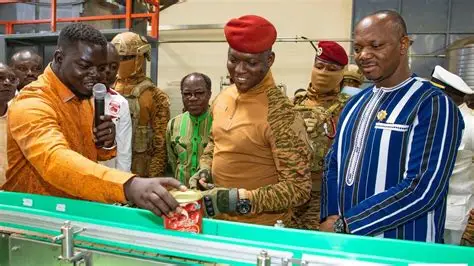
In recent months, Captain Ibrahim Traoré has intensified his public appearances, inaugurating industrial projects across Burkina Faso. From tomato processing plants to gold refining facilities, the transitional government’s communications machine has been working overtime to project an image of progress and self-reliance. Yet beneath the carefully staged media coverage, the harsh realities of Burkina Faso’s economic and security crises remain unaddressed.
The illusion of progress through grand projects
Governments in search of legitimacy often resort to what is commonly referred to as the “ribbon-cutting strategy”—a tactic that involves showcasing large-scale infrastructure and industrial initiatives. In Ouagadougou and Bobo-Dioulasso alike, Captain Traoré has positioned himself as the architect of Burkina Faso’s economic revival, emphasizing local job creation and self-sufficiency. For regime supporters, each newly launched project symbolizes a step toward breaking free from Western influence. However, economic analysts argue that these highly publicized endeavors are more indicative of a desperate scramble for visibility than a coherent development plan.
Industries propped up by opacity and questionable funding
Closer examination of these flagship industrial ventures reveals troubling inconsistencies. While official ceremonies paint a picture of robust progress, critical details—such as actual funding sources, operational viability, and long-term production capabilities—remain conspicuously absent. Additionally, concerns over financial mismanagement have cast a shadow over the management of patriotism-driven funds allocated for both security and industrialization efforts.
As traditional private enterprises struggle under the weight of excessive taxation and escalating insecurity, the emergence of new entities with close ties to the ruling circle raises serious questions about the fairness and transparency of contract allocations. The opacity surrounding these arrangements only deepens skepticism about the true beneficiaries of Burkina Faso’s so-called economic transformation.
The stark divide between political narratives and daily reality
The narrative of industrial progress stands in stark contrast to the lived experiences of ordinary Burkinabè citizens. While government officials celebrate the inauguration of new factories, the average household grapples with rising costs of essential goods.
- Soaring inflation: The prices of staple foods—including rice, cooking oil, and millet—have reached unprecedented levels, pushing vulnerable populations to the brink of survival.
- Humanitarian catastrophe: With over two million internally displaced persons, Burkina Faso is experiencing one of the most severe humanitarian crises in its history. Entire communities remain trapped under terrorist blockades, reliant on sporadic and unreliable humanitarian aid.
- Economic paralysis: The informal sector, the backbone of Burkina Faso’s economy, is on the verge of collapse. Persistent power shortages and the insecurity of major trade routes have ground commercial activity to a halt.
The limits of propaganda
State-sponsored media campaigns present a meticulously curated vision of Burkina Faso as a nation on the rise—complete with gleaming machinery, determined leaders, and a bright future. Yet this carefully constructed reality collides with the harsh truth faced by ordinary citizens, who struggle to afford basic education for their children and whose soldiers operate under extreme duress to protect shrinking areas of government control.
The government’s insistence on projecting an image of resilience risks deepening the disconnect between leadership and the populace. While industrialization remains a commendable goal, it cannot thrive on a foundation of illusion. Without transparent financial management and genuine territorial security, these high-profile inaugurations will ultimately amount to little more than mirages in the Sahelian landscape.
