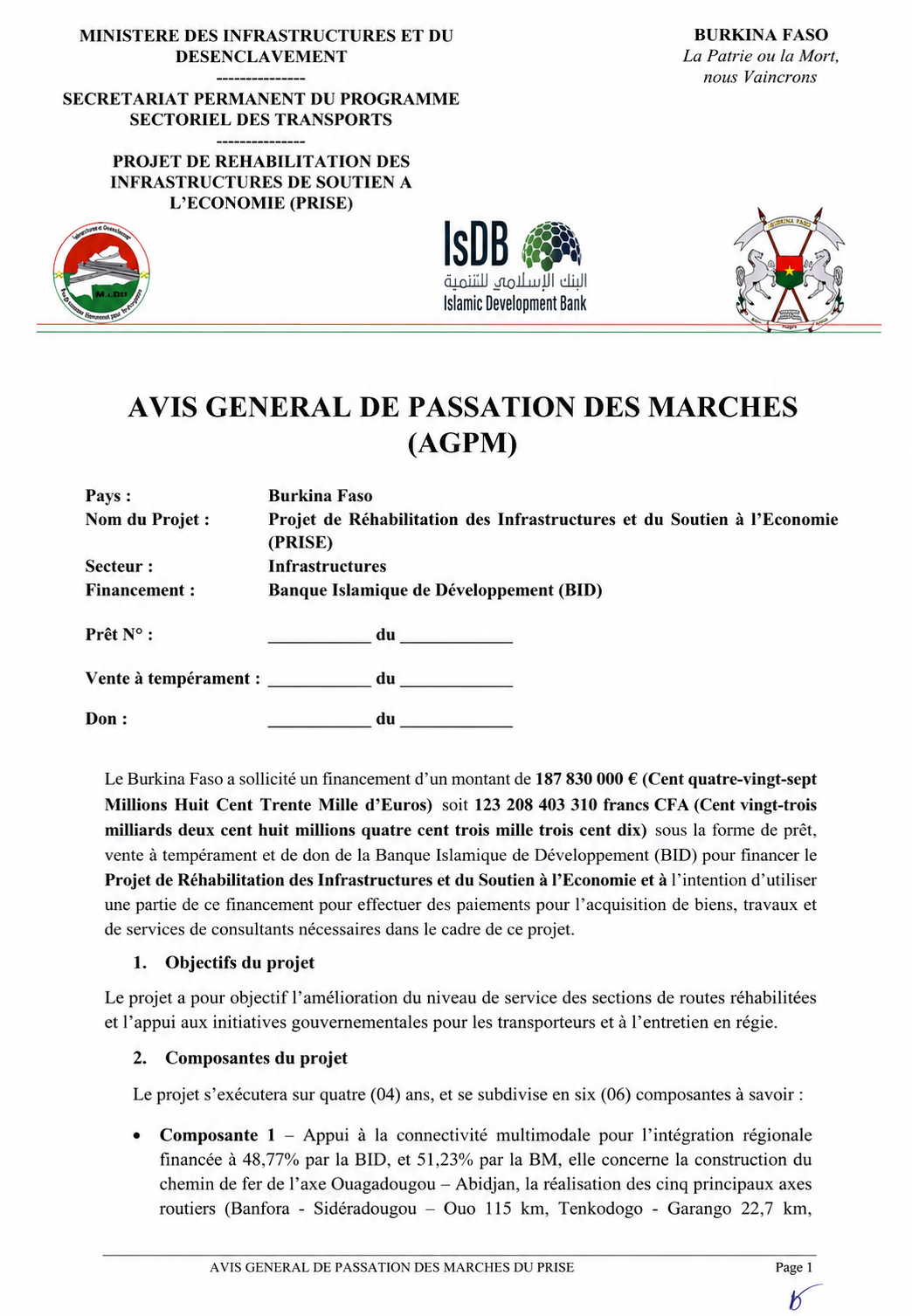
Burkina Faso’s financial autonomy myth: how debt persists despite official claims
From slogan to financial reality
The military-led government in Ouagadougou has adopted a powerful catchphrase to promote its economic strategy: “Y’a pas crédit dedans”. Repeated endlessly on social media and echoed by supporters, this phrase claims that major infrastructure projects—road rehabilitation, state modernization, equipment purchases—are fully funded by domestic resources, with no reliance on foreign debt.
The message is direct, persuasive, and politically charged: Burkina Faso is advancing under its own power, free from dependence on international donors.
A gap between words and ledgers
While sovereignty is a legitimate national goal, the claim that every public investment is financed entirely from internal sources raises serious questions when official documents and financial conventions reveal the use of concessional loans and multilateral funding.
Recent agreements with the Islamic Development Bank to fund large-scale road projects confirm this reality. These initiatives draw on external financing that must be repaid according to agreed schedules, even when terms are favorable. In other words, the funding is not free—it creates future obligations recorded in the national budget.
The paradox of claiming debt-free progress
Why insist so forcefully that “there’s no credit inside” when multiple projects depend on international financing?
Borrowing is a standard tool governments use to fund development when domestic revenues fall short. What stands out is the contrast between a narrative of near-total financial independence and the continued reliance on external partners. This inconsistency fuels skepticism about the government’s transparency.
A nation under economic strain
Burkina Faso’s economic landscape makes large-scale self-financing highly implausible. The country faces overlapping crises:
- A severe security emergency driving up defense spending;
- Public finances stretched thin by rising expenditures;
- Critical infrastructure needs across vast regions;
- Mass displacements of communities due to conflict;
- Weakened tax collection amid economic slowdown in key areas.
Given these pressures, financing multi-billion-franc investments without external support would strain credibility among economists and financial analysts.
Debt itself isn’t the issue—it’s the lack of clarity
Public borrowing is not inherently negative. When used wisely, loans can build productive infrastructure, enhance transport networks, stimulate growth, and strengthen public services. The real concern lies in transparency.
Citizens deserve full disclosure on:
- The exact sources of funding;
- The total amounts borrowed;
- The interest rates applied;
- The repayment timelines;
- The guarantees provided;
- The true cost of each project.
A responsible financial governance framework is built on clarity, not slogans.
A message shaped more by politics than policy
The slogan “Y’a pas crédit dedans” appears designed to reinforce the image of a regime breaking with past practices—presenting every completed project as proof of regained independence. It also stirs national pride among supporters, especially as sovereignty debates dominate political discourse.
Yet when political messaging overshadows fiscal education, the result is unrealistic expectations about the state’s ability to fund development without external help.
The future burden of today’s choices
Every loan taken today will be repaid tomorrow using future tax revenues. While today’s infrastructure may serve coming generations, they will also inherit the financial obligations that accompany it. This makes transparency in borrowing not just a financial issue—but a democratic one.
Citizens need to assess whether loans are financing productive investments capable of generating enough wealth to cover repayment. A nation’s strength is not measured by the absence of debt, but by its ability to manage it responsibly.
The true meaning of economic sovereignty
Real economic sovereignty lies not in denying debt, but in:
- Sustainably managing public finances;
- Investing in high-impact projects;
- Publishing transparent accounts;
- Holding leaders accountable to the people;
- Using borrowing strategically and efficiently;
- Reducing external dependence through a stronger, more competitive economy.
A resilient nation is one that acknowledges its commitments openly and directs them toward sustainable development—not one that hides behind slogans while sidestepping fiscal reality.
Beyond the catchphrase
The “no credit inside” narrative has left a strong impression. But public finance cannot be built on slogans alone.
International financing agreements remain a key pillar of Burkina Faso’s investment strategy, as they are for most developing nations. The debate should not pit borrowing against sovereignty, but focus instead on the quality of governance, the clarity of financial commitments, and the effectiveness of public spending.
Ultimately, it is today’s and tomorrow’s taxpayers who will bear the consequences of today’s budgetary decisions—and they deserve nothing less than full transparency.
