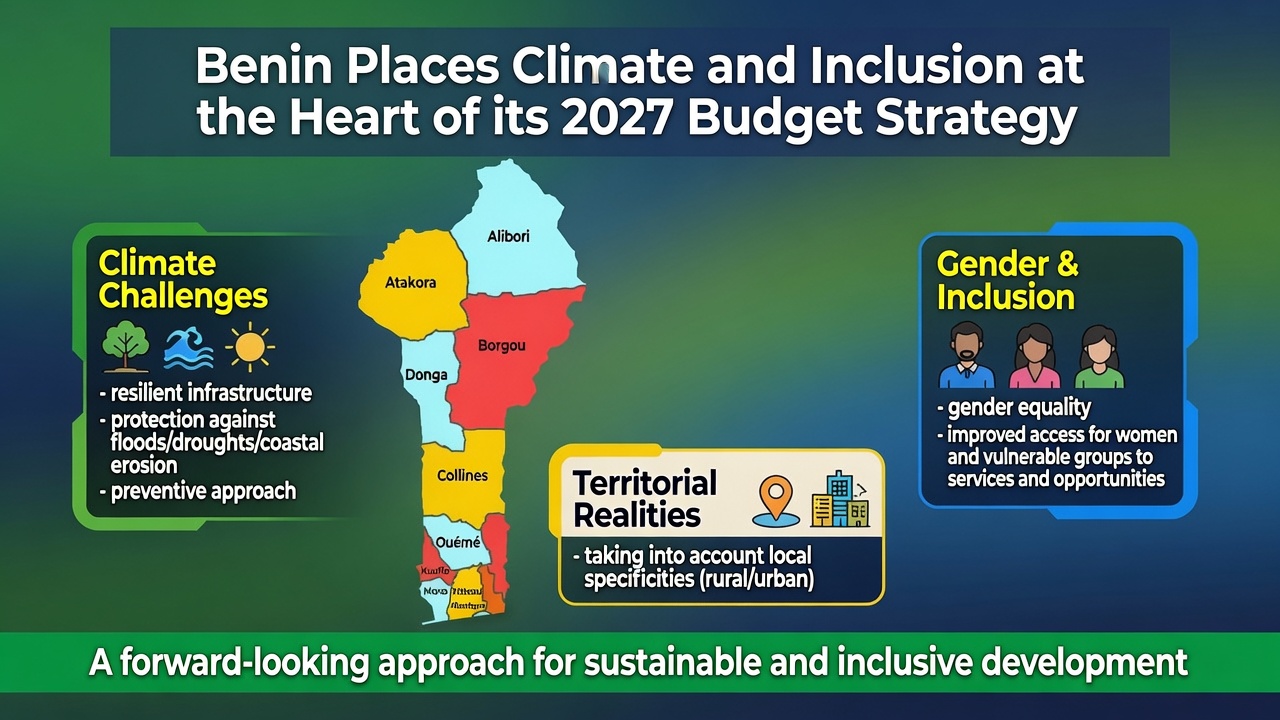
Benin prioritises climate and inclusion in 2027 budget strategy
Benin has embarked on a transformative journey in public policy modernization with its 2027 budget framework. Under the first government of the seven-year term, the administration has made a strategic decision to embed climate resilience, gender equality, and regional disparities at the core of fiscal planning. This commitment reflects a forward-thinking approach that elevates public investment from mere financial management to a catalyst for sustainable development.
The 2027 budget framework arrives at a critical juncture where extreme weather events are intensifying, natural resource pressures are escalating, and persistent social challenges demand urgent solutions. Rather than reacting to crises after they unfold, the new strategy prioritizes proactive risk mitigation, ensuring public policies are designed to prevent rather than merely respond to emergencies.
Climate resilience takes center stage in fiscal planning
One of the most notable innovations in the 2027 budget is the integration of climate considerations into financial decisions. This shift enables the allocation of resources toward resilient infrastructure, enhanced protection for vulnerable populations, and improved national capacity to withstand extreme weather phenomena such as flooding, droughts, and coastal erosion. By adopting a preventive stance, the government not only safeguards communities but also strengthens economic stability by reducing the long-term financial burdens associated with climate-related disasters.
Gender mainstreaming reshapes resource allocation
Another key advancement lies in the explicit incorporation of gender perspectives into budgetary planning. Acknowledging that public policies often yield unequal outcomes for women and men, the government has committed to fostering a more inclusive development model. This entails ensuring equitable access to essential services, economic opportunities, and social protection mechanisms for women, youth, and marginalized groups—thereby fostering a society where no segment is left behind.
Territorial equity drives local relevance
The 2027 budget also marks a significant departure from one-size-fits-all approaches by placing greater emphasis on regional diversity. Urban and rural areas face distinct challenges, and this recognition allows for more precise, locally adapted investments. By aligning national policies with ground-level realities, the government enhances the effectiveness of public spending and strengthens citizen trust in state institutions.
This evolution signals a shift toward a more adaptive and forward-looking administration, one that aligns economic, social, and environmental planning with the demands of the 21st century. The budget is no longer viewed solely as a financial document but as a strategic instrument capable of guiding the nation’s transformation while mitigating vulnerabilities.
By adopting this integrated approach, Benin also enhances its standing with international partners. Global institutions increasingly prioritize climate-aware, socially inclusive, and sustainable fiscal policies. Through this proactive stance, the country positions itself to attract greater financial support for resilience-building initiatives, ecological transition projects, and equitable territorial development.
Ultimately, the 2027 budget framework embodies a clear political vision: to prepare for the future rather than merely endure crises. By embedding climate resilience, gender equity, and territorial specificity into the very design of public policies, the government is laying the groundwork for a sustainable, balanced, and inclusive development model—one that benefits all segments of Beninese society.
