
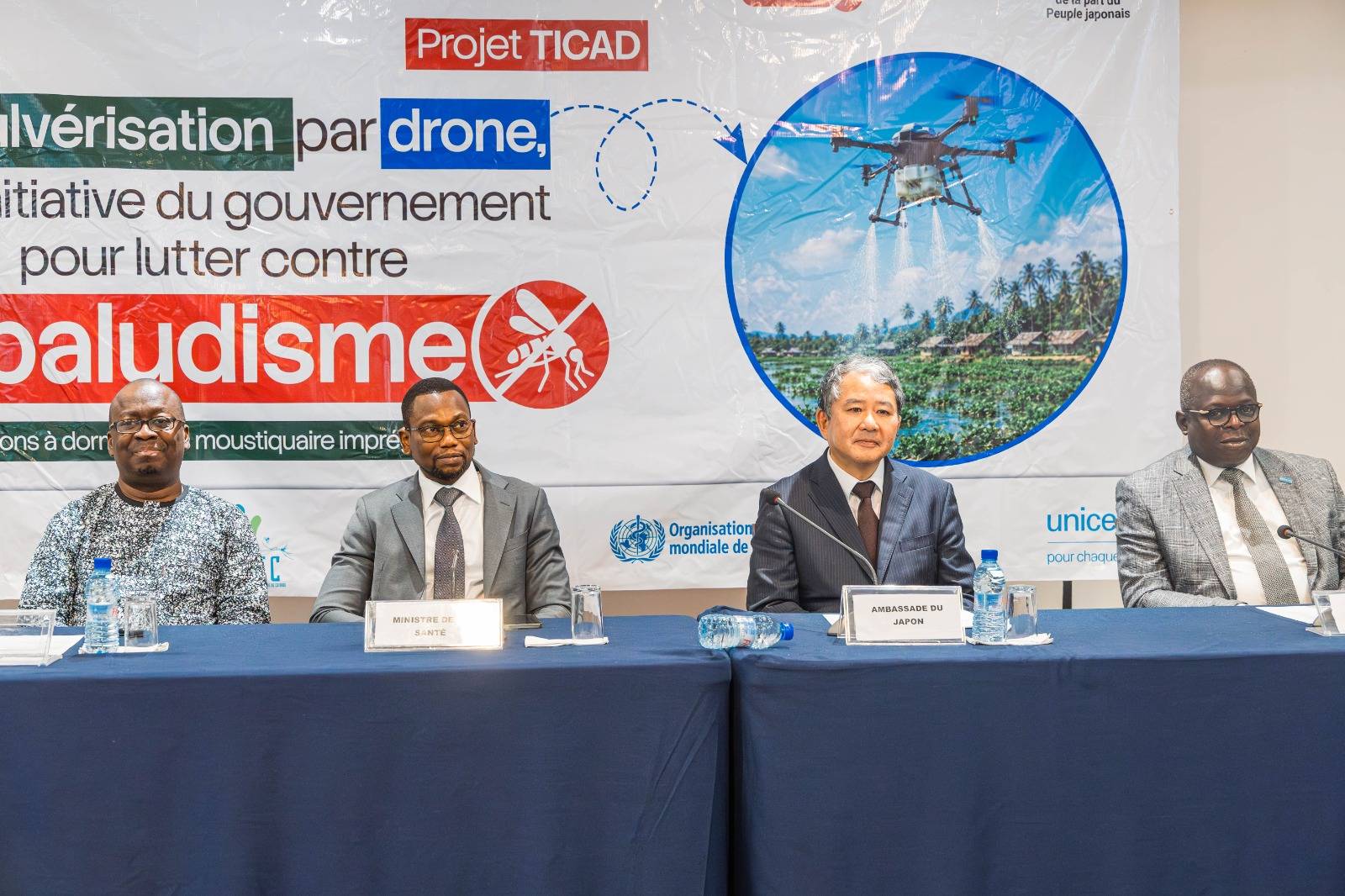
An unprecedented public health offensive is unfolding in Bénin this week, as authorities deploy high-tech drones to stamp out malaria at its source. The initiative, unveiled in Cotonou on June 30, 2026, marks a radical departure from traditional control methods, combining artificial intelligence, geospatial mapping, and precision drone spraying to target mosquito breeding sites before they hatch.
Funded with a $2.3 million grant from Japan and supported by UNICEF, the program focuses on six municipalities—Copargo, Djougou, Tchaourou, Ouidah, Abomey-Calavi, and Cotonou—where malaria remains a persistent scourge. While past efforts relied on bed nets and reactive treatments, this system uses real-time data to predict and eliminate larval hotspots before they become threats.
How the technology works
The initiative’s core is a three-pronged technological framework. First, geospatial mapping and AI analyze terrain, climate, and water patterns to pinpoint high-risk zones with meter-level accuracy. Next, drone squadrons equipped with WHO-approved larvicides execute targeted aerial treatments, reaching remote marshes and dense urban areas alike. The result: a surgical strike against mosquito populations before they can spread disease.
Professor Benjamin Hounkpatin, Benin’s Minister of Health, emphasized the breakthrough: “This isn’t just another prevention campaign—it’s a paradigm shift. By tackling larvae where they thrive, we’re cutting the mosquito population at its root, not just treating the symptoms.”
Local impact: economic and health relief
For communities long battered by malaria, the project offers more than health benefits—it’s an economic lifeline. Small traders, farmers, and artisans, who form the backbone of Bénin’s informal economy, often face ruin during peak transmission seasons. A single outbreak can drain household savings, forcing parents to choose between medical bills and daily survival.
Amavi, a mother of four and fabric vendor in Abomey-Calavi, shared her relief: “Last rainy season, my two youngest were hospitalized twice. The costs wiped out a month’s earnings, and I missed days at the market. If these drones can stop mosquitoes in the marshes behind my home, it’s not just my children’s health that improves—it’s our livelihood.”
The financial strain extends beyond households. Local businesses lose productivity when workers fall ill, and families divert funds from education or savings to cover treatment. By reducing malaria cases in pilot areas, the project aims to restore economic stability, particularly in sectors where social safety nets are weak.
Youth power: the human backbone of the campaign
While drones and AI handle the heavy lifting, the campaign’s success hinges on local youth engagement. Trained as community health sentinels, young volunteers will monitor drone-treated zones, educate neighbors on eliminating standing water, and ensure no new breeding sites emerge. Their role bridges the gap between technology and daily life, turning abstract innovations into tangible protection.
UNICEF underscored this partnership as key to sustainability: “No drone can replace community vigilance. The real victory lies in empowering young people to own this fight, ensuring the gains outlast the project itself.”
A blueprint for West Africa?
The pilot phase in six towns will serve as a test case for scaling up. If successful, the model—public-private collaboration, youth mobilization, and high-precision technology—could become a template for other malaria-stricken nations. For now, the hum of drone propellers over Bénin’s wetlands signals a new era: one where malaria doesn’t just decline, but is systematically dismantled from the ground up.