
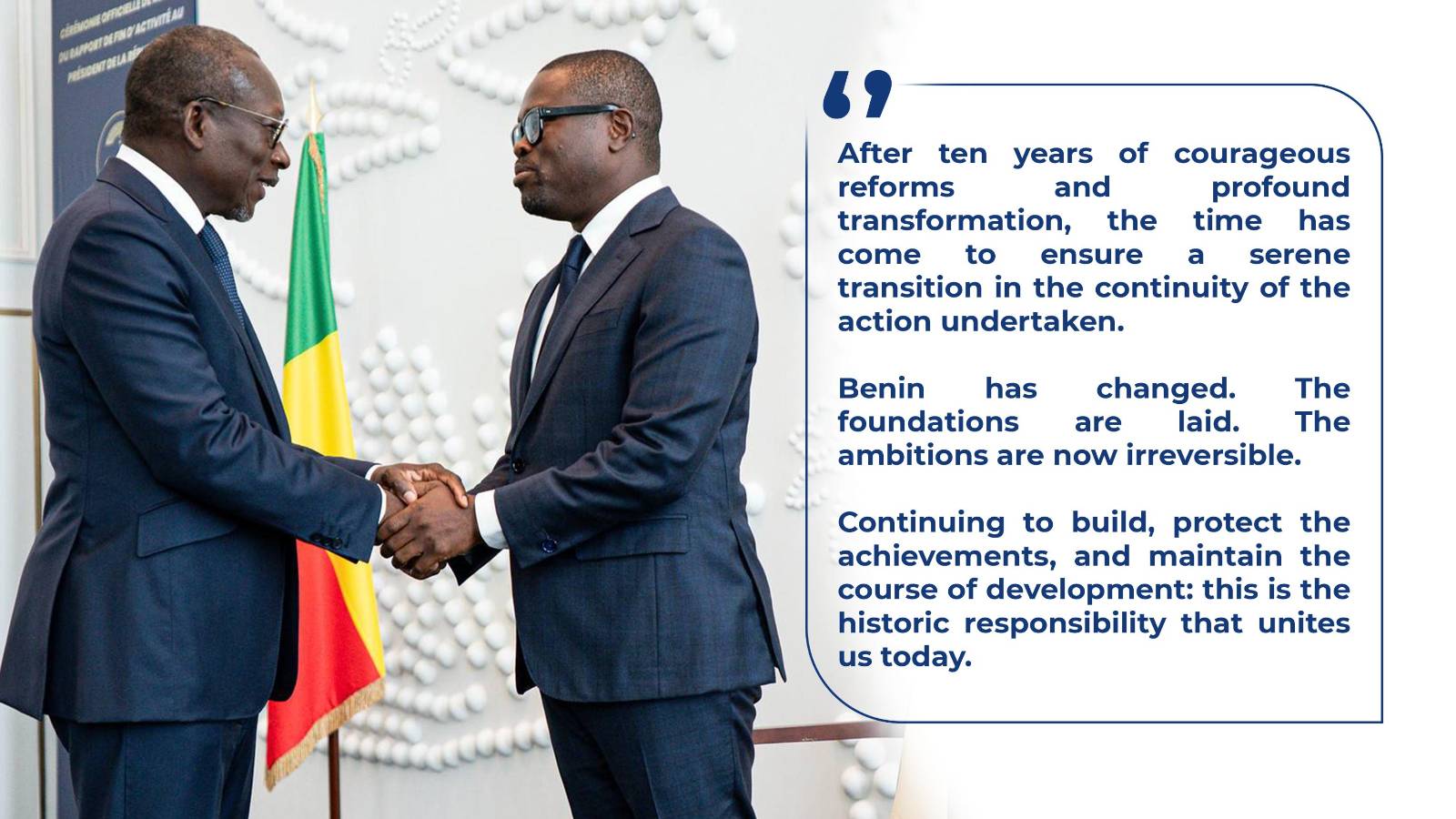
A pivotal chapter in Bénin’s contemporary political narrative draws to a close. Just days before the inauguration of his elected successor, Romuald Wadagni, outgoing President Patrice Talon delivered a solemn address to the nation. This farewell message marks the twilight of a decade of governance under the banner of “Rupture,” a period that profoundly and enduringly reshaped the country’s economic, social, and institutional landscape.
A leader’s reflection: achievements and necessary sacrifices
In a televised address broadcast across official channels, the departing head of state extensively defended a comprehensive record of achievements, initiated upon his ascent to power in 2016. The past decade was characterized by rigorous structural reforms, a drastic overhaul of public finances, and an accelerated modernization of infrastructure.
Patrice Talon, however, chose not to shy away from the more challenging aspects of his tenure:
“The path demanded significant sacrifices from the Béninois people. These choices, at times unpopular, were nonetheless essential to extricate the nation from underdevelopment and solidify its international credibility.”
The outgoing president conveyed his profound gratitude to his compatriots, commending their resilience and patriotism in the face of the intensive transformations and the “shock therapy” implemented over these ten years.
Embracing technocratic continuity for the future
The core of the presidential message then shifted towards the future, embodied by an unprecedented transfer of leadership. By publicly endorsing Romuald Wadagni, his former Minister of Economy and Finance and a key architect of the regime’s macroeconomic policy, Patrice Talon positioned this transition under the auspices of technocratic continuity and institutional stability.
For the departing head of state, his chosen successor’s accession guarantees the longevity of major national recovery projects, while simultaneously ushering in a new era of governance, anticipated to be more focused on consolidation.
Defining hallmarks of the talon decade
- Economy: Robust public finance management and a significant improvement in sovereign financial ratings.
- Infrastructures: Visible urban transformation through the ambitious “asphaltage” program.
- Industrialization: The emergence and dynamic growth of the Glo-Djigbé Industrial Zone (GDIZ).
Critical priorities for the incoming president
The future head of state inherits a nation profoundly transformed, yet the challenges awaiting him remain substantial. While the rigor of the Talon era successfully solidified Bénin’s macroeconomic foundations, Romuald Wadagni must promptly address pressing social demands.
Three critical issues already stand at the forefront of his presidential agenda:
- Social: Boosting purchasing power and ensuring a more equitable distribution of economic growth.
- Political: Calming the domestic political climate and easing tensions with the opposition.
- Security: Containing the persistent terrorist threat and securing the northern borders.
A democratic commitment reaffirmed
By scrupulously adhering to the constitutional limit of two terms, Patrice Talon effectively silences accusations of authoritarianism and unequivocally reinforces Bénin’s tradition of democratic alternation. This sends a powerful signal, starkly contrasting with the political turbulence and opportunistic constitutional revisions witnessed elsewhere in the West African sub-region.
As preparations for the official inauguration ceremony accelerate in Cotonou, the economic capital, Bénin stands ready to definitively close the chapter of “Rupture” and, with pragmatism, open a new page in its contemporary history.