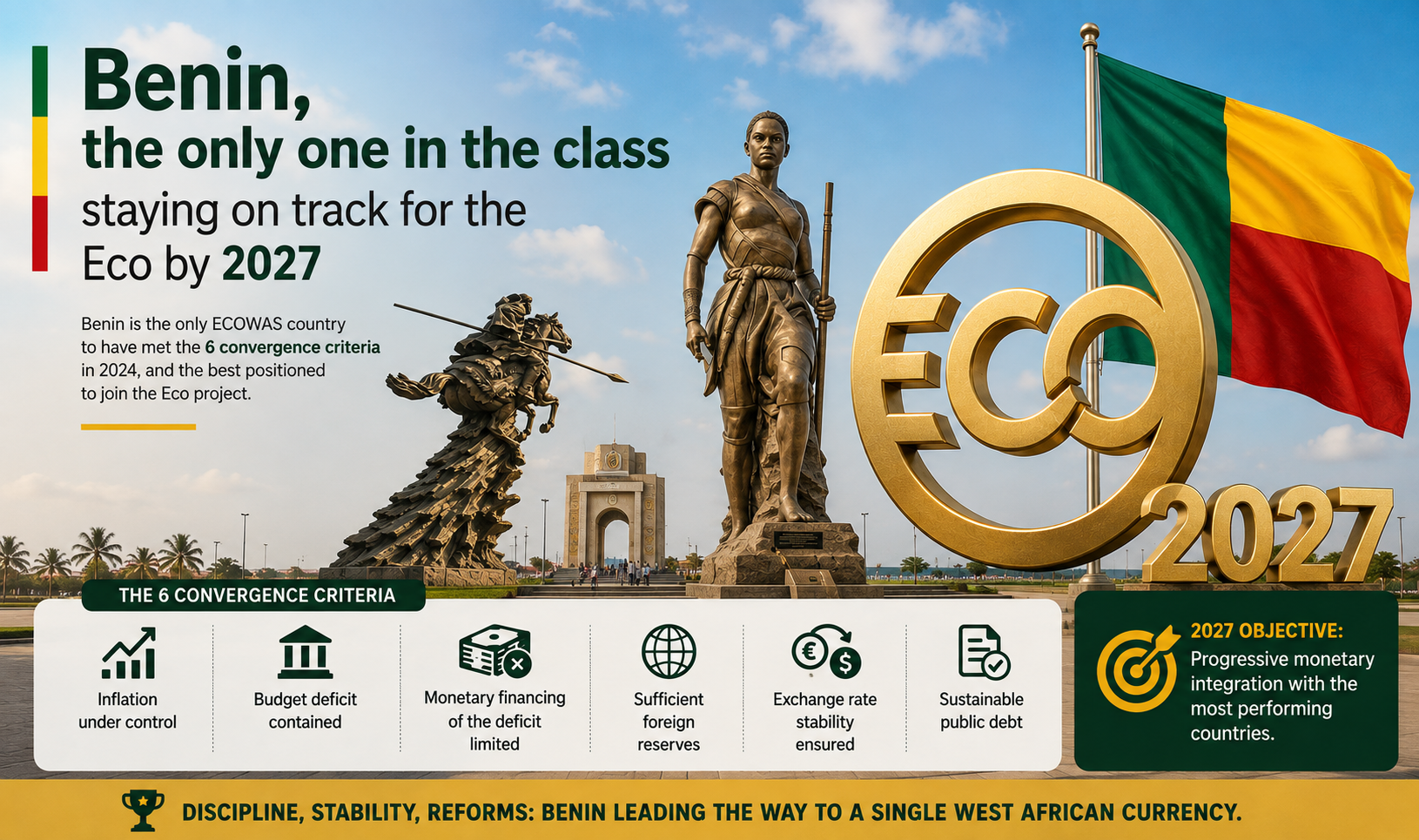
Benin leads eco convergence with strong macroeconomic performance
Bénin stands out in the West African integration race
As the Economic Community of West African States (CEDEAO) advances toward launching the Eco by 2027, economic realities across the region reveal divergent readiness levels among member states. Amid this uneven landscape, Bénin distinguishes itself as one of the most prepared countries to participate in an initial phase of monetary integration.
The concept of a unified West African currency has long been a cornerstone of CEDEAO’s economic integration agenda. However, the path from political ambition to economic reality remains fraught with challenges, including inflation, public deficits, debt levels, foreign reserves, exchange rate stability, and disparities between national economies.
A progressive approach to monetary integration
Given these complexities, the 2027 deadline may lead to a phased implementation, allowing the most advanced economies to adopt the Eco first while others continue working toward convergence criteria.
Bénin’s exceptional macroeconomic compliance
In 2024, Bénin became the sole CEDEAO member to meet all six macroeconomic convergence criteria outlined for the Eco project. This achievement is significant because these criteria assess multiple dimensions of economic stability:
Inflation control to preserve purchasing power and monetary stability;
Containment of the budget deficit within prescribed limits;
Restriction of monetary financing for public deficits;
Adequate foreign reserves to cover several months of imports;
Maintenance of nominal exchange rate stability;
Sustainable public debt levels.
Meeting these criteria simultaneously reflects a coherent and credible macroeconomic policy, demonstrating more than just a one-year success it signals a sustainable trajectory aligned with the demands of a future common currency.
Six pillars of convergence
The convergence criteria form the technical foundation of the Eco project, designed to prevent a shared currency from being undermined by divergent national economic policies.
These indicators ensure that member states maintain fiscal discipline, monetary stability, and sustainable debt levels essential conditions for a functional monetary union. Without such alignment, the risks of economic imbalances and financial instability grow, potentially jeopardizing the entire initiative.
A carefully constructed economic strategy
Bénin’s current performance is the result of years of deliberate economic reforms, including enhanced revenue mobilization, improved public financial management, and sustained investment in infrastructure and public services. Yet, these efforts required strategic trade-offs, particularly in balancing fiscal discipline with necessary development spending.
The true test for Cotonou will be transforming this year’s compliance into a long-term trend. Meeting the criteria once is a positive signal; sustaining it over multiple years would solidify the country’s credibility in the Eco framework.
Uneven readiness across the region
The primary obstacle to the Eco remains the economic heterogeneity among CEDEAO member states. Structural differences, debt levels, fiscal capacities, and external pressures such as security crises, geopolitical tensions, and regional trade disruptions vary widely across the bloc.
Given these disparities, a staggered implementation may prove more viable than an abrupt, simultaneous transition. The goal is no longer to bring all CEDEAO members into the Eco at once but to enable those meeting the criteria to lead the way.
A strategic advantage for Bénin
If this phased approach materializes and Bénin maintains its macroeconomic performance, Cotonou could secure a place among the first group of countries integrating the Eco. Beyond the technical benefits, this position would strengthen Bénin’s economic influence in regional discussions, as monetary integration demands closer coordination of fiscal, financial, and economic policies.
For Bénin, being among the frontrunners could enhance economic attractiveness, financial credibility, and trade integration key advantages in a competitive regional landscape.
Uncertainties cloud the 2027 horizon
However, the launch of the Eco by 2027 remains uncertain. Success depends not only on individual economic performance but also on collective political decisions regarding governance, institutional frameworks, monetary policy, and solidarity mechanisms among member states.
The recent withdrawal of several Sahelian countries from CEDEAO further complicates the regional integration landscape, reshaping the dynamics of what was once a straightforward project. The path to 2027 must now navigate an altered institutional environment.
Consolidating an advantage
Bénin’s current lead stems from its proven ability to meet convergence criteria amid a challenging regional environment. Yet, this advantage is not guaranteed to last.
The priority now is to sustain macroeconomic stability, control debt levels, curb inflation, and continue structural reforms all while maintaining critical investments in development. As 2027 approaches, the challenge will not merely be leading the class but remaining among the frontrunners when the Eco transitions from a political vision to an economic reality.
Should the Eco proceed on a phased timeline, Bénin could emerge in a particularly favorable position: a country that has already cleared most of the technical hurdles required for West African monetary integration.
