
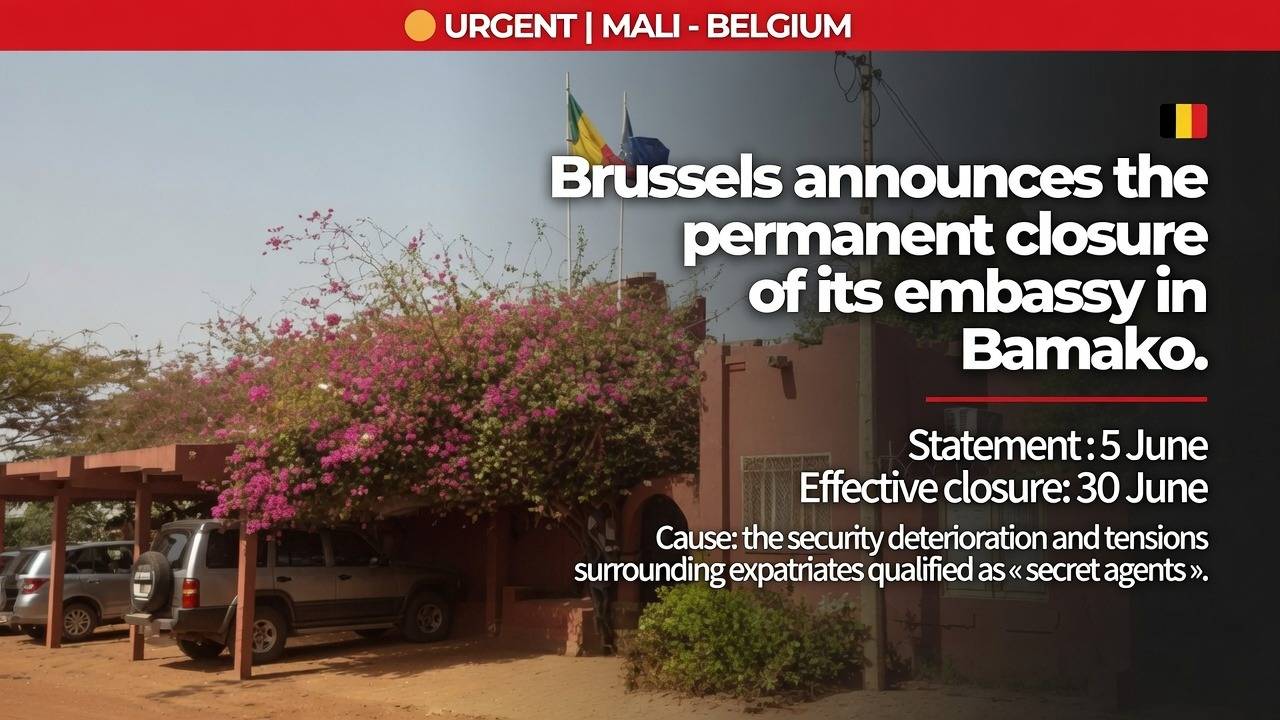
Brussels has taken a decisive step in its relations with Bamako by announcing the permanent closure of its embassy in Mali. The decision, confirmed in an official statement on June 5, will take full effect by June 30, marking a historic turning point in bilateral cooperation. This move follows a steady deterioration of security conditions in the Sahel and a recent surge in arbitrary arrests targeting Western expatriates, frequently accused by Mali’s transitional authorities of acting as foreign intelligence agents. For Mali, already grappling with deepening international isolation, this withdrawal represents yet another setback.
An era of partnership comes to an end
The announcement sent shockwaves through diplomatic circles in Bamako. In its June 5 statement, Belgium’s foreign ministry confirmed that its diplomatic mission would cease operations by June 30, surrendering control of embassy premises. This decision brings to a close decades of cultural, humanitarian, and economic collaboration between the two countries. For Mali, a nation facing growing isolation, the loss of a long-standing European partner is particularly significant.
Belgium has been a key player in Mali’s development landscape, funding critical initiatives in northern and central regions. Yet this withdrawal aligns with a broader trend: the gradual disengagement of Western nations from Mali, pushing the country toward deeper ties with alternative partners such as Russia.
Security concerns drive diplomatic retreat
The primary driver behind Belgium’s decision is the worsening security environment. Since the withdrawal of French forces from Operation Barkhane and the forced exit of the UN’s MINUSMA mission, the security vacuum has expanded rapidly. Terrorist groups have intensified attacks on major roads and urban centers, leaving both civilians and international personnel increasingly exposed.
For Belgium, the safety of its citizens and diplomatic staff could no longer be assured beyond June 30. Authorities concluded that the current political and military climate made it impossible to sustain development assistance missions. Without reliable security guarantees and amid persistent instability, maintaining a full-scale embassy was deemed an unacceptable risk.
A climate of suspicion and targeted expulsions
Beyond the immediate security threat, a second factor accelerated the rupture: the climate of distrust cultivated by Mali’s transitional leadership. In recent months, humanitarians, technical experts, and consultants—many of whom were supporting critical development projects—have faced arbitrary detention.
The state narrative has increasingly framed foreign professionals as potential destabilizers or intelligence operatives. This systematic labeling of civilians as “secret agents” has fostered widespread unease. Prolonged detentions without clear legal justification or adherence to consular standards have made ground operations untenable, convincing Belgian authorities that their staff were no longer secure in Mali.
The human cost of Belgium’s departure
From July onward, the closure will have tangible consequences for ordinary Malians. Belgium’s embassy has administered vital aid programs, including initiatives focused on clean water access, reproductive health, and primary education. The suspension or transfer of these funds to neighboring countries risks leaving vulnerable communities without essential support.
For Malian citizens, securing visas for study, medical treatment, or business within the Schengen Zone will become even more challenging. Applicants will now need to rely on the overburdened embassies of other active European nations or travel to neighboring countries to complete their paperwork.
A path toward deeper isolation
The June 5 announcement and June 30 execution of Belgium’s embassy closure is not an isolated incident but a symptom of a broader rift between Bamako and the European Union. By severing ties with traditional partners and escalating arrests under espionage allegations, Mali’s leadership has chosen confrontation over cooperation.
While this uncompromising stance resonates with certain sovereignist factions domestically, it weakens Mali’s international standing at a time when economic and security challenges demand global collaboration. By cutting ties with Brussels, Mali loses a stabilizing voice within Europe, deepening its isolation when pragmatic partnerships are most needed.