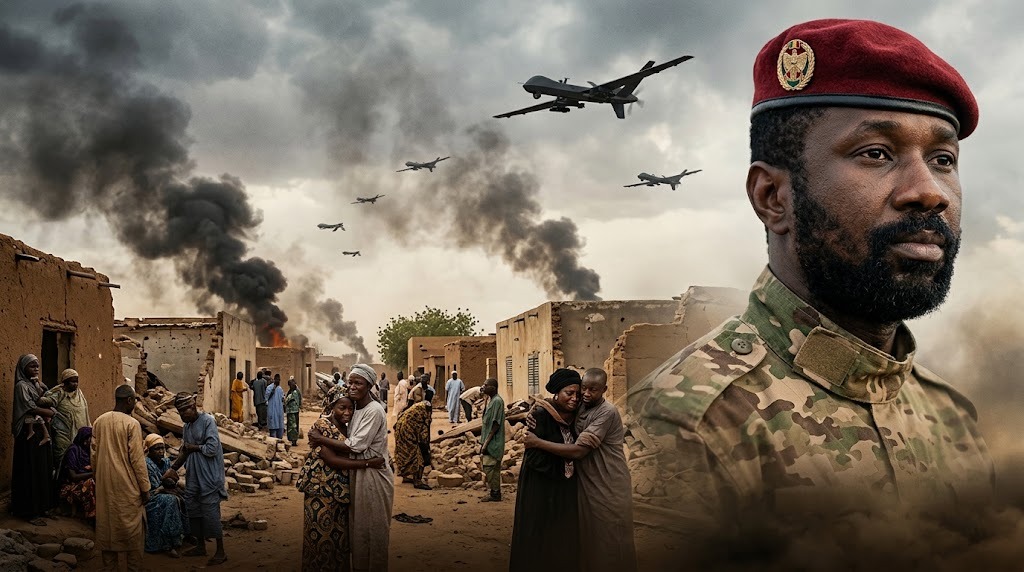
What’s really driving civilian deaths in Mali’s drone war?
The transformation of Mali’s conflict through drone warfare has been as rapid as it has been devastating. What were once marketed as precision weapons capable of surgically targeting militant groups now appear to be causing systemic harm to civilians. Between 2023 and 2026, 731 non-combatants lost their lives across 199 air strikes—figures that go far beyond isolated incidents to reveal a pattern of collateral damage deeply embedded in military operations.
Why the drone war’s true scale is only now coming into focus
The surge in aerial operations over Mali’s northern and central regions has been rapid and heavily backed by foreign technology. Turkish-made Bayraktar TB2 and Akinci drones, along with advanced fighter jets, form the backbone of operations led by Malian forces and their Russian partners in the Africa Corps. On paper, these systems promise enhanced accuracy and reduced risk for friendly forces. In practice, however, the human cost has been catastrophic.
What began as a tactical shift has evolved into a strategic dilemma: the same drones that allow operators to observe targets from afar also expose the limits of modern warfare when civilians are caught in the crosshairs. The growing number of civilian casualties is not merely a byproduct of conflict—it reflects a systemic breakdown in the decision-making chain behind each strike.
What the hidden details of drone strikes reveal about accountability
Independent investigators analyzed nearly 60 documented air strikes, reconstructing 12 operations through satellite imagery, video footage, munitions debris, eyewitness accounts, and geolocation data. In these cases alone, 146 civilians were killed. When cross-referenced with broader datasets, including those from ACLED, the pattern becomes unmistakable: 199 strikes over three years, resulting in at least 731 civilian deaths.
These figures do not assign individual blame or establish legal responsibility for each incident. But they do expose a critical gap: the technology that allows commanders to view targets in real time doesn’t erase the ambiguity of human judgment in the field. In a theater where armed groups move among civilians and terrain is remote, identifying a genuine combatant can be nearly impossible.
One recurring account—echoed by multiple sources—captures the ethical weight of the issue: “They saw the children. They fired anyway.”
Such claims, if verified, would directly contravene core tenets of international humanitarian law, including the principle of distinction and the obligation to take all feasible precautions to protect civilians. They also raise urgent questions about the chain of command—from intelligence gathering and target validation to final authorization and execution.
Who is behind the strikes—and who is responsible when civilians pay the price?
The Malian military isn’t acting alone. The Africa Corps, widely reported to include Russian personnel, plays a key role in air operations. Meanwhile, Turkish-manufactured drones introduce another layer of involvement—suppliers, trainers, and contractors who enable their deployment. This layered command structure makes accountability murky at best.
At each stage of the process—from drone acquisition and flight control to target selection and strike execution—responsibility becomes diluted across multiple actors. Who verifies that a target is indeed a militant? Who confirms the absence of civilians? Who monitors the operation in real time? And most importantly, who answers when a strike goes wrong?
Government statements often frame these operations as surgical strikes against armed groups. But the civilian death toll tells a different story—one in which technological precision is no shield against error, misinformation, or flawed intelligence.
The human face behind the numbers: villages shattered by distant decisions
For communities in northern and central Mali, the sound of a drone in the sky is no longer a distant hum—it’s a signal of dread. Families report losing children, elders, and breadwinners in strikes that hit homes, markets, and gathering places. The emotional and economic toll is irreversible: livelihoods shattered, children orphaned, and entire communities displaced.
The distinction between “civilian” and “combatant” becomes meaningless when a drone’s footage blurs the line between a farmer tending crops and a militant hiding among them. In a region where armed groups operate with near-impunity and access to civilian areas is restricted, gathering accurate intelligence is a constant challenge.
The rise in civilian casualties also coincides with a broader escalation of violence across the Sahel. While militant groups remain active perpetrators of atrocities, the growing use of aerial drones by state forces has introduced a new source of harm—one that operates beyond ground-level scrutiny and often without immediate accountability.
The future of Mali’s air war: precision or recklessness?
As Mali’s armed forces integrate increasingly sophisticated aerial platforms, the question is no longer whether drones can strike with precision—but whether the systems, procedures, and oversight in place can prevent civilian harm. The 731 documented deaths over three years are not an accident. They are the result of a war fought at a distance, where accountability is measured not in meters, but in human lives.
For the families of the victims, the debate over technology and tactics is secondary. What matters is that a button press in a distant command center ended their loved ones’ lives. And in a war defined by drones, the distance between action and consequence has never been greater—or more morally urgent.
