Traditional leaders in Benin face trust and political neutrality demands
Cultural pillars and institutional recognition
In Benin, traditional leaders hold a pivotal role in society, blending cultural stewardship with institutional recognition. They embody the enduring values, traditions, and identity of local communities, serving as pillars of moral and cultural legitimacy. Their influence extends beyond symbolism, as they play active roles in conflict resolution and social cohesion.
To formalize their status, the Beninese government enacted Law No. 2025-09 of April 3, 2025, which establishes a legal framework for traditional chieftaincies. This legislation categorizes and legally recognizes 16 kingdoms and 90 traditional chieftaincies, acknowledging their contributions to socio-economic development, social cohesion, and cultural preservation. The law underscores their importance while setting boundaries for their engagement in public affairs.
Balancing tradition and political neutrality
Despite their respected position, traditional leaders often find themselves at the crossroads of politics. Political parties frequently seek their endorsement, sometimes offering material or financial incentives in exchange. This practice has raised concerns about the integrity of traditional leadership in Benin.
In response, the government has prohibited traditional kings and chiefs from participating in partisan politics, aiming to preserve their neutrality and public trust.
Public perception: trust with growing skepticism
Recent data reveals a nuanced picture of public trust in traditional leaders. Nearly a quarter of citizens reported interacting with them in the past year, and a majority expressed confidence in their ability to influence local governance. Many even advocate for greater involvement of traditional leaders in decision-making processes.
However, this trust is not absolute. Three-quarters of respondents believe that some traditional leaders are involved in corruption, a concern that has intensified since 2022. Confidence in their integrity has also declined compared to 2020.
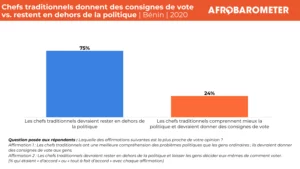
Despite their influence, an overwhelming majority of citizens insist that traditional leaders should refrain from political engagement. They argue that voting decisions should remain a matter of personal choice, free from external pressures.
