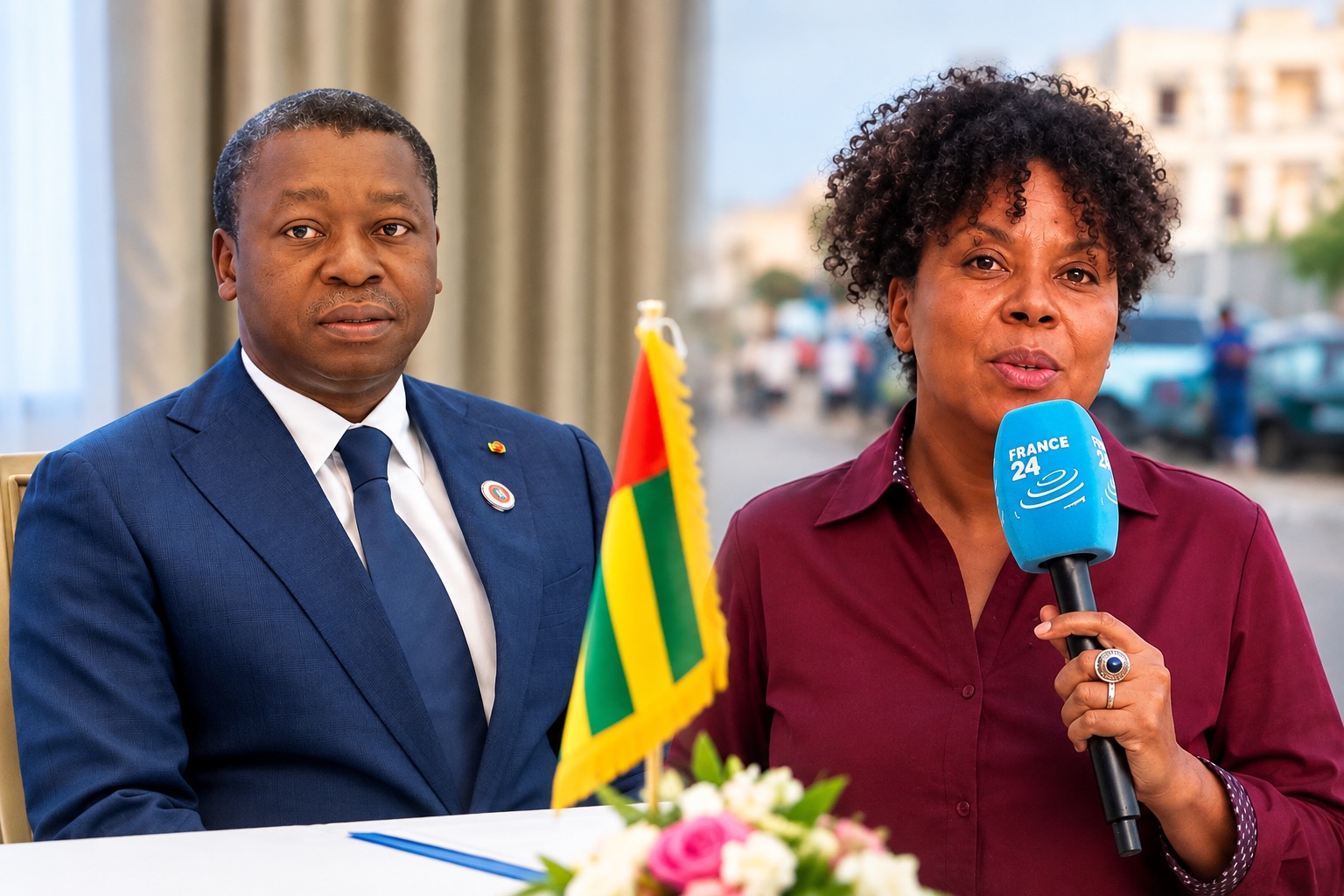
Togo: the fallout from Emmanuelle Sodji’s sidelining and what comes next for the press
When journalism starts colliding with the demands of political power, the consequences reach far beyond a single newsroom. In Togo, the sidelining of correspondent Emmanuelle Sodji has touched off a public argument about what the episode says about press conditions in the country — and about where the line between professional responsibility and political pressure actually sits.
The events that triggered the dispute
On 18 August 2026, Sodji, long-serving correspondent for a major international broadcaster covering Benin and the region, reported on the indictment of two French nationals held in Togo. According to the SNJ-CGT journalists’ union, that information was already public, circulating in several outlets and across social media. The union further contends that Togo’s media regulator itself acknowledged the following day that the details had been in circulation since 18 August.
The two Frenchmen at the centre of the story — filmmakers Gaël Mocaër and Sebastian Perez Pezzani — had been arrested on 27 July 2026 while working on a documentary in the north of the country. Togolese authorities pursued them over matters linked to their visa declarations. They were granted provisional release on 1 September and allowed to leave the territory.The chronology now sits at the heart of the controversy: can a journalist be blamed for reporting information that was already publicly accessible if a restrictive instruction had not yet been clearly communicated to her newsroom?
The SNJ-CGT argues that this is precisely the problem, raising the question of a retroactive sanction. It maintains that Sodji was set aside after relaying the information and denounces a decision liable to undermine journalistic freedom. That reading belongs to the union and must be distinguished from the position of France Médias Monde’s management.A media climate already under strain
The case lands in an environment that was already tense.
In June 2025, Togo’s High Authority for Audiovisual and Communication suspended the programmes of RFI and France 24 for three months, citing repeated failures of impartiality, rigour and fact-checking. Togolese authorities said certain broadcasts had aired information deemed inaccurate or tendentious. The broadcasters defended their journalism, while observers voiced concern about the shrinking media space in an already fraught political context. That backdrop gives the Sodji affair a reach far beyond the fate of one correspondent.Where the real question lies
The central issue is not whether journalists must follow professional rules. Of course they must. The real question concerns the nature of those rules — their clarity, their timing, and the conditions under which they can be used to sanction an information professional.
Drawing the line
In any democracy, authorities have the right to protect sensitive information, particularly when a judicial procedure or a national security question is at stake. But that power must be framed by rules that are understandable, known in advance and applied transparently.
Conversely, journalists have a responsibility to verify their information, respect judicial proceedings and avoid turning sensitive material into speculation. It is precisely this dividing line that now deserves clarification in Togo. When information is already public, when it circulates in multiple outlets and on social media, and when an authority itself acknowledges that it was already in circulation, the question of editorial responsibility becomes necessarily more complex.A wider test for the Togolese government
Under President Faure Gnassingbé, the debate over Togo’s democratic space hardly begins or ends with this single case. In June 2025, protests in Lomé against the government were dispersed by security forces, in a political climate shaped by institutional changes around the presidency of the Council of Ministers.
Against that background, every restriction targeting the media is scrutinised more closely. The stakes therefore exceed the fate of one foreign correspondent. They touch a fundamental question: can journalists investigate, verify and publish freely when a story touches on the interests of those in power or on sensitive matters? The answer should not depend on a media outlet’s political proximity, its country of origin or the personality of the journalist. It should rest on clear professional rules, legal guarantees and one essential principle: a free press is not one that escapes all rules; it is one that can apply those rules without suffering political pressure. That is the ground on which Togo will now be watched.What comes next
How far will pressure on journalists go when they investigate sensitive subjects? And above all, what guarantees is the Togolese government prepared to offer those who do the work of informing the public?
These are questions that Togolese authorities, regulators and media managers will have to answer with facts, rules and transparency.