
Russian military deployment in Lomé raises strategic questions
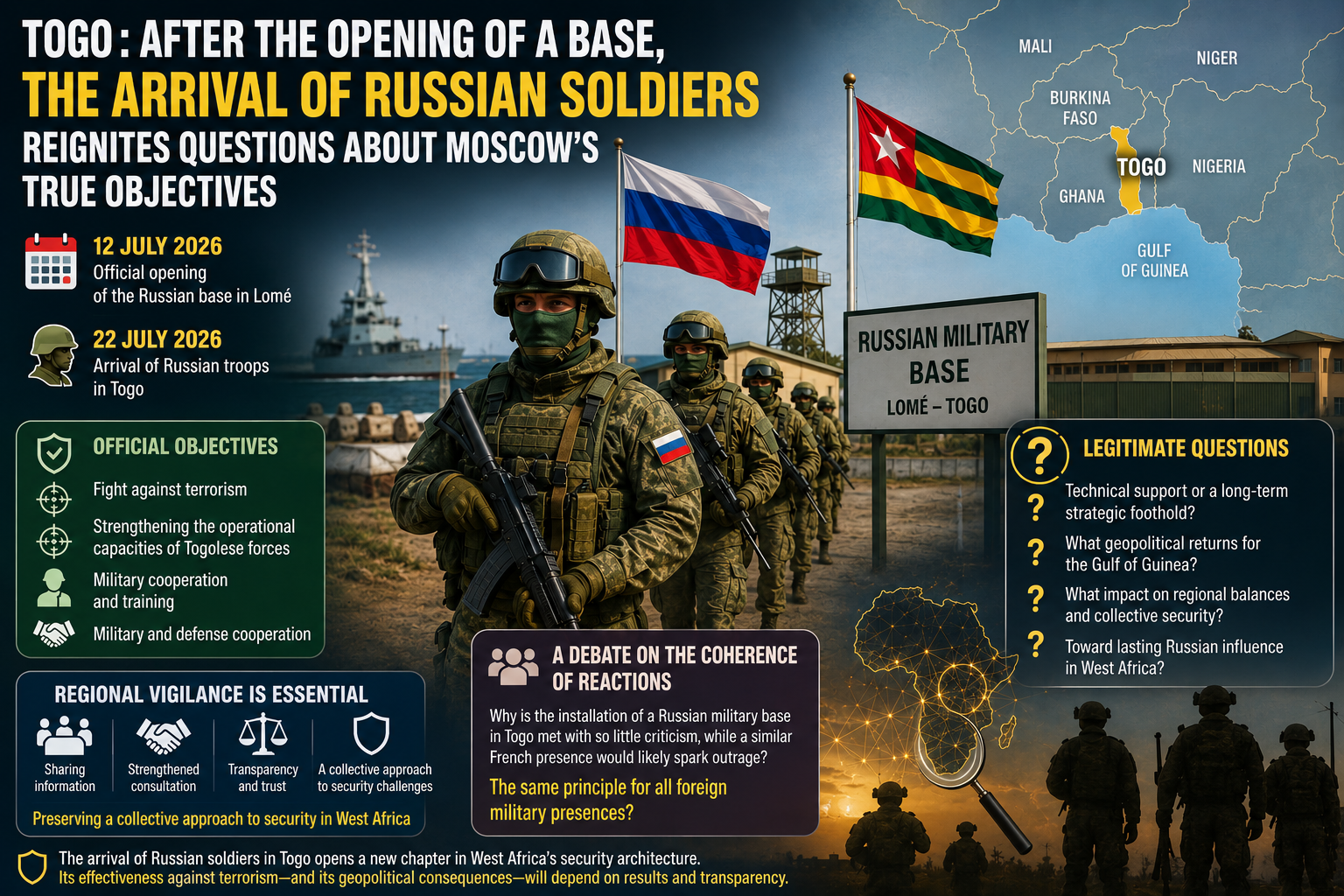
Lomé has welcomed Russian troops following the inauguration of a new military base on July 12, 2026. The soldiers arrived on July 22 as part of an official security cooperation agreement between Togo and Moscow. Their stated mission: supporting counterterrorism efforts and enhancing operational capabilities for local forces.
The move intensifies Russia’s expanding military footprint across Africa, where Moscow has been securing defense agreements, training programs, and equipment deliveries in multiple countries. This pattern of engagement now includes Togo, where the new base represents the latest step in deepening defense partnerships.
Strategic implications for West Africa
The deployment has triggered scrutiny over its potential long-term effects on regional stability. While Lomé exercises sovereign authority in selecting defense partners, the presence of foreign troops in a fragile security environment inevitably reshapes power balances in the Gulf of Guinea.
Analysts point out that Moscow’s military cooperation extends beyond direct combat support. Training, intelligence sharing, logistical support, and defense diplomacy may all expand under this framework—raising questions about whether this is purely a security partnership or part of a broader geopolitical strategy.
Double standards in foreign military presence?
A striking contrast has emerged in public discourse. While some African governments and observers have previously criticized French military bases in West Africa as destabilizing or interfering, reactions to the Russian deployment in Togo have been notably muted. This discrepancy has fueled speculation about whether assessments are based on principle or geopolitical alignment.
Some analysts argue that if foreign military presence is seen as a threat to sovereignty, such concerns should apply consistently—regardless of the partner nation. Others counter that different contexts justify different approaches, but stress the need for clear, transparent criteria rather than selective scrutiny.
Regional vigilance and collective security
Neighboring states are watching closely. While respecting Togo’s sovereign right to choose its defense partners, regional actors emphasize the importance of monitoring how this cooperation evolves and what it means for collective security. In an era where terrorist threats cross borders and external powers vie for influence, maintaining transparency and dialogue is essential to avoid misunderstandings.
Strengthening information-sharing mechanisms and regional coordination could help mitigate risks and ensure that security responses remain aligned with West African priorities. The effectiveness of this Russian-Togolese partnership—both in combating terrorism and in shaping regional power dynamics—will ultimately be measured by tangible outcomes on the ground and the evolution of diplomatic relations in the subregion.