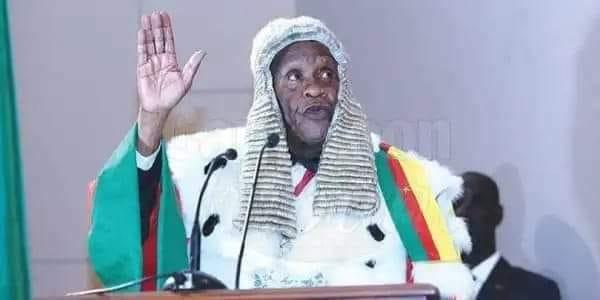
The silent arbitrator: Clément Atangana’s death and the unspoken tensions within Cameroon’s constitutional council
The passing of Clément Atangana, a towering figure in Cameroon’s judiciary, marks not just the end of an era but the unraveling of an institution long perceived as a monolith of political control. His death in Paris at the age of 84, following a prolonged illness, leaves behind a constitutional council that many now question: could its rigid structures have been the architect of its own fragility?
The weight of a single word: how Atangana’s gavel shaped Cameroon’s electoral landscape
Born in Ekoumeyeck in 1941, Atangana rose through the ranks of Cameroon’s judicial system to become the first president of the Constitutional Council in 2018, a role he held until his death. His tenure coincided with two highly contested presidential elections—in 2018 and 2025—where his rulings on electoral disputes became synonymous with the word “irrecevable” (irreceivable), a term that echoed through the corridors of power and dissent alike. The phrase, often repeated in dismissals of opposition challenges, became a symbol of both judicial authority and institutional bias.
The council’s refusal to uphold any opposition petitions during Atangana’s leadership fueled accusations of being a tool of the ruling establishment. Whether justified or not, the perception persisted, embedding a narrative of judicial subservience in the public consciousness. Yet, Atangana’s legacy is more nuanced than a single verdict. His career spanned over five decades, marked by a relentless ascent through Cameroon’s legal hierarchy—from district courts to the Supreme Court—before his appointment to head the constitutional watchdog.
His departure leaves a void at the top of a council tasked with arbitrating electoral disputes, a role now thrust into the spotlight. With no automatic successor in place, the responsibility falls squarely on the president of the Republic to appoint a replacement, a decision that could redefine the council’s future trajectory.
The council’s double-edged sword: legitimacy versus control
Atangana’s era was defined by two pivotal moments: the 2018 and 2025 presidential elections. In each case, the council’s rulings upheld the official results, drawing sharp criticism from opposition figures like Maurice Kamto and Issa Tchiroma Bakary, who alleged electoral fraud. A viral video from October 2025 captured Atangana congratulating supporters, a moment that crystallized the council’s perceived alignment with the status quo. The phrase “your father”, interpreted as a reference to President Paul Biya, further fueled perceptions of institutional alignment.
Yet, the council’s role is not merely symbolic. As the highest electoral authority in Cameroon, its decisions carry legal weight, shaping the political landscape for years to come. The question now is whether the council can evolve beyond its controversial past or if Atangana’s absence will expose deeper fractures within its structure.
A judicial legacy etched in controversy
Atangana’s career was a study in institutional loyalty and judicial grit. Trained at the National School of Administration and Magistracy (ENAM) in Cameroon and the International Institute of Public Administration in Paris, he cut his teeth in judicial roles across the country—from Nkongsamba to Maroua—before ascending to the Supreme Court. His retirement in 2014 marked a ceremonial end to a distinguished career, but his legacy was far from over. Four years later, he was recalled to lead the Constitutional Council, a testament to his unparalleled experience and the government’s confidence in his ability to navigate politically charged waters.
His death, however, raises a critical juncture. Without Atangana’s steady hand, the council faces an uncertain future. Will it continue to act as a bulwark of the regime, or will his departure open the door to reform and greater independence? The answer may hinge on the president’s choice for his successor—a decision that could either reinforce the council’s perceived partisanship or signal a shift toward transparency.
The constitutional council’s role in Cameroon’s electoral framework is more than procedural; it is a cornerstone of the country’s democratic facade. How its next leader interprets that role could redefine the balance of power in a system where the judiciary has long been seen as an extension of the executive.
What lies ahead: a council in transition
The immediate consequence of Atangana’s passing is the vacancy at the helm of the constitutional council, the highest electoral authority in Cameroon. The president’s decree will determine its next leader, but the stakes extend beyond a simple appointment. The council’s credibility is at a crossroads, and the choice of successor will be scrutinized as a litmus test for the institution’s independence.
For opposition figures and civil society, the moment presents an opportunity to challenge the council’s perceived lack of impartiality. For the ruling establishment, it could be a chance to reassert control or, conversely, to introduce a figure who might restore some measure of public trust. Either way, Atangana’s death is not just an ending—it is a catalyst for change, one that could reshape Cameroon’s electoral landscape in ways no single ruling can predict.
