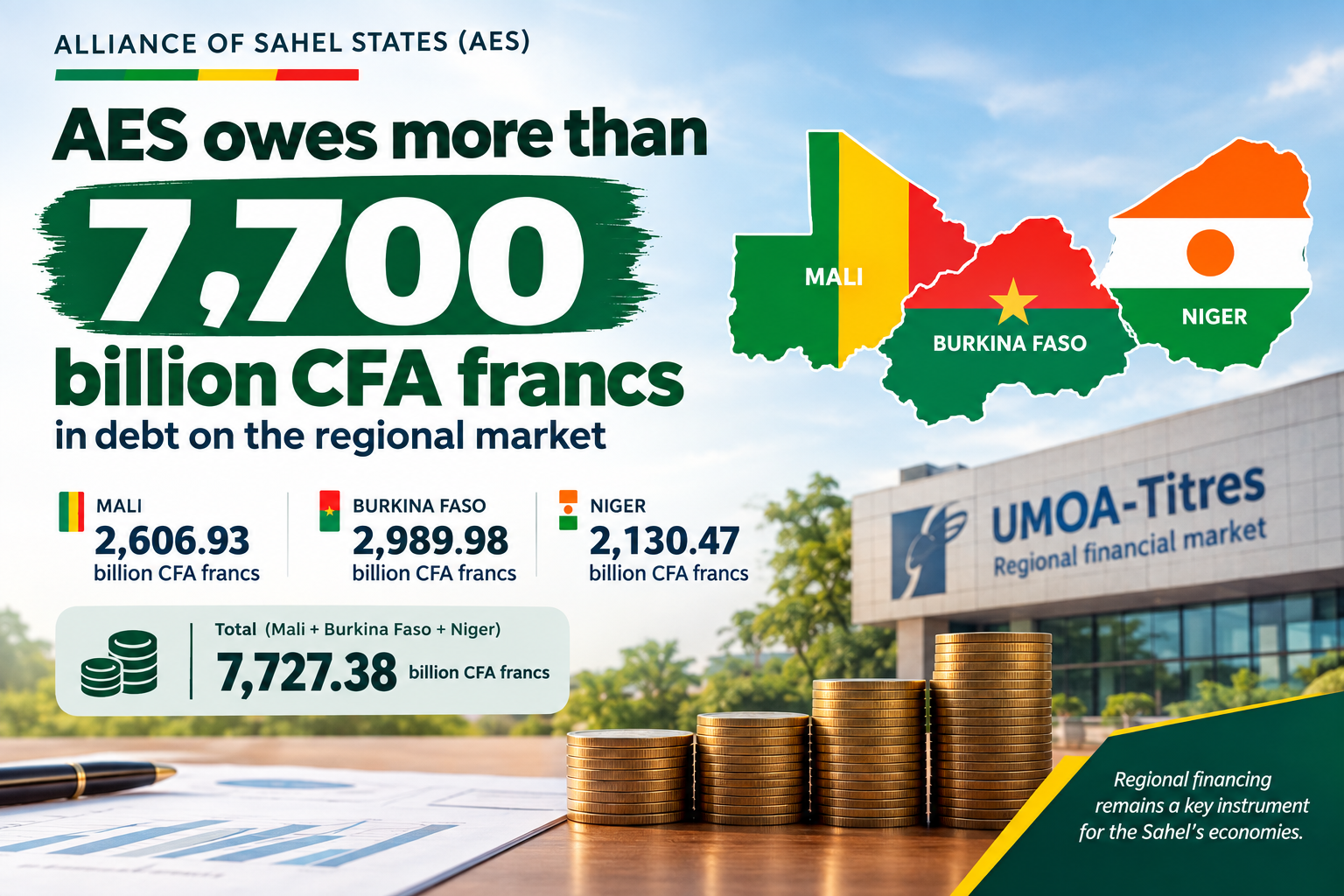
The Alliance of Sahel States owes the regional market more than 7,700 billion CFA francs
Three governments that have staked their political identity on financial autonomy are, in practice, among the busiest borrowers on West Africa’s shared bond market. As of 31 July 2026, Burkina Faso, Mali and Niger, the three members of the Alliance of Sahel States, carried a combined 7,727.38 billion CFA francs in outstanding public securities on the regional market of the West African Monetary Union.
The number sits uncomfortably beside a message repeated at every official podium: sovereignty, a clean break with old dependencies, state spending funded from national resources, and a rejection of mechanisms presented as imposed from abroad. The market’s own figures tell a more complicated story.
What the outstanding stock looks like, country by country
The three Sahel states remain heavy presences on the regional market for public securities. At the end of July 2026, their outstanding stocks stood at:
- Burkina Faso: 2,989.98 billion CFA francs
- Mali: 2,606.93 billion CFA francs
- Niger: 2,130.47 billion CFA francs
Added together, the three positions come to 7,727.38 billion CFA francs.
One precision matters here. These sums are not a debt owed to the monetary union as an institution. They represent securities still circulating on the regional market, bought by investors who subscribed to treasury bills and bonds issued by the three states. That market exists precisely to channel financing toward national budgets.
Burkina Faso: just under 3,000 billion CFA francs
With 2,989.98 billion CFA francs outstanding at the end of July 2026, Burkina Faso accounts for roughly 12.4 percent of the entire stock held by the union’s member states, which stood at 24,073.53 billion CFA francs on the same date.
What sharpens the picture is the direction of travel: the Burkinabe position was still climbing, up 2.46 percent over a single month.
Through the early months of 2026, Ouagadougou kept tapping the regional market while simultaneously paying down older paper. In May alone, the country raised 99.50 billion CFA francs in treasury bonds and repaid 72.04 billion CFA francs. Regional financing has not disappeared along with the sovereignty speeches. It remains a working tool for cash management and for funding the state.
Mali: past 2,600 billion and still rolling over debt
Mali’s outstanding stock reached 2,606.93 billion CFA francs on 31 July 2026, or about 10.8 percent of the regional total.
The pattern is not a one-off. By the end of May 2026, Bamako’s position already stood at 2,637.64 billion CFA francs. During that single month, the Malian treasury raised 93.50 billion CFA francs while repayments reached 110.07 billion CFA francs, meaning the state borrowed and repaid at the same time, in the ordinary rhythm of debt management.
The useful question is therefore not whether Bamako borrows. It is at what pace, at what price, and to pay for what.
Niger: the sharpest jump of the three
Niger closed July 2026 with 2,130.47 billion CFA francs outstanding, close to 8.9 percent of the union’s total.
It is the trajectory that deserves attention. Between April and May 2026, the Nigerien stock moved from 1,732.05 billion to 2,120.45 billion CFA francs, a leap of nearly 388.4 billion in one month. Large financing operations and a restructuring of existing debt explain much of that surge.
In May 2026, Niger raised 567.49 billion CFA francs, including 519.51 billion in treasury bonds and 47.97 billion in bills, while repaying 191.31 billion CFA francs. Days earlier, a broader operation had handled 446.386 billion CFA francs of securities, among them about 59.710 billion in short-term paper bought back to ease immediate pressure on the treasury. Net resources released by that operation were put at roughly 327 billion CFA francs.
Together, close to a third of the regional market
2,989.98 plus 2,606.93 plus 2,130.47 equals 7,727.38 billion CFA francs. In other words, nearly 7,727 billion CFA francs of public securities issued by the three Sahel states are still in circulation on the regional market.
For comparison, all member states of the monetary union together carried 24,073.53 billion CFA francs at that date. The three countries of the alliance alone therefore represented about 32.1 percent of the region’s entire outstanding stock.
The sovereignty narrative meets the bond desk
This is where the real reporting begins.
It would be inaccurate to describe the three states as wholly dependent on the regional market. It would be just as inaccurate to claim they have walked away from it. The figures show the opposite: sustained, heavy use of regional financing.
Nor is the market simply an outside mechanism forced on governments. For years it has been a routine channel for funding national budgets across the West African monetary area.
A political and economic question nonetheless persists: can a policy be presented as fully autonomous when several thousand billion CFA francs are raised from regional investors to cover the needs of the state? Answering it requires looking past the slogans.
Regional investors are quietly trimming their exposure
The paradox has grown sharper since Burkina Faso, Mali and Niger left the wider regional bloc. Politically, the three have pledged to build an independent path. Financially, they continue to use the union’s regional market, which rests heavily on banks and investors from across West Africa.
An analysis published in late 2025 noted that investors in the other member states had reduced their exposure to Sahel sovereign debt, with their holdings falling from 3,174 billion to 2,801 billion CFA francs, a drop of 373 billion between the fourth quarter of 2024 and the third quarter of 2025. Over the same period, cross-holdings of securities among the three Sahel states fell by 622 billion CFA francs, to about 3,160 billion.
That trend is worth watching. When investors grow cautious, borrowing becomes more expensive and harder to arrange.
Why the size of the stock is not the real measure
The headline total alone settles nothing. Judging whether this debt is sustainable means examining:
- interest rates;
- maturity dates;
- the annual volume of repayments;
- the state’s capacity to raise tax revenue;
- economic growth;
- the share of spending absorbed by security needs;
- the ability to refinance loans as they fall due.
That is where the risk lives. A state can carry a large stock comfortably if its revenue is solid and growth is strong. Another can run into serious trouble with a smaller debt if much of it matures at once or if interest rates climb too high.
Gross issuance versus net cash
Niger offers a clear illustration of the mechanism. In May 2026, the country raised 567.49 billion CFA francs and repaid 191.31 billion. A separate operation covered 446.386 billion CFA francs, part of which was used to buy back securities reaching maturity.
The implication is straightforward: a portion of newly raised money is not fresh cash available for projects. It refinances debt that already exists. This is standard practice on bond markets, but it needs to be stated plainly. Raising several hundred billion does not automatically mean those hundreds of billions add in full to the resources available for development.
A closer look at Niger’s May operation
When a government announces an issue of 500 billion CFA francs, several questions should follow. How much of it is genuinely new? How much goes to repay old paper? What is the interest rate? What is the maturity? What will the total bill be for the taxpayer?
In Niger’s case, the May 2026 operation shows why the distinction matters: 446.386 billion CFA francs handled in gross terms, against roughly 327 billion in net resources released. That gap is not an accounting detail. It changes entirely how the political headline should be read.
What the 2026 figures leave open
The debate over the Alliance of Sahel States should not be reduced to a simple contest between sovereignty and dependence. The numbers describe something more layered.
At the end of July 2026, Burkina Faso, Mali and Niger together held 7,727.38 billion CFA francs in outstanding public securities on the regional market. This is not a debt owed to the monetary union as an organisation. It is a debt to the investors who bought the paper these states issued.
The observation stands all the same: three countries demanding greater financial autonomy continue to lean heavily on regional bond financing to cover their needs. The question is no longer whether the alliance borrows. It is how far these states can keep borrowing before the price of that financial sovereignty starts to weigh on the budgets of the years ahead.
