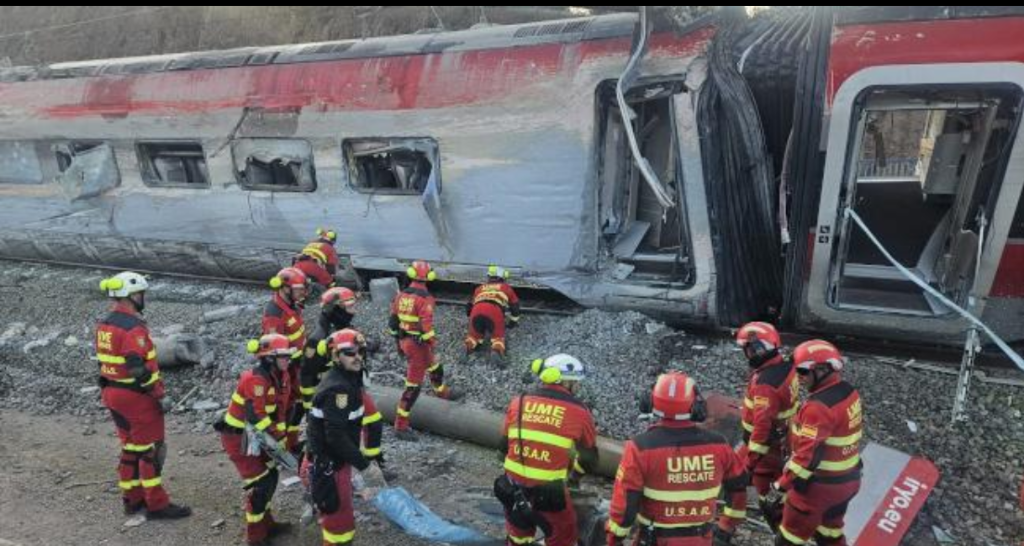
Spain reels as high-speed train collision near Urda leaves 46 dead and 179 injured
Spain is grappling with the aftermath of a devastating high-speed train collision near Urda, in the province of Toledo, where at least 46 people have died and 179 others have been injured. Rescue operations are underway as authorities scramble to determine the exact cause of the tragedy, which has sent shockwaves across the nation.
Urda collision: a high-speed rail disaster with a tragic toll
Two trains operating in close proximity in the Toledo region became the center of a catastrophic accident. The first, a high-speed train operated by Spain’s national rail company Renfe, collided with a stationary Iryo train. The impact derailed multiple carriages, with some wagons forced off the tracks and down an embankment, severely complicating rescue efforts.
The collision occurred on a critical rail link connecting Madrid to Andalusia, a route used by thousands of passengers daily. Emergency services, including firefighters, medical teams, and civil protection personnel, were immediately deployed to the scene. Rescuers worked tirelessly to extract passengers trapped in the damaged carriages, many of whom were in urgent need of medical attention.
Human cost and emergency response
The provisional death toll stands at 46, though authorities caution that this figure may rise as the full scope of the disaster is assessed. Meanwhile, 179 people have suffered injuries of varying severity. Hospitals in the region have been placed on high alert to receive the wounded, while families of passengers await news with mounting anxiety.
Transportation across the affected rail corridor has been suspended, causing widespread disruption for travelers heading to or from Madrid and southern Spain. The suspension adds to the urgency of the situation, as authorities work to restore service while ensuring no further risks to passengers.
Investigating the causes: where did the system fail?
With the human toll still being counted, attention has turned to the circumstances that led to the collision. Early reports point to possible failures in railway signaling, traffic management, or communication between drivers and control centers. Questions have also been raised about the coordination of train movements on this busy route.
The investigation aims to uncover whether a technical malfunction, human error, or a combination of factors contributed to the disaster. Authorities are examining train control records, signaling systems, radio communications, and infrastructure conditions to reconstruct the moments leading up to the impact. The goal is to determine whether preventable safety measures were overlooked.
Key areas under scrutiny
- Signal integrity: Was there a malfunction or miscommunication in the signaling system that allowed the collision to occur?
- Driver instructions: Were the train operators given conflicting or incorrect orders in the moments before the crash?
- Infrastructure condition: Could defects in the tracks or signaling equipment have played a role?
- Traffic management: Was the system overloaded or improperly regulated at the time of the accident?
Safety overhaul likely as Spain faces fresh scrutiny
This tragedy comes amid growing public concern over rail safety in Spain. Recent accidents have already prompted calls for stricter maintenance, upgraded safety equipment, and improved traffic control procedures. While each incident must be evaluated on its own merits, the frequency of such events is raising demands for systemic change.
For authorities, the dual challenge is clear: deliver answers to grieving families and reassure the public that steps will be taken to prevent future tragedies. The findings of the investigation will be pivotal in determining accountability and guiding reforms across the rail network.
Nation holds its breath for clarity and closure
Beyond the statistics, the Urda collision has left a trail of shattered lives, grief-stricken families, and a deeply shaken nation. As the search for answers continues, the focus remains on supporting survivors, comforting the bereaved, and uncovering the truth behind this preventable disaster.
The coming hours and days will be critical. Authorities must provide transparent updates while avoiding premature conclusions. One certainty remains: until the causes are fully understood, the priority is the care of victims and the pursuit of justice for those affected by this tragic event.
