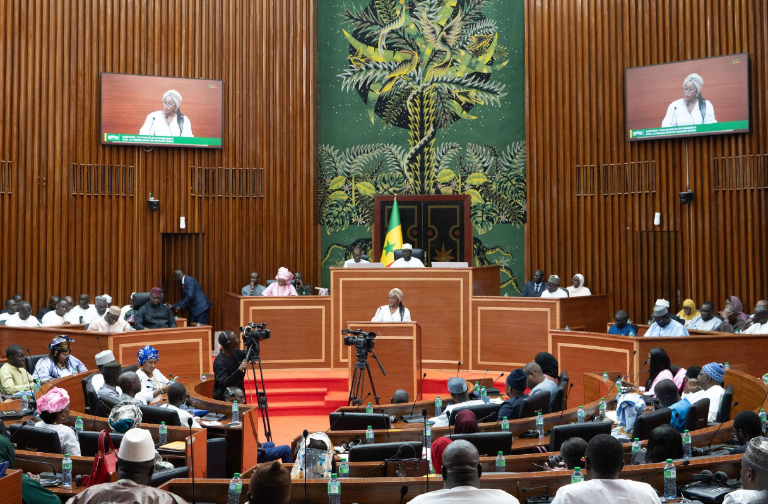
Senegal’s revised budget faces rebellion from ruling party MPs ahead of key vote
The Senegalese government is scrambling to secure support from its own parliamentary majority as the revised budget bill teeters on the brink of rejection. Prime Minister Ahmadou Al Aminou Lô has launched urgent negotiations with Pastef party MPs to salvage the legislation ahead of Tuesday’s critical plenary vote.
Parliamentary rejection triggers political standoff
The revised finance bill suffered a major setback on Friday when Pastef lawmakers — despite being part of the ruling coalition — blocked the proposal in committee. The vote signals deep divisions within the majority, raising fears of a prolonged institutional crisis just days before the national assembly’s scheduled review.
The government now faces a delicate balancing act: defend fiscal adjustments while negotiating with MPs who share its political allegiance but disagree on spending priorities. The rejection in committee was more than a procedural setback—it was a political warning that the executive can no longer take its majority for granted.
Budget disputes expose deeper political fractures
The clash over the revised budget highlights tensions between economic necessity and political loyalty. With the state’s finances under pressure, the government argues that adjustments are unavoidable. Yet Pastef MPs appear unconvinced, suggesting that their objections run deeper than mere fiscal details.
While specifics of the dispute remain unclear, the confrontation reveals a fundamental question: Can a government with a comfortable parliamentary majority still struggle to pass its own budget? The answer may depend on whether the disagreements stem from policy differences or procedural frustrations.
Divided majority, divided priorities
Analysts suggest the dispute may reflect broader disagreements over which sectors should bear the brunt of spending cuts. The government’s insistence on maintaining fiscal discipline clashes with lawmakers’ demands for more investment in social programs, infrastructure, or regional development.
For Prime Minister Lô, the challenge is twofold: justify the budget adjustments convincingly, and find enough common ground to avoid a humiliating defeat in parliament. A rejected bill would not only undermine economic planning but also weaken the government’s credibility at home and abroad.
Last-minute diplomacy to avert crisis
With the October 27 plenary session looming, the Prime Minister has shifted from confrontation to negotiation. High-level talks are underway to identify compromises that could win over skeptical MPs without derailing the government’s core economic agenda.
The urgency is palpable. While the Prime Minister’s team insists that the budget remains negotiable in detail but not in principle, Pastef MPs insist on meaningful concessions. The question now is how far each side is willing to bend to avoid a political rupture.
What’s at stake beyond the budget
If the bill fails, the consequences could extend beyond fiscal policy. A parliamentary defeat would signal a loss of control over the legislative agenda, emboldening opposition groups and complicating future reforms. For the ruling party, it would raise doubts about its ability to govern cohesively.
On the other hand, caving to every parliamentary demand could erode investor confidence and undermine fiscal discipline. The Prime Minister’s ability to navigate this fine line will define not just the fate of a single bill, but the strength of Senegal’s democratic institutions.
The moment of truth arrives
Tuesday’s plenary debate is set to be a high-stakes showdown. The government will defend its revised budget, but it will do so against a backdrop of growing parliamentary defiance. The outcome could either restore faith in coalition unity or confirm the depth of internal divisions.
The coming hours will determine whether Senegal avoids another institutional crisis—or faces weeks of political limbo.
