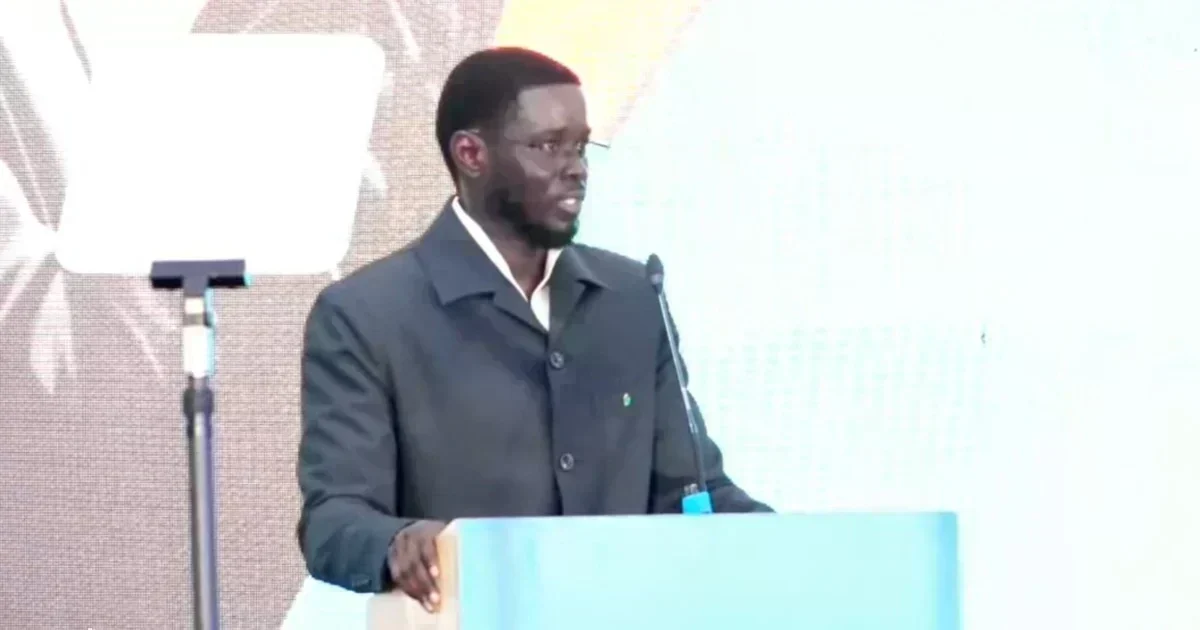
Senegal’s President Bassirou Diomaye Faye subtly challenges Ousmane Sonko
During the inaugural general assembly of his newly formed political party at the King Fahd Palace this past Saturday, President Bassirou Diomaye Faye delivered remarks that resonated deeply across the nation. His address, punctuated with reflections on recent political tensions, carried a weighty message that many interpreted as a veiled critique of opposition leader Ousmane Sonko.
The head of state revisited the tragic loss of lives during years of political unrest, framing his words with solemnity: “Do you see? Their memory demands neither vengeance nor silence. It compels us to ensure that no political disagreement in this country ever costs another life again.” While the tone was one of reconciliation and collective responsibility, it was followed by a sharper statement: “In this nation, those who disrupt the peace will no longer find fulfillment here.”
Political rivalry takes center stage
Though President Faye did not mention any names directly, political analysts and observers swiftly drew parallels with Ousmane Sonko. The latter’s long-standing reputation for confrontational politics has been a defining feature of his public career, making the president’s remarks difficult to ignore in the context of their escalating rivalry.
This subtle yet pointed exchange unfolds against the backdrop of a shifting political landscape in Senegal. The launch of the president’s new party has intensified competition, while notable departures from the ranks of Pastef—the party that once united both leaders—have further strained relations. The tension between them, once allies in the fight for change, is now impossible to overlook.
A call for unity or a strategic warning?
The president’s carefully chosen words serve a dual purpose. On one hand, they reinforce his commitment to peace and stability, a message likely intended to reassure the public amid ongoing political volatility. On the other, they may signal a hardening stance toward those perceived as obstacles to his vision for the country.
The timing of the address, coming just as the new party solidifies its presence, suggests a strategic move to assert authority and define the parameters of acceptable political conduct in Senegal’s evolving democracy.
