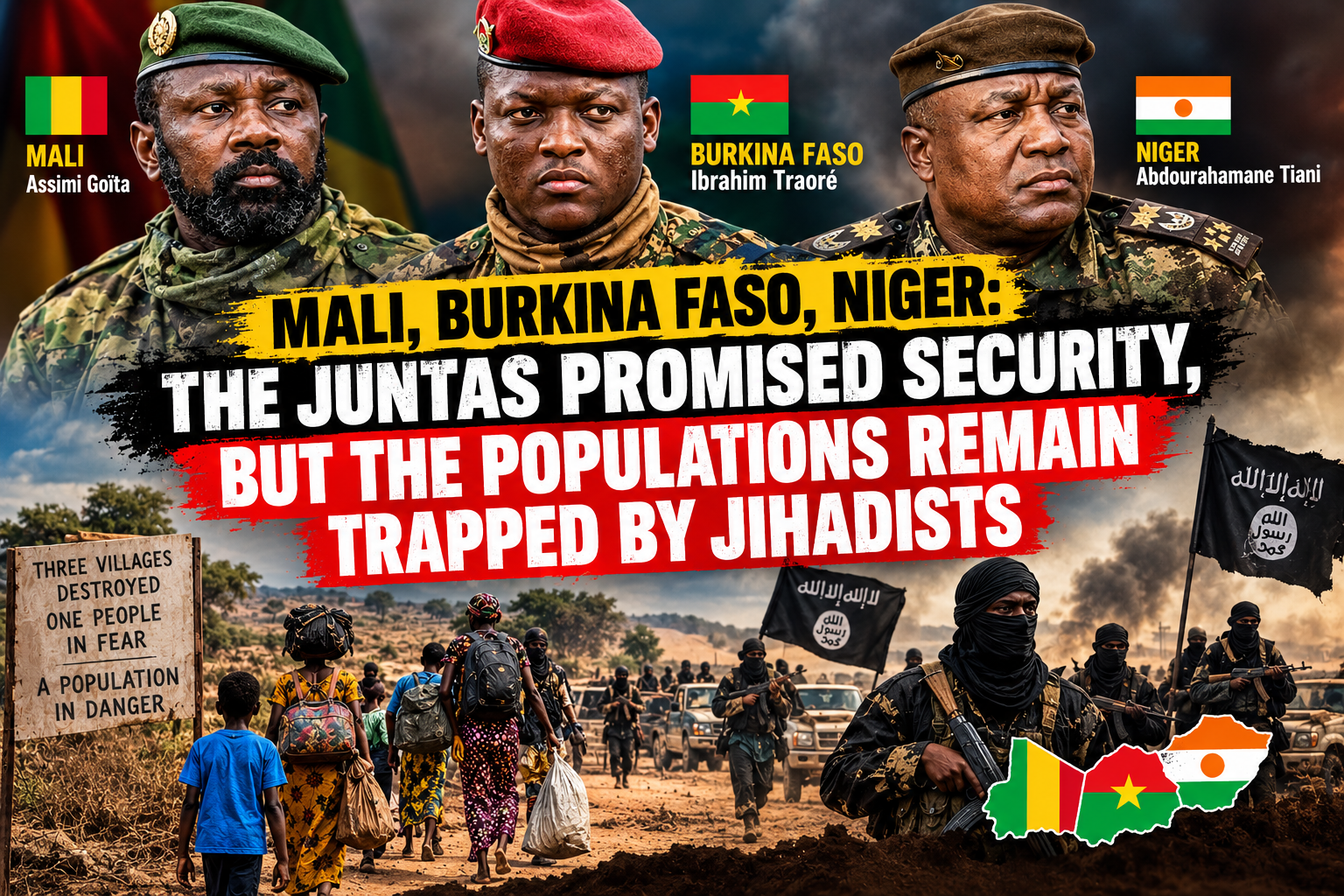
Sahel’s jihadist power struggle leaves civilians caught in deadly crossfire
Unprecedented clashes between rival jihadist factions fuel a humanitarian crisis
The tri-border region of Mali, Burkina Faso, and Niger has become a battleground where the Islamic State in the Sahel and the Group for the Support of Islam and Muslims (JNIM), an Al-Qaida affiliate, wage an escalating war. The past weeks have seen some of the deadliest confrontations in years, with both groups claiming hundreds of casualties in their struggle for dominance over key territories, supply routes, and resources.
For the populations trapped in this conflict, the consequences are devastating. Forced displacements, restricted movement, paralyzed economies, and constant fear have become everyday realities. As the jihadists’ territorial disputes intensify, local communities bear the brunt of a war they neither started nor can control.
Military regimes under scrutiny as security promises falter
The military juntas of Mali, Burkina Faso, and Niger rose to power on the promise of reclaiming national territory and restoring security. They have severed diplomatic ties, restructured military partnerships, and championed strategic autonomy but the ongoing violence in the tri-border zone raises a critical question: How can these governments justify their rule when civilians remain trapped in the crossfire of jihadist factions?
While the juntas emphasize their independence and denounce foreign interference, their ability to protect citizens is increasingly being questioned. Sovereignty, they argue, must be measured not just by political declarations but by tangible results: the freedom of movement, access to essential services, and the safety of local populations. Without these guarantees, even the boldest political maneuvers lose their credibility.
Civilians bear the human cost of jihadist clashes
The fighting between the Islamic State in the Sahel and JNIM is not a sign of weakening jihadist power. Instead, it often leads to brutal reprisals against communities accused of supporting the opposing faction. Displacements surge, and insecurity deepens as armed groups tighten their control over rural areas.
Official casualty figures from the groups must be viewed with caution, as propaganda often distorts the true scale of losses. Independent verification remains essential to assess the real impact of the conflict. But beyond the numbers, the pressing question is: Who protects the villagers when combat reaches their doorsteps? Who ensures access to healthcare, education, and livelihoods when the state’s presence is weak or absent?
Rural communities face collapsing social and economic structures
The impact of the conflict extends far beyond immediate violence. In the most exposed areas, insecurity leads to the withdrawal of state services, the closure of markets, and the abandonment of farmland. Families face an impossible choice: endure perilous conditions or abandon their homes and livelihoods entirely.
The juntas have not abandoned these territories outright, but the persistence of violence demands accountability. Military operations alone are not enough to restore security. The real test of governance lies in whether authorities can protect civilians, reopen essential services, and restore a sense of normalcy to daily life.
Alliance of Sahel States: A strategy under the microscope
The three countries have forged a closer alliance under the banner of the Alliance of Sahel States, positioning it as a cornerstone of their security strategy. This move signals a break from past partnerships and a renewed focus on self-reliance. Yet, its success hinges on delivering concrete results not just diplomatic declarations.
To reclaim sovereignty, these regimes must demonstrate real improvements: fewer attacks, protected villages, reopened roads, and safe returns for displaced populations. Without progress, their claims of strategic autonomy will ring hollow to those living under the shadow of jihadist rule.
The true measure of sovereignty: Securing lives, not just territory
The crisis in the Sahel is not merely a military challenge; it is a humanitarian one. Jihadist groups adapt quickly, exploiting governance gaps and community grievances. A purely military response is insufficient. Sustainable security requires protecting civilians, gathering intelligence, fostering cross-border cooperation, delivering justice, and restoring critical services.
The military regimes of Bamako, Ouagadougou, and Niamey must now prove that their sovereignty translates into real security for citizens. The people’s trust is earned not through rhetoric or alliances, but through the assurance that they can live without fear, work their land, and send their children to school without constant peril.
As long as this assurance remains unfulfilled in the most vulnerable regions, the promise of a safer Sahel will continue to clash with the harsh reality on the ground.
By Yacouba Ouédraogo — Journalist
