Russia’s gold-for-security deals in central Africa: how sovereignty is traded for stability
Russian security firms deepen ties with central Africa through gold-backed deals
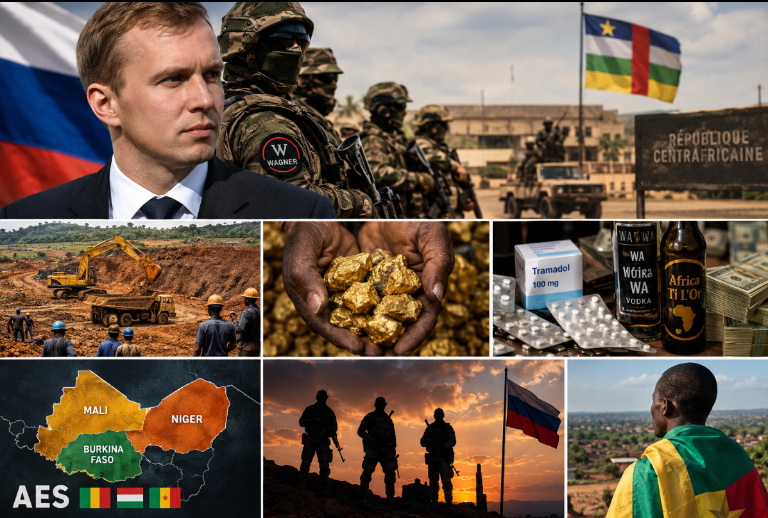
In the Central African Republic (CAR), the private military network linked to Pavel Prigojine—son of the late Wagner founder Yevgeny Prigojine—has allegedly expanded into a $400 million annual business empire. This model, blending security services, gold mining, and alleged illicit trade, raises critical questions about Moscow’s evolving partnerships with Sahel nations.
From mercenaries to miners: a new form of cooperation
The Central African Republic has become a testing ground for a controversial security-and-resources exchange. Wagner-affiliated groups, now reportedly under Pavel Prigojine’s control, provide protection to President Faustin-Archange Touadéra’s regime in exchange for access to lucrative gold deposits. With around 500 fighters still active in the country, the network’s influence now spans mining, logistics, and trade.
The main gold mine linked to this network produces an estimated $250 million worth of gold annually. Yet serious concerns persist over export transparency and whether the CAR government receives its fair share of revenues. This raises a troubling question: when security partners double as economic players, who truly benefits?
When security contracts come with strings attached
The model raises alarm not only for its opacity but for how it blurs the lines between military support and economic control. Wagner’s Central African operations reportedly extend beyond gold mining into alcohol distribution, arms trafficking, and even the illicit tramadol market—an opioid with severe addiction risks.
These activities, if confirmed, suggest a dangerous precedent: a security partner that finances itself through local resources may prioritize profit over public safety. For a government already battling insurgencies, such dependencies could undermine long-term stability and state sovereignty.
The Sahel’s uneasy lesson from Bangui’s experience
The Central African model is now under scrutiny in the Sahel, where Mali, Burkina Faso, and Niger have strengthened ties with Moscow amid jihadist threats and strained relations with Western partners. While none of these nations has replicated CAR’s exact arrangement, the risks of unchecked military partnerships are being closely examined.
In Mali, Russian security contractors have been linked to controversial operations, sparking debates over accountability and civilian casualties. Burkina Faso and Niger, though still in early cooperation phases, face similar dilemmas: how to secure military support without surrendering control over national resources.
Transparency as the only safeguard
The core issue is not whether Sahel nations should engage with Russia—it’s how they do so. Without transparent contracts, independent oversight of mining concessions, and clear revenue-sharing mechanisms, security partnerships risk becoming economic liabilities. Citizens must know whether their country’s gold is funding schools or shadow networks.
Moscow’s evolving strategy: control vs. autonomy
Following Yevgeny Prigojine’s failed 2023 rebellion and death, Russia moved to formalize Wagner’s African operations under the Africa Corps, a Defense Ministry-linked structure. Yet in CAR, the transition may not have dismantled existing economic networks. Pavel Prigojine’s reported continued influence suggests Moscow struggles to rein in autonomous factions tied to resource extraction.
This duality—state-backed military presence alongside private economic interests—creates a precarious balance. For CAR and Sahel nations alike, the danger lies in trading short-term security for long-term dependence.
Can sovereignty survive a gold-fueled security deal?
The fundamental dilemma is stark: when a nation’s safety depends on a partner that also controls its gold trade, who ultimately governs? The CAR case shows how security alliances can quietly evolve into resource monopolies, with profits flowing to unaccountable networks rather than the public.
For Sahel nations, the answer lies in enforceable contracts, third-party audits of mining revenues, and mechanisms to ensure military operations serve the people—not parallel economies. The alternative is a future where sovereign decisions are held hostage to financial and strategic interests disguised as protection.
