Niger’s security crisis: rising toll of terror as military struggles to deliver
Deadly coordinated assaults expose gaps in Niger’s security strategy
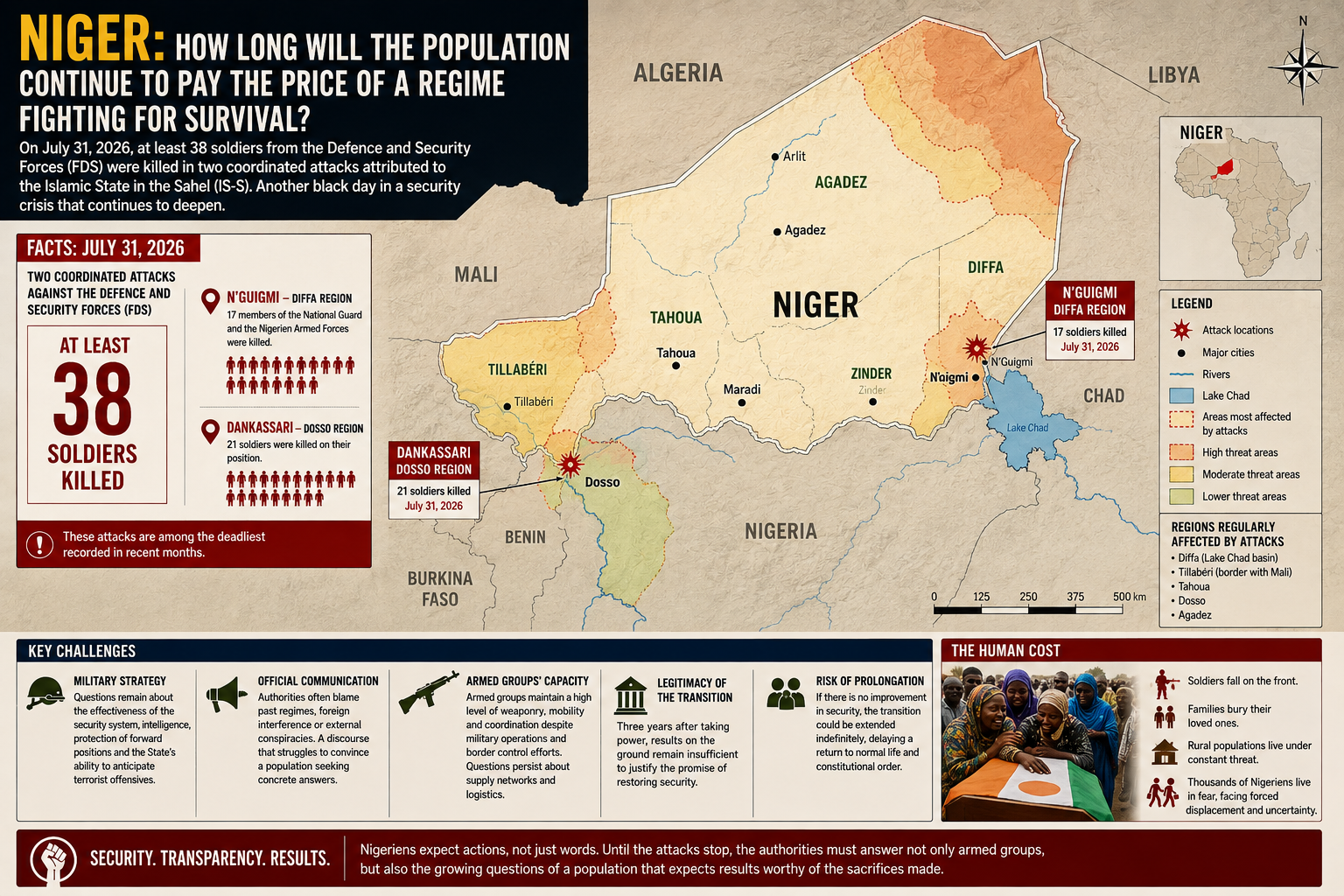
July 31, 2026, has been etched into Niger’s recent history as a day of profound loss. In two separate but meticulously planned assaults, at least 38 members of the Forces de défense et de sécurité (FDS) were killed, with both attacks attributed to the Islamic State in the Sahel (EI-S).
The first strike struck N’Guigmi, a town in the Diffa region, where 17 soldiers from the National Guard and Nigerien Armed Forces perished. Hours later, another violent raid unfolded in Dankassari, located in the Dosso region, claiming the lives of 21 more military personnel.
These devastating incidents rank among the deadliest in recent months, underscoring a grim reality: terrorism continues to expand its reach while the human cost mounts unabated.
From promises to peril: the shifting narrative of Niger’s military transition
When General Abdourahamane Tiani assumed control, the overriding justification for suspending constitutional order was an urgent need to reverse the country’s spiraling security crisis. The military leadership pledged to restore stability, reclaim lost territories, and safeguard civilian populations from relentless jihadist violence.
Three years into this transition, however, the outcomes tell a far more troubling story. Attacks persist across critical zones, from the Lake Chad basin to the Tillabéri, Tahoua, and Dosso regions. Armed groups continue to demonstrate alarming operational capacity, executing coordinated strikes against military outposts despite repeated announcements of force restructuring.
This recurring pattern raises a critical question: Are the stated objectives of the transitional authorities being realized on the ground?
Military setbacks expose systemic vulnerabilities
Each attack leaves behind more than just casualties—it exposes glaring deficiencies in intelligence gathering, perimeter defense, and the state’s ability to preempt terrorist offensives. As the frequency of assaults intensifies, public skepticism toward the current strategy grows.
Is the allocation of resources skewed toward political consolidation at the expense of urgent military imperatives? A transition that derives its legitimacy from security guarantees cannot indefinitely evade scrutiny of its battlefield performance.
Official rhetoric struggles to mask persistent insecurity
Following each attack, government statements often pivot to historical grievances, foreign interference, or external geopolitical pressures. While such factors may contribute to a complex regional landscape, they do little to address the immediate concerns of grieving families or local communities.
The bereaved demand concrete explanations: operational failures, corrective measures, and tangible steps to prevent future tragedies. As attacks multiply, the credibility of official narratives risks eroding without visible improvements in security outcomes.
Armed groups adapt while state responses lag
One of the most alarming developments is the sustained operational tempo of jihadist factions. Despite repeated military operations and border control initiatives, these groups retain advanced weaponry, high mobility, and sophisticated coordination. The persistence of large-scale attacks fuels growing public doubt about the effectiveness of counterterrorism efforts, particularly in dismantling arms supply chains and terrorist logistics networks.
The lack of transparent public information only fuels speculation, deepening the rift between citizens and state institutions.
A transition tested by failure to deliver security
The military’s legitimacy hinges almost entirely on its pledge to restore safety. Yet, as the crisis drags on, that promise increasingly rings hollow. Each new attack pushes the prospect of normalcy further out of reach, destabilizes local communities, and prolongs the uncertainty surrounding a return to constitutional governance.
Public discourse now increasingly questions whether the absence of security gains may inadvertently extend the transition period. This debate can only be resolved through greater transparency, measurable progress on the ground, and a credible roadmap toward resolving the crisis.
The human toll of an unending conflict
The most poignant cost of this crisis is borne by the people of Niger. It is measured in the lives of fallen soldiers, the grief of families burying their loved ones, and the daily ordeal of rural populations living under the shadow of armed groups. Thousands of Nigeriens continue to navigate lives dictated by fear, forced displacement, and uncertainty.
The restoration of security was the cornerstone of the military transition. Today, it remains its most urgent test. Until the cycle of violence is broken, authorities will face not only the challenge of defeating armed groups but also the growing skepticism of a population demanding results commensurate with their sacrifices.
