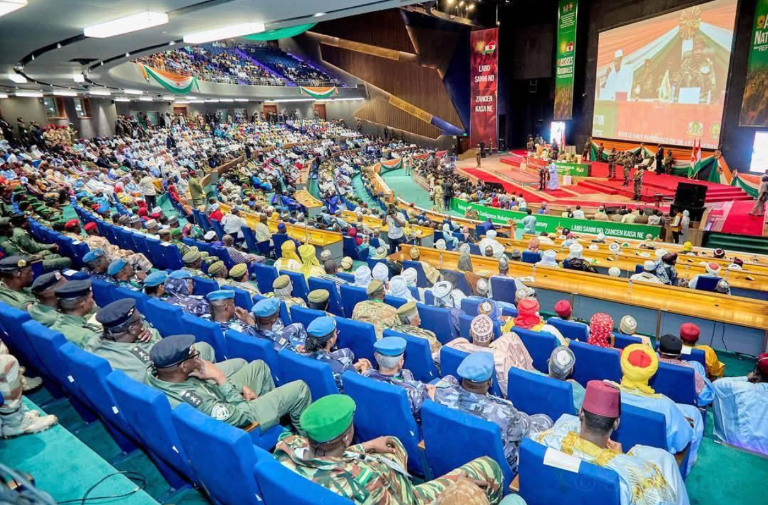
Niger’s refoundation charter faces legal test over Algeria troop deployment
Is public consent required before foreign troops enter Niger?
Niger’s refoundation charter establishes strict rules for allowing foreign military presence on its soil. As Algeria prepares to deploy troops, the government in Niamey must clarify whether it followed the constitutional process—or invoked emergency powers without full justification.
What does the charter require?
The Refoundation Charter, enacted in March 2025, outlines the conditions under which foreign forces can operate in Niger. According to the charter, such presence requires either:
- A referendum to seek the people’s consent for permanent or temporary troop deployments
- An emergency decree issued by the president, but only after consulting the Refoundation Advisory Council—and solely for urgent stabilization needs
Article 45 of the charter makes public consultation central to the process. Without clear evidence of a referendum or a valid emergency decree, the legality of the Algerian deployment remains in question.
Has the Nigerien people been given a voice?
As of now, no official announcement confirms whether a referendum was held regarding the deployment of Algerian troops. There is also no public record of a presidential decree invoking emergency powers, despite the charter’s requirement for an advisory council review.
This silence raises concerns. While cooperation with Algeria may address pressing security threats—such as border instability and cross-border militant activity—the charter’s procedural safeguards exist to prevent unilateral decisions from undermining democratic legitimacy.
Why the charter’s rules matter now
Since the July 2023 military takeover led by General Abdourahamane Tiani, Niger has been in a period of institutional refoundation. The charter now functions as a quasi-constitutional document, giving its provisions binding authority.
A military agreement with Algeria must therefore comply with these rules to be considered lawful. Skirting the referendum requirement without clear justification risks eroding trust in the government’s commitment to constitutional governance—even if the move aims to enhance national security.
Potential consequences of an unchecked deployment
Beyond legal compliance, an unvetted military presence could trigger several long-term issues:
- Over-reliance on foreign forces: Could weaken Niger’s long-term ability to defend its own territory
- Misaligned priorities: May prioritize foreign interests—such as protecting energy infrastructure—over domestic security needs
- Mission creep: Risk of operations expanding beyond their original scope, especially in volatile border regions like Madama
- Erosion of public trust: Lack of transparency could fuel skepticism about the real motives behind the deal
The deployment site near Madama, close to the Libyan border, underscores the strategic sensitivity. But strategic value alone does not override the constitutional requirement for public consent.
What the government must do next
Niamey must publicly disclose:
- The legal basis for authorizing Algerian troops—referendum or emergency decree?
- The exact mission parameters and duration
- The mechanisms for monitoring and reviewing the deployment
- Any agreements made regarding troop movements or operational control
Civil society leaders, political figures, and advisory bodies should be given the opportunity to review and question the decision. Transparency is not optional—it is a cornerstone of the charter’s democratic vision.
Sovereignty is more than military choice
Niger has the right to seek international allies, especially amid rising insecurity in the Sahel. But sovereignty is not just about selecting partners—it is about upholding the rules that define the nation’s democratic foundations.
If the charter’s provisions on foreign troop presence are ignored, the message sent is troubling: that security needs can justify bypassing the very system meant to protect the people’s voice.
The time for ambiguity is over. Niger’s leadership must either prove compliance with the charter—or explain why it chose to disregard it.
The credibility of the refoundation process—and the trust of the Nigerien people—hangs in the balance.
General Abdourahamane Tiani leads Niger during its period of institutional refoundation, a phase in which the charter holds heightened legal significance.
