Niger’s Mohamid community faces sweeping state exclusion measures: what’s behind the crackdown?
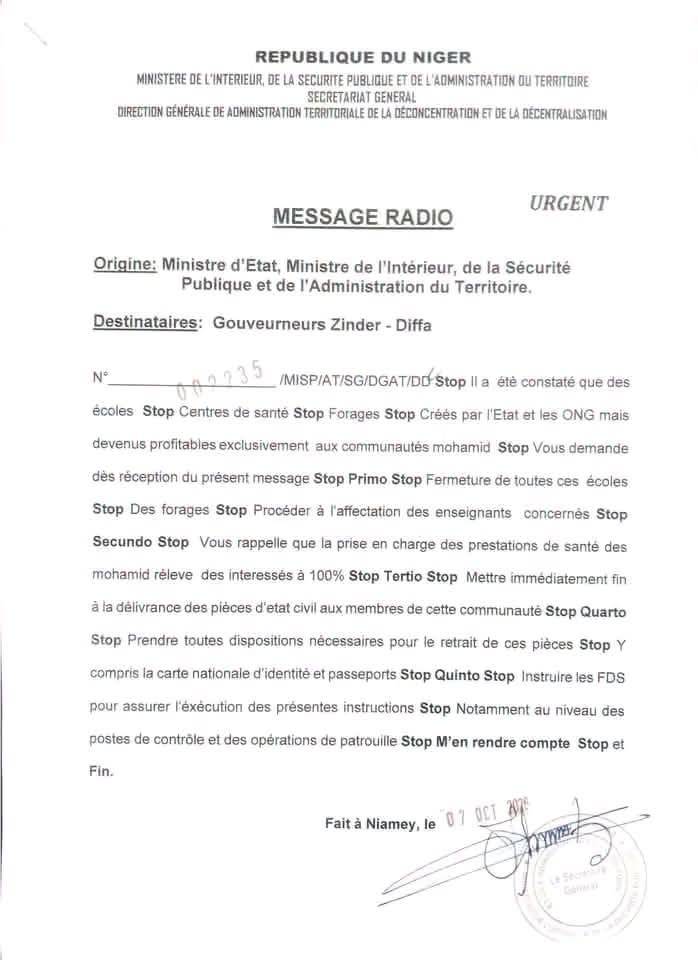
The Nigerien government has implemented sweeping exclusion measures targeting the Mohamid community, raising serious concerns about fundamental rights violations. A radio directive from the Ministry of Interior, dated October 7, 2026, has reportedly led to the closure of schools, restricted water access, suspended healthcare support, and halted the issuance of civil documents for this ethnic group.
What the directive entails
The Ministry of Interior’s instructions, addressed to governors in Zinder and Diffa, mandated the immediate closure of schools and water wells exclusively serving the Mohamid community. Teachers assigned to these schools were reassigned, and collective healthcare funding for the group was terminated. Additionally, authorities ordered the suspension of civil document issuance, including national identity cards and passports, with plans to revoke previously issued documents. Security forces were directed to enforce these measures.
Educational and healthcare disruptions
The closure of schools disrupts children’s education and risks long-term academic setbacks. In a region where water scarcity is already a critical issue, restricting access to wells threatens both households and livestock. The withdrawal of healthcare support disproportionately affects low-income families, potentially leaving them without essential medical services.
Civil documentation crisis
Identity documents such as birth certificates, national IDs, and passports are vital for legal recognition and daily life. Revoking these documents without individual due process raises serious concerns about legal vulnerability and potential statelessness. The directive’s broad application to an entire community contradicts the principle that administrative measures must be proportionate and legally justified.
Security vs. collective punishment
Niger faces persistent security threats, particularly in the eastern region of Diffa, where armed violence and trafficking persist. However, combating insecurity cannot justify punishing an entire community for the alleged actions of a few. Criminal responsibility is individual, and ethnic or social affiliation cannot substitute for legal evidence. Authorities must clarify the legal basis for these measures and provide accessible avenues for appeal.
Widening restrictions under military rule
Since the July 2023 coup that ousted President Mohamed Bazoum, General Abdourahamane Tiani has led Niger under military rule. Reports indicate a tightening of political freedoms, including the dissolution of political parties, restrictions on civil society organizations, and arbitrary detentions. These developments raise questions about the government’s commitment to upholding constitutional rights and due process.
Economic and social ripple effects
The Mohamid community contributes significantly to local commerce, transportation, and livestock sectors. Measures targeting this group could disrupt regional economic activities, affecting not only the community but also neighboring populations dependent on these trades. Authorities must weigh the broader consequences of exclusionary policies on livelihoods and social cohesion.
Call for accountability and reversal
The government must reassess these measures to ensure continued access to education, water, and healthcare for the Mohamid community. Suspension of collective document revocations is critical unless backed by individualized legal procedures. An independent investigation into the directive’s implementation could help establish accountability and mitigate human rights violations. Fundamental rights cannot be sacrificed in the name of security, and equality before the law must remain a cornerstone of governance.
