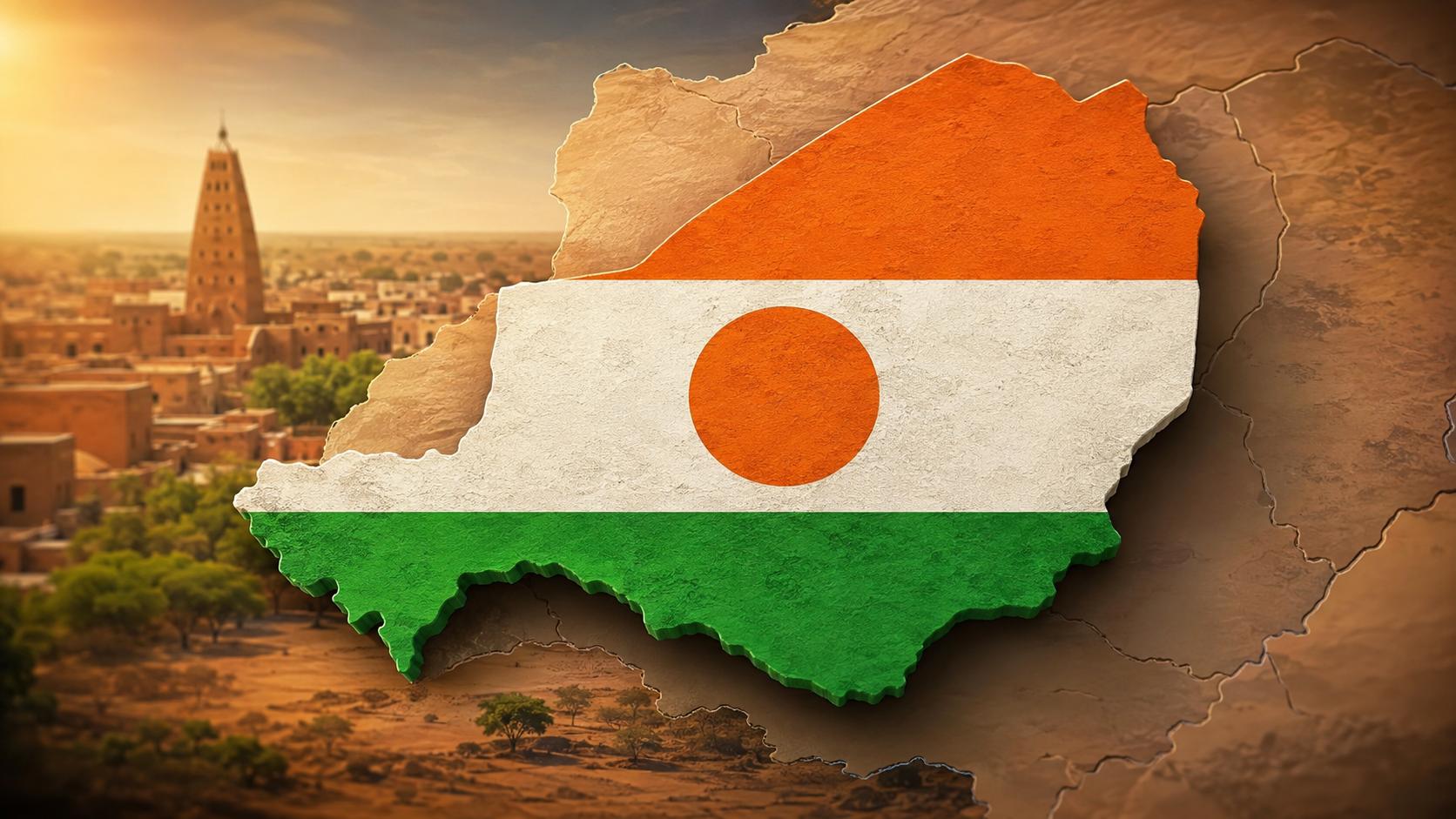
Niger’s military leader Tiani faces internal coup attempt, exposing vulnerabilities
Following the attempted coup on August 29, the Nigerien regime appears more fragile than ever. The intervention of Russian forces and the announced military support from Algeria starkly contrast with the absence of direct involvement from Mali and Burkina Faso, despite their membership in the Alliance of Sahel States (AES).
Niamey’s unrest exposes deep military rifts
The intense fighting that rocked Niamey on August 29 and 30, 2026, did more than just thwart an attempt to oust General Abdourahamane Tiani. These clashes brought to light profound fractures within Niger’s military apparatus and underscored the limitations of the Alliance of Sahel States (AES), which since its inception has been presented as a collective defense mechanism.
Tiani’s administration, which took control of Niger after the July 2023 coup against elected President Mohamed Bazoum, became the direct target of its own military personnel. The mutineers, primarily drawn from special forces units and those stationed around the capital, assaulted several key strategic locations, including the presidential palace and Air Base 101 at Diori-Hamani International Airport.
This development carries significant political and military weight: it was not foreign forces or rebel groups that took up arms against Tiani, but elements from within the Nigerien armed forces themselves. Their grievances reportedly stem from the persistent degradation of the security situation and the heavy casualties suffered in ongoing battles against jihadist groups.
Tiani, a leader who seized power through a coup himself
The recent events are particularly paradoxical. General Tiani has governed Niger since he, along with other officers, overthrew President Mohamed Bazoum in July 2023. The very man who justified his power grab by citing the urgent need to restore security and combat jihadism now finds himself confronting armed dissent originating precisely from the military institution he leads.
Over three years, the promise to make security the regime’s absolute priority has collided with a far more intricate reality. Groups affiliated with Al-Qaeda and the Islamic State continue to launch deadly attacks, some alarmingly close to the capital. Niamey’s airport itself was reportedly targeted multiple times in 2026.
Consequently, this week’s mutiny emerges as a symptom of a deeper crisis: the regime faces not only political opposition but is now challenged from within its own military establishment.
Russia called to the rescue
It is within this volatile context that Russia’s role takes on particular significance.
Reports indicate that elements of the Russian Africa Corps directly participated in operations aimed at reclaiming Air Base 101 and repelling the mutinous soldiers. Sources confirm Russian forces were engaged in the fighting, with drones reportedly utilized during the operation. Moscow, for its part, affirmed its support for the Nigerien authorities.
This episode is highly telling. Since Niamey severed ties with Western partners and saw the departure of French and American forces, it has increasingly relied on Moscow as one of its primary security allies. Yet, when the regime faced a direct threat from its own soldiers, it still required external assistance to bolster its defense capabilities.
The paradox is striking: a military government that champions its sovereignty and strategic autonomy ultimately needed Russian combatants to help it contend with an internal military rebellion.
Algeria, a noticeable military endorsement
Algeria, too, extended its support to Niamey. The Algerian Ministry of Defense announced the deployment of four fighter jets and other equipment to assist Niger in addressing what Algiers described as an attempt to destabilize the nation.
Algeria’s stance is particularly crucial given its extensive shared border with Niger and its long-standing concern over the deteriorating security situation across the Sahel region.
The interventions by Algeria and Russia thus paint an unusual picture: to prevent a coup-born government from being overthrown by a new military revolt, two foreign powers provided crucial assistance to forces loyal to the regime.
This reality also serves to highlight the inherent vulnerability of Tiani’s hold on power.
The AES: political solidarity, but where is the military action?
Another key lesson from this crisis pertains to the Alliance of Sahel States. Established in 2023 by Mali, Burkina Faso, and Niger as a mutual defense pact against threats to the three military regimes, the AES has become a cornerstone of the Sahelian juntas’ regional strategy.
However, at the very moment the Nigerien government in Niamey was under direct threat, no significant military intervention from Mali or Burkina Faso was reported.
To be precise, Bamako and Ouagadougou did not abandon their ally politically. Both governments condemned the attempted overthrow and reaffirmed their support for Nigerien institutions and General Tiani. The AES also commended the Nigerien forces who remained loyal to the regime.
Yet, this solidarity remained predominantly political.
It is precisely in situations like this that the credibility of a military alliance is truly tested: when a member state is attacked or faces a major armed threat, are its partners capable of rapidly deploying forces to provide assistance?
In this particular instance, the answer appears to be no.
Two missed opportunities for the AES
The paradox is even more striking considering the AES was theoretically designed for this exact type of scenario.
Mali and Burkina Faso had a clear strategic imperative to intervene: preventing the destabilization of Niger was tantamount to preventing the collapse of one of the three pillars of their own alliance.
Even a limited military intervention would have sent a powerful signal about the AES’s capacity to enact its principle of collective defense. Instead, while Nigerien forces confronted the mutineers, it was ultimately Russia and Algeria that provided concrete external support, while Niger’s two AES neighbors confined their response to political solidarity.
The contrast is difficult to overlook: the alliance meant to guarantee the collective defense of the Sahel expressed its support, but it was partners external to the AES who delivered the most visible military aid.
Therefore, it would be premature to declare that the AES exists
