Niger’s junta at a crossroads: how a thwarted coup reshaped power under Tiani
In the world of politics, few moments are as revealing as a leader who gains power through an unconstitutional takeover only to later fear being toppled in a similar fashion. This paradox now defines the Nigerien junta led by General Abdourahamane Tiani.
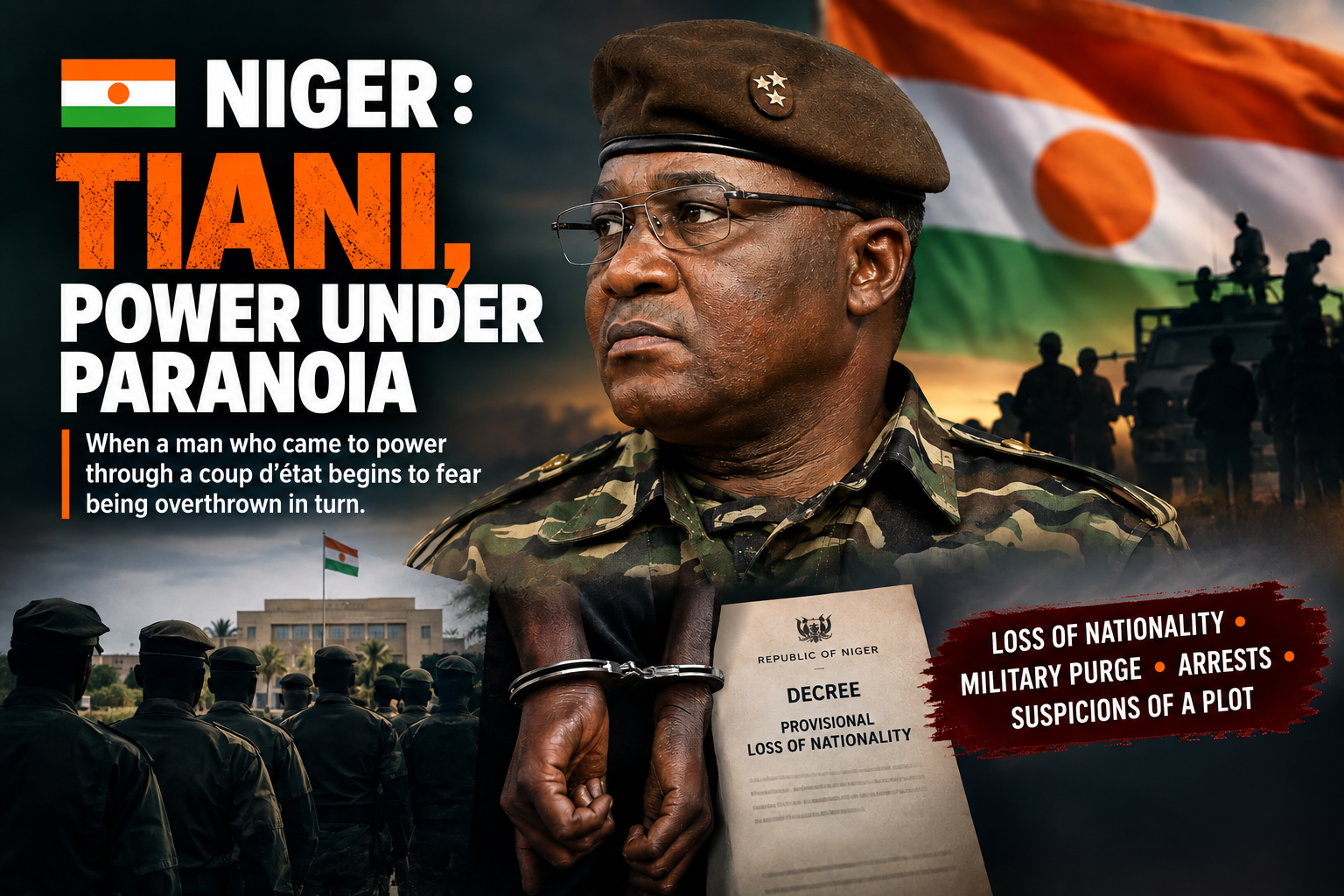
Less than three months after surviving a violent coup attempt on August 29, Tiani finds himself in a position where survival seems to depend on eliminating not just external threats, but internal ones as well. The decree issued on September 17 stripping five prominent Nigeriens of their citizenship, including former Prime Minister Ouhoumoudou Mahamadou, signals a regime not only in crisis but actively redefining its relationship with dissent and loyalty.
The day the junta discovered its own vulnerability
The August 29 attack on the presidential palace, Air Base 101, and state television represented more than a failed overthrow attempt it exposed the fragility of a regime built on mutiny. Reports from the time described moments of hesitation within the military chain of command as some officers wavered between supporting the junta or joining the mutineers. For a leader who rose to power through insubordination, this internal fracture was an existential revelation.
The response has been swift and comprehensive. According to military sources, over 200 soldiers have been detained since the assault, with particular focus on special forces units. The purge extended beyond the barracks on September 11 when Chief of Staff General Moussa Salaou Barmou was abruptly dismissed, followed by the replacement of four cabinet ministers in the subsequent days.
Officially, these moves were framed as necessary reorganizations to strengthen command structures and address operational failures. Yet in the context of a junta that just survived an internal coup attempt, these changes reveal a deeper reality: after being threatened by its own ranks, the regime is now reshaping itself around what it considers the most trustworthy elements.
The September 17 decree: weaponizing nationality as a political tool
The most dramatic manifestation of this new security calculus came with the September 17 decree that provisionally revoked the Nigerien citizenship of five individuals, including Ouhoumoudou Mahamadou, who served as Prime Minister under the deposed president Mohamed Bazoum. The accusations ranging from alleged collaboration with foreign powers to undermining national morale and state security paint a picture of a regime expanding its definition of threat to include anyone connected to the previous administration.
Critically, these are not court convictions but administrative decisions that immediately strip citizens of fundamental rights. With 25 individuals now affected by this policy since its implementation in 2024, according to official sources, the junta is leveraging nationality as a tool of political exclusion rather than a matter of legal guilt.
From security operation to political cleansing?
The evolution from traditional counter-coup measures to mass revocations of citizenship raises a troubling question: when does national defense transition from legitimate security operations to systematic political cleansing? The targeting of former officials from Bazoum’s government suggests that loyalty to the previous regime has become an unforgivable offense in the eyes of the current leadership.
Each arrest, dismissal, and citizenship revocation can be justified individually through the lens of national security. Yet when viewed collectively, they reveal a regime consumed by paranoia, where every former associate of the deposed president is treated as a potential fifth columnist. The junta’s actions imply a dangerous assumption: that anyone who served under Bazoum must necessarily represent an ongoing threat to Tiani’s authority.
Can a coup-born regime ever feel secure?
The psychological toll of vulnerability
The paradox facing Tiani’s junta is both simple and devastating: a regime that seized power through extra-constitutional means now finds itself constantly vulnerable to the same tactics it used. The August 29 mutiny demonstrated that no amount of consolidation can erase the fact that power derived from force can just as easily be taken by force.
This realization has created a leadership style defined by reactive paranoia rather than proactive governance. The constant fear of another internal conspiracy has led to what critics describe as an obsession with identifying loyalists and purging potential threats. The junta appears to be operating under an unspoken principle: if a coup can come from within the military, then anyone within the military could be complicit in plotting one.
The dangerous normalization of suspicion
The most concerning development may be the institutionalization of suspicion as a governing philosophy. When military replacements, ministerial dismissals, and citizenship revocations become routine responses to perceived threats, the regime risks transforming every dissenting voice into an automatic conspiracy. This creates a dangerous precedent where opposition is no longer debated but automatically criminalized.
The junta’s narrative suggests that every former ally of Bazoum, every critical voice in civil society, and every questioning soldier represents an existential danger to the state. Yet in transforming political opposition into security threats, Tiani’s regime may be inadvertently creating the very conditions that could justify future coups—systems where exclusion becomes so normalized that rebellion feels like the only remaining option.
The ultimate question: protecting the state or protecting the junta?
At its core, this crisis represents the fundamental tension facing any regime born from illegitimate power. When a junta that overthrew a democratically elected government then spends its energy trying to prevent its own overthrow through increasingly repressive measures, it exposes a fundamental contradiction: how can a system built on force ever achieve genuine stability?
The Nigerien people now face a regime that appears to govern through fear rather than legitimacy. The more Tiani seeks to eliminate all possible threats real or imagined the more he risks transforming his leadership from a protective force into the very instability he claims to combat.
As the junta continues its aggressive purge of perceived enemies, both within and beyond the military, it begs the question: when will the regime recognize that the greatest threat to its survival may not be external conspiracies, but the systematic erosion of trust that such policies inevitably produce among its own citizens?
By Yacouba Ouédraogo — Investigative journalist
