Niger’s hidden power struggle: how a 1.8 billion FCFA monthly fund reshapes elite dynamics
The Nigerien power elite is locked in a behind-the-scenes confrontation that stretches far beyond military doctrine. At the center of this internal power game is the Commandement des Forces de Protection et de Développement (CFPD), a specialized unit tasked with safeguarding the country’s most vital infrastructure. Behind its official mandate, however, lies a much more critical consideration: the monthly allocation of 1.8 billion FCFA — a financial lever poised to decide the balance of influence within the ruling class.
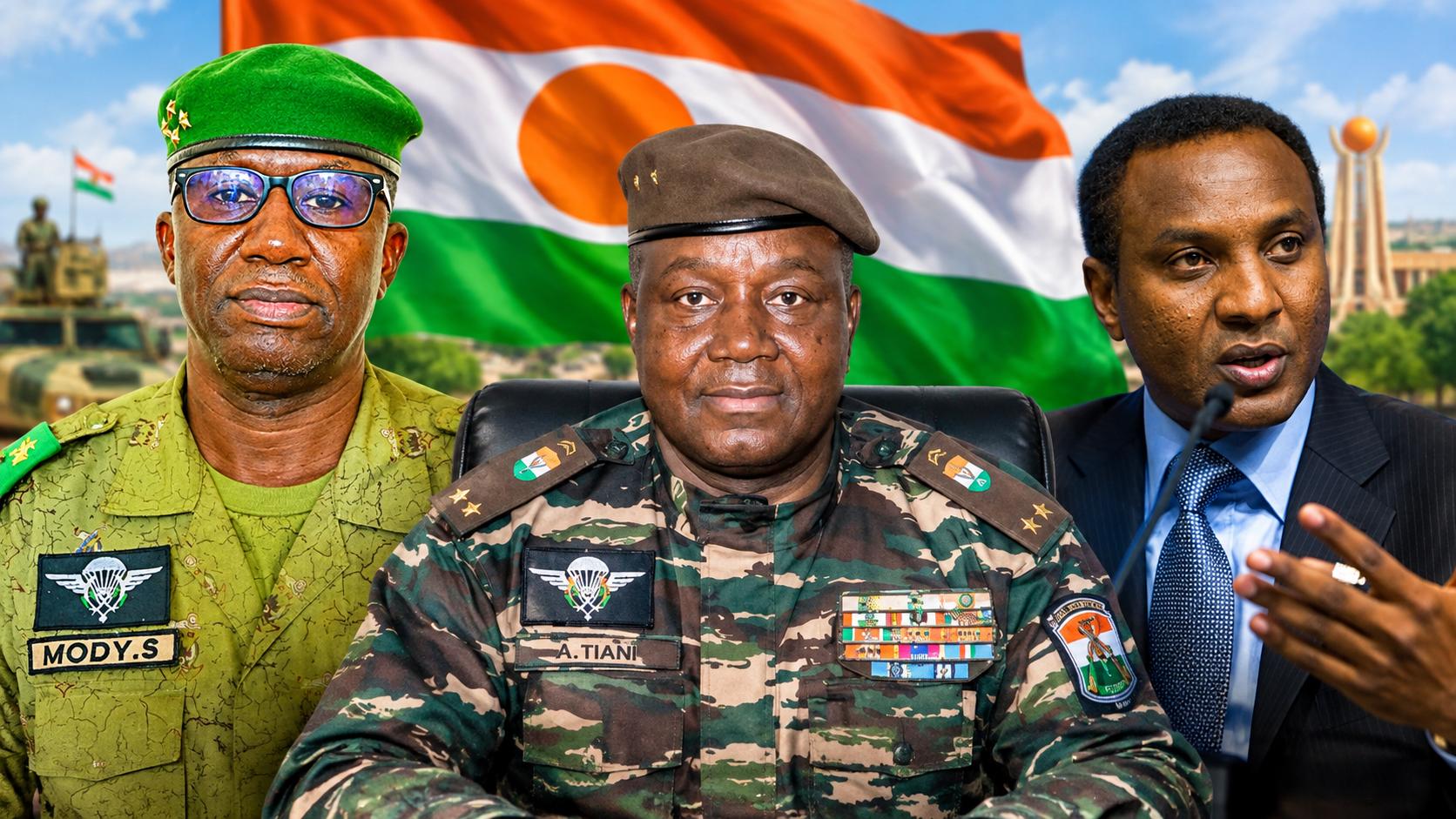
Three key figures now stand on opposing sides of this silent battle: General Abdourahamane Tiani, head of the National Council for the Safeguard of the Homeland (CNSP); General Salifou Mody, a powerful military strategist; and Lamine Zeine, former Prime Minister and Finance Minister. Their clash over the CFPD is not just about security — it is about control over resources, decision-making, and ultimately, the future of Niger’s political structure.
The Birth of a Strategic Command
The CFPD was officially established on May 9, 2024 through Decree 2024-309/P/CNSP/MDN. This decree was signed by General Tiani himself and placed under the authority of the Ministry of Defense. Its stated mission was to protect critical infrastructure: oil fields, mining installations, logistics corridors, and pipelines that form the backbone of Niger’s economy.
To support this mission, the decree authorized the recruitment of 10,000 new soldiers in 2024, adding to the nation’s military strength. The move was framed as a necessary step to reinforce national defense amid rising regional instability. However, the real battleground would soon shift from the battlefield to the boardroom — and from boots on the ground to zeros in a bank ledger.
The financial engine driving the CFPD lies in Article 28 of the decree, which introduces a Daily Standby Premium (PUA). Each soldier deployed under the CFPD is entitled to at least 12,000 FCFA per day — a significant allowance designed to ensure high readiness and performance.
The arithmetic of power: 1.8 billion FCFA per month
At full operational capacity, the CFPD’s financial footprint becomes clear:
- Daily cost (5,000 soldiers at 12,000 FCFA each): 60 million FCFA
- Monthly cost (30 days): 1.8 billion FCFA
- Annual cost: 21.9 billion FCFA
This monthly sum — 1.8 billion FCFA — is not a theoretical figure. It is the tangible price of a security apparatus whose activities are directly tied to contracts with private companies, state budgets, and the allocation of national resources. Who controls this fund controls more than troops — they control access to economic influence and political leverage.
The financial blockade and the decline of Zeine
The confrontation crystallized when General Salifou Mody, a key architect of the CFPD, pushed for its immediate implementation. General Tiani, as head of state, signed the decree under pressure from the Defense Ministry — effectively endorsing the project. However, the approval came with a catch.
Lamine Zeine, then Minister of Finance, was ordered to block the financial disbursements required to activate the CFPD. The money remained frozen. The structure existed on paper, but without the funds to pay soldiers or engage contractors, it was rendered inert. General Mody’s vision was stalled by a single bureaucratic veto.
This financial blockade became the first major fracture in the fragile alliance between the ruling junta’s top figures. Zeine, tasked with maintaining fiscal discipline, found himself at the center of a power play he did not choose. His refusal to release the funds was interpreted as resistance to Mody’s agenda — and as a threat to the CNSP’s stability.
The resignation of Zeine and the rise of Mody
By January 2026, the political chessboard had shifted dramatically.
Lamine Zeine had ascended to the dual role of Prime Minister and Minister of Economy and Finance. General Mody, meanwhile, held the position of Minister of State for Defense. The rivalry intensified: Mody demanded that the Finance portfolio be stripped from Zeine, then orchestrated his removal from the Prime Ministry. The CFPD was not just a policy dispute — it became the catalyst for a palace coup.
With Zeine out, Mody ascended to Prime Minister in a reshuffle that consolidated power in his hands. He took on the additional role of Defense Minister, merging operational and financial levers of the state. No longer could the Finance Ministry block his initiatives. The 1.8 billion FCFA monthly fund — once frozen — now became a tool at his disposal.
The Damolleydi distraction and the erosion of control
Facing a paralyzed CFPD, the regime launched Operation Damolleydi, a nationwide mobilization campaign aimed at recruiting volunteers and reinforcing local security structures. The initiative was intended to bypass institutional bottlenecks and empower grassroots networks.
Yet even this counter-strategy became a battleground. General Mody was placed at the head of the Damolleydi Committee, effectively sidelining General Mohamed Toumba, the Interior Minister. But rather than accelerate the mobilization, Mody deliberately slowed it down. The campaign lost momentum, fragmented into local initiatives with varying levels of coordination and commitment.
What began as an attempt to bypass the CFPD’s funding crisis instead exposed the fragility of the regime’s command structure. The Damolleydi initiative, meant to unite the nation, became yet another mechanism of internal competition — and another casualty of the zero-sum logic gripping the junta.
Who really controls Niger’s future? The three levers of power
The conflict over the CFPD is ultimately a struggle for dominance over three interconnected systems:
1. Command and Personnel: Control over who serves, where they are deployed, and under whose authority.
2. Mission and Priorities: Decisions over which infrastructure receives protection, and which sectors are deemed critical.
3. Money and Influence: The flow of the 1.8 billion FCFA each month — and the power to allocate it to allies, contractors, or patronage networks.
Article 28 of the CFPD decree does more than define a benefit — it codifies a new source of patronage. The monthly fund is not just a budget line; it is a currency of loyalty, a tool to strengthen alliances, and a weapon to silence dissent. Whoever controls the disbursement of this money controls the state.
In this silent war, the stakes are higher than security. They are existential. The victor will not only shape Niger’s defense policy — they will define who leads the country, who benefits from its resources, and who decides its future direction.
The cost of division: what Niger’s elite struggle means for the nation
While the generals and ministers clash behind closed doors, the consequences ripple outward. Unpaid soldiers, delayed infrastructure projects, and eroding public trust in state institutions are the visible signs of a system in crisis.
The frozen funds meant for the CFPD did not vanish — they were redistributed, redirected, or simply withheld. The 1.8 billion FCFA per month did not fund security — it funded political survival. Meanwhile, communities along critical pipelines and mining corridors continue to face threats, not from external enemies, but from a state distracted by internal power games.
As the junta reshuffles and reconsolidates, one question remains unanswered: Is Niger safeguarding its future — or surrendering it to the ambitions of its leaders?
