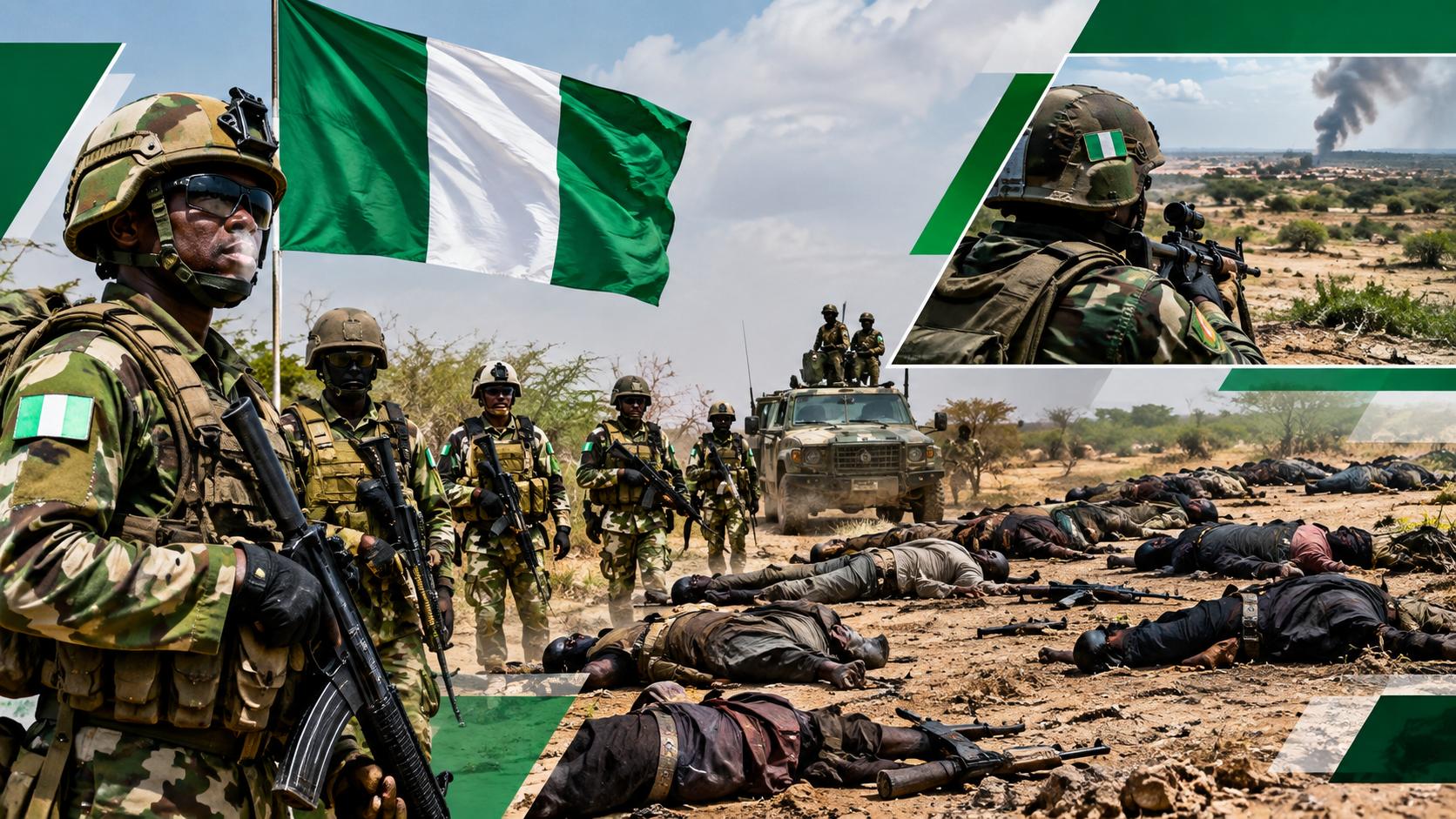
Nigeria’s counter-terrorism surge sparks national debate over jihadist decline
The Nigerian military’s sustained operations against Boko Haram and ISWAP in the Lake Chad region have ignited a nationwide discussion about the long-term viability of these insurgent groups. With the handover of command for Operation HADIN KAI in Maiduguri, key military figures are evaluating the fallout of recent offensives, including disputed casualty claims and shifting public sentiment toward the conflict’s trajectory.
Military High Command Unveils Staggering Casualty Numbers
During a high-profile briefing at the Operation HADIN KAI headquarters in Maiduguri, outgoing commander Major General Abdulsalam Abubakar disclosed that Nigerian forces had neutralized over 1,100 fighters since April 2025. The announcement—delivered as he prepared to transfer leadership—has intensified debates about the durability of these results, with analysts questioning whether the gains represent a definitive weakening of jihadist networks.
The military’s tally includes combat-related deaths as well as targeted airstrikes and ground operations in critical zones like the Sambisa Forest, Mandara Mountains, and Lake Chad’s periphery. While the figures are substantial, they arrive at a time when public skepticism about government transparency in conflict reporting has grown.
Armor and explosives stockpiles reveal insurgent vulnerabilities
Beyond manpower losses, the military highlighted the seizure of 475 firearms, ranging from assault rifles to heavy weaponry, alongside vast quantities of captured ammunition. Perhaps more critically, 295 improvised explosive devices (IEDs) were dismantled—artifacts that have long plagued military convoys and civilian mobility in the region. The revelation underscores claims that recent intelligence-led operations have successfully dismantled several logistical pipelines sustaining the insurgency.
Collaborators and surrendered fighters reshape the battlefield
Operation HADIN KAI’s intelligence units reported detaining 758 alleged supporters and logistical operatives, including financiers and suppliers critical to insurgent operations. The arrests signal a broader strategy to starve militants of resources, though questions persist about the sufficiency of these measures in eradicating entrenched support systems.
Concurrently, a marked increase in surrenders—totaling 969 individuals—has fueled optimism among officials. The demobilized group includes active fighters and their dependents, who are being processed under Nigeria’s Disarmament, Demobilization, and Reintegration (DDR) programs. However, debates rage over whether these figures reflect genuine ideological shifts or simply tactical retreats by combatants facing relentless military pressure.
Humanitarian breakthroughs amid lingering insecurity
One of the most visible outcomes of the military campaign has been the rescue of 638 civilians from insurgent captivity. Among those freed are women and children abducted during raids on remote villages, many of whom now undergo medical and psychological evaluation before reintegration with their communities. Yet, humanitarian workers warn that while these rescues are welcome, they represent only a fraction of the more than two million displaced persons in the Lake Chad basin—a crisis that remains far from resolved.
What’s next for Nigeria’s battle-scarred northeast?
The transition in leadership of Operation HADIN KAI arrives at a precarious juncture. While the outgoing command points to tactical victories—such as the neutralization of key strongholds and disruption of supply chains—the incoming team faces the monumental task of stabilizing newly liberated zones and facilitating the return of displaced populations.
Critics argue that without sustained governance, economic revitalization, and community-based reconciliation, the gains against Boko Haram and ISWAP could prove ephemeral. Meanwhile, reports of ambushes and renewed IED attacks suggest that insurgent factions retain the capacity for disruption, leaving many to question whether Nigeria has finally turned a corner—or merely bought itself time in a protracted struggle.
Can public trust in military narratives hold?
The military’s latest pronouncements have done little to silence skeptics who cite historical precedents of exaggerated success claims. As the debate over the true state of Nigeria’s counter-terrorism fight intensifies, one thing is clear: the path to lasting peace in the northeast will demand more than firepower alone. It will require transparency, robust civil-military collaboration, and a renewed commitment to addressing the root causes of radicalization.
