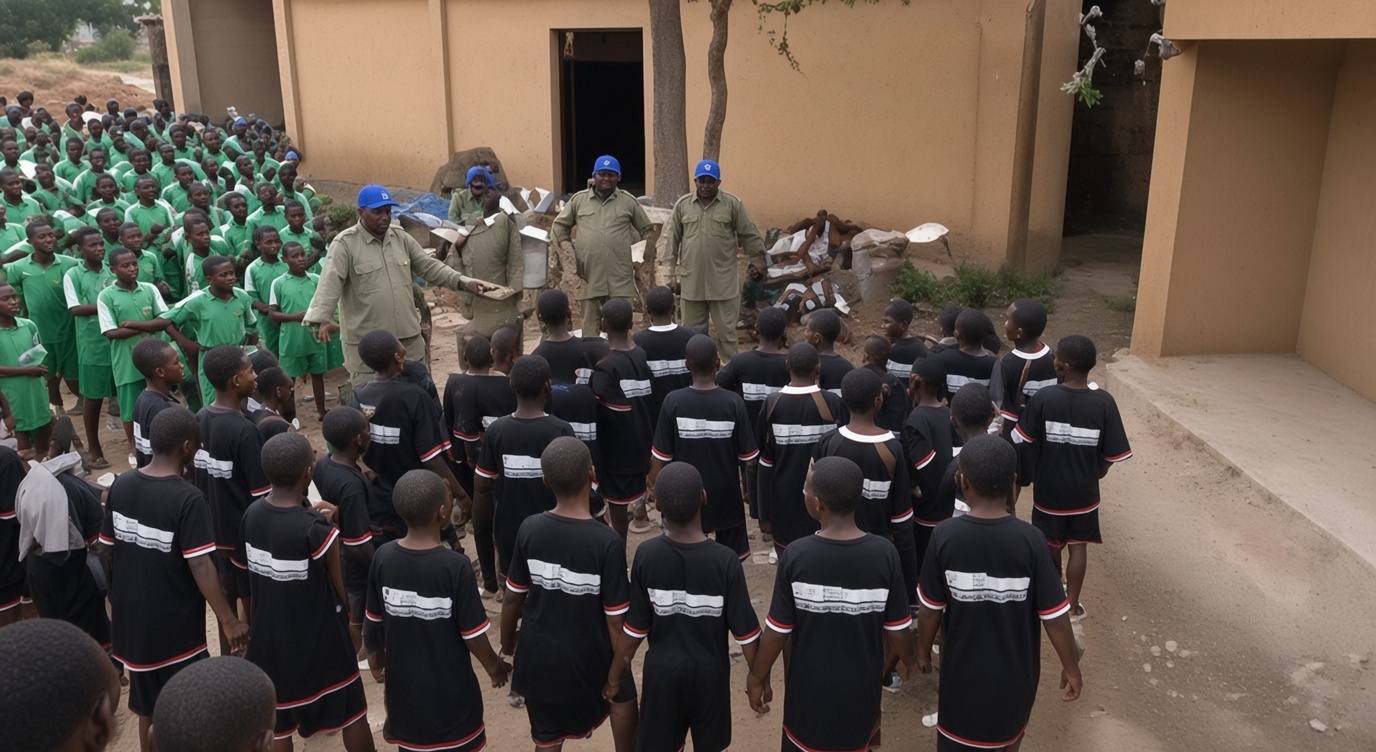
Niger: concerns raised over new youth program and early militarization efforts
The recent inauguration of a training camp by General Abdourahamane Tiani, bringing together over 300 young Nigeriens, has sparked intense debate. While framed as a civic engagement initiative focused on national renewal, the program’s underlying structure mirrors the approach adopted in Burkina Faso under Captain Ibrahim Traoré. Despite the carefully crafted rhetoric celebrating the virtues of an ‘engaged youth,’ the initiative’s underlying implications raise significant concerns regarding early militarization.
Educational priorities versus militarized conditioning
For adolescents, educational development, vocational training, sports, cultural enrichment, and civic learning should remain the cornerstone of personal and social growth. Introducing a militarized environment at such a formative stage can normalize concepts of discipline, unquestioning obedience, and perpetual mobilization principles that may ultimately trivialize the culture of confrontation and conflict.
The insidious nature of politicized patriotism
The gravest risk of this initiative is not merely its structure, but the ideological message it conveys to an entire generation. When a military regime frames youth participation as a patriotic duty, it risks conflating duty to the nation with loyalty to a regime. True civic engagement, however, entails the right to question, debate, and advocate for the public good not blind obedience to political authority.
A youth mobilized in the name of national defense can contribute meaningfully to society, but it must never be reduced to a human resource pool designed to sustain a military-led government indefinitely.
Questioning the priorities behind the program
Why is so much emphasis placed on ideological mobilization when thousands of young people in Niger require functional schools, vocational training, employment opportunities, infrastructure, and real prospects for the future? Patriotism, admirable as it is, does not fill empty stomachs, replace academic credentials, or create jobs. A nationalist rhetoric framed as a civic imperative may serve as a convenient political veil distracting attention from pressing economic challenges, educational deficits, youth unemployment, and the broader consequences of political instability.
The long-term consequences of normalized militarization
Once a generation is conditioned to accept perpetual mobilization as a social norm, what is presented today as an exceptional campaign could easily become tomorrow’s institutionalized model for political and paramilitary indoctrination of youth. This trajectory is not merely speculative it poses a systemic risk to societal and democratic values.
While the situation in Burkina Faso offers a relevant reference point, it must be examined with caution. The proliferation of youth mobilization programs centered on patriotism and national defense should not push Sahelian states into an escalating cycle of militarizing their young populations. Despite pressing security challenges, the answer to insecurity cannot be the progressive transformation of an entire generation into a potential fighting force.
Demanding better for Niger’s youth
Niger’s youth deserve more than a symbolic role as instruments of political messaging. They deserve access to quality education, marketable skills, meaningful employment, intellectual freedom, and the ability to participate in civic life without being coerced into subscribing to a political or military ideology. The enthusiasm of the nation’s youth should not be weaponized to obscure governance failures or mask public discontent.
A strong state is not one that accelerates the conditioning of children into obedient soldiers it is one that empowers them with knowledge, autonomy, and opportunity, enabling them to shape the nation’s future through innovation, reflection, and responsible citizenship.
The essence of true patriotism lies not in prematurely molding minds for combat, but in cultivating citizens capable of building, questioning, innovating, and defending their country when duty calls not when ideology demands it. The Republic of Niger must ensure that the fight against insecurity does not become a pretext for the enduring militarization of childhood and adolescence.
