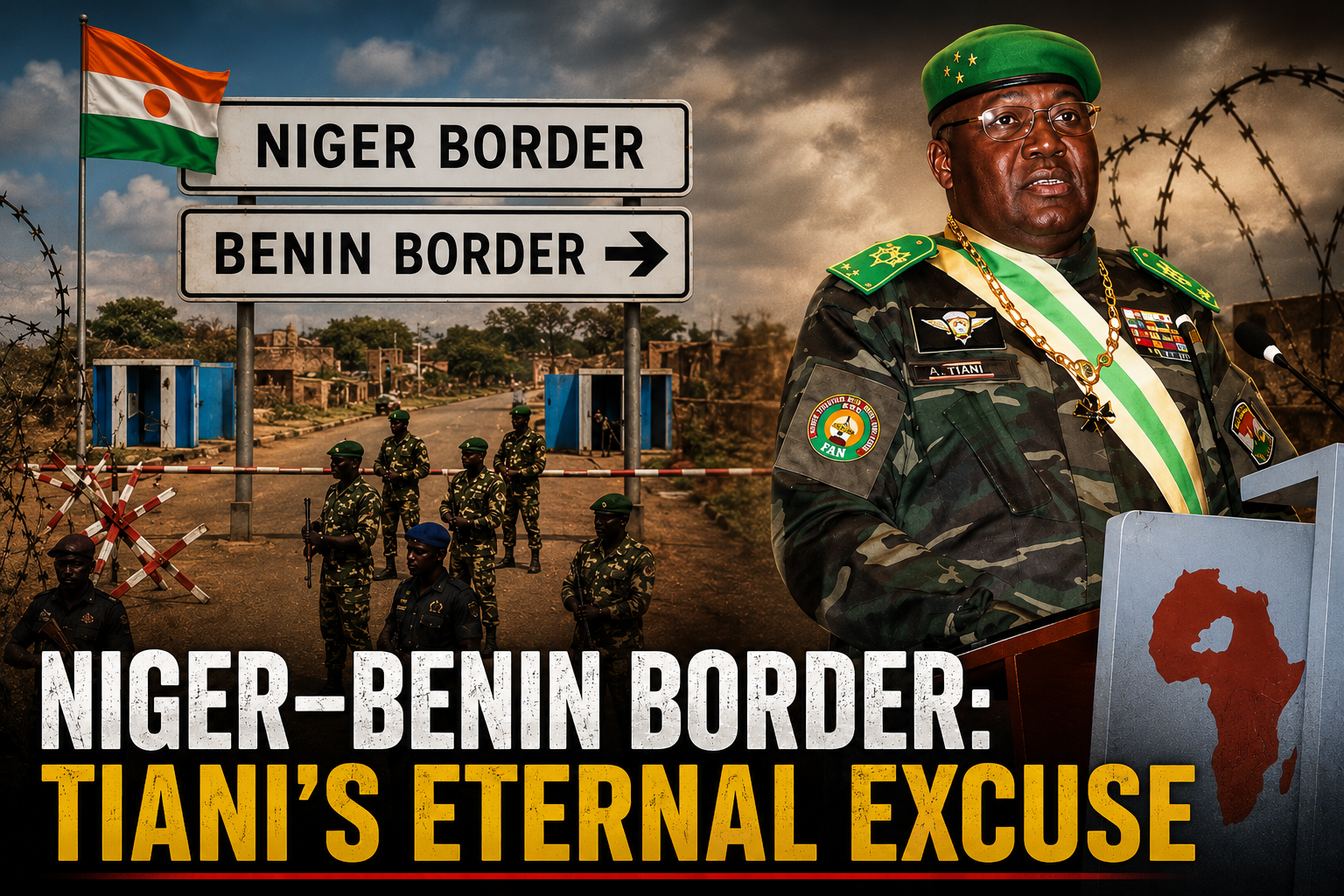
Niger and Benin border dispute: a political lever with heavy consequences
The border between Niger and Benin, once a mere transit point, has evolved into a high-stakes political instrument. Nearly three years after the closure, the situation remains unresolved, despite technical discussions that had raised hopes for a gradual reopening. This impasse underscores a deliberate strategy rather than a mere administrative delay.
Unresolved prerequisites: a deliberate ambiguity
Following the visit of Beninese President Romuald Wadagni to Niamey and subsequent technical meetings, expectations for a swift resolution were high. However, on July 26, during a national address marking the first anniversary of his leadership, General Abdourahamane Tiani dismissed any immediate prospect of reopening the border. He stated, ‘Certain prerequisites must be addressed before making the irreversible decision to reopen the frontier.’
The lack of clarity surrounding these so-called prerequisites is striking. What exactly do they entail? What metrics would determine their fulfillment? No timeline or concrete criteria have been provided. This deliberate vagueness grants the military regime a strategic advantage: it can indefinitely postpone reopening without ever having to justify its stance.
Each new demand can be replaced by another, ensuring the border closure remains an open-ended issue. This tactic perpetuates uncertainty, preventing any lasting normalization of relations.
A security narrative that lacks credibility
Since the July 2023 coup, the Nigerien authorities have consistently cited security concerns to justify the border closure. Niamey alleges that Benin serves as a rear base for armed groups or foreign powers threatening its sovereignty. Yet, these claims have never been substantiated with public evidence.
Meanwhile, terrorist attacks persist in regions such as Tillabéri, Tahoua, and Diffa, suggesting that the closure has not significantly enhanced internal security. This contradiction raises a critical question: if the border closure were intended to bolster national security, why do violent incidents continue unabated?
Technical dialogue sidelined in favor of political calculations
Prior to the general’s statement, Beninese and Nigerien experts had engaged in discussions to explore technical modalities for a gradual resumption of trade. These meetings aimed to address security concerns while restoring commercial flows. By rejecting these efforts, General Tiani signals that the final decision rests solely on political grounds.
Rather than facilitating solutions, these technical exchanges now appear to serve as a delaying tactic, prioritizing political posturing over tangible progress.
Economic fallout: a burden borne disproportionately by Niger
The prolonged closure has exacted a heavy toll on both nations, though the impact is more severe for landlocked Niger. Historically reliant on regional corridors for trade, Niger now faces significantly higher logistical costs due to alternative routes through neighboring countries. These additional expenses ripple through the economy, manifesting in:
- Rising food prices;
- Increased costs for construction materials;
- Higher prices for imported medicines and goods;
- Supply chain disruptions for businesses;
- Reduced competitiveness for Nigerien enterprises.
Small-scale traders along the border are among the hardest hit, with many seeing their livelihoods vanish. Entire communities that once thrived now face economic stagnation.
Regional cooperation weakened by political posturing
The closure extends beyond economic consequences, undermining broader regional collaboration. University exchanges, cross-border municipal partnerships, joint development projects, and anti-trafficking initiatives have all been severely disrupted. Paradoxically, while official trade routes languish, illicit networks often flourish, complicating authorities’ efforts to maintain control.
Sovereignty as a political tool
By framing the border closure as an ‘irreversible’ decision, General Tiani frames it as a symbol of sovereignty against external pressures. Yet, this raises a fundamental question: does sovereignty lie in isolating an economy or in effectively safeguarding the welfare of its people?
For many observers, the prolonged closure appears less a security strategy and more a political narrative designed to consolidate the junta’s domestic legitimacy. It perpetuates a discourse of perpetual resistance, appealing to a segment of the population that views the regime as a bulwark against foreign interference.
The human cost of a political standoff
The official declarations mask the profound human consequences. Transport workers deprived of income, merchants facing ruin, students barred from travel, separated families, and entrepreneurs grappling with uncertainty—these are the real victims. Each passing week deepens their struggles and delays the prospect of normalcy.
An impasse with no end in sight
Three years into the crisis, the Niger-Benin border is no longer a security issue but a political lever. By invoking vaguely defined prerequisites, the Nigerien leadership maintains absolute control over the timeline, ensuring the status quo persists for as long as politically expedient. Meanwhile, citizens bear the brunt of an impasse whose tangible benefits remain elusive.
The path to normalization will likely require prioritizing the daily needs of the people over political considerations, restoring cooperation rooted in dialogue, trust, and pragmatic solutions.
